Bruce Robbins Takes on Suffering in His New Book
Atrocity: A Literary History explores written representations of mass violence.
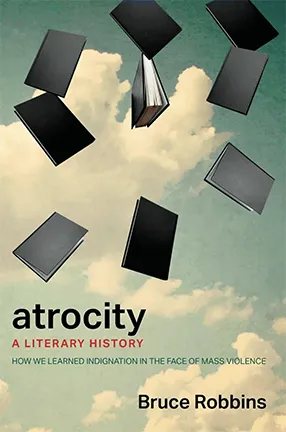
In Atrocity: A Literary History, Bruce Robbins, Old Dominion Foundation Professor in the Humanities, ventures from the Bible to Zadie Smith. He explores the literature of suffering, to show how, over time, abhorrence of mass violence takes shape. With it comes the emergence of a necessary element of cosmopolitanism—the ability to look at one's own nation with the critical eyes of a stranger.
Drawing on a vast written archive, Robbins takes up such literary representations of violence as Bartolomé de las Casas's account of his fellow Spaniards' atrocities; Kurt Vonnegut's Slaughterhouse-Five; Grimmelshausen's 1668 novel, Simplicissimus; David Mitchell's Cloud Atlas; Gabriel García Márquez's One Hundred Years of Solitude; Homero Aridjis's short novel, Smyrna in Flames; and Tolstoy's Hadji Murat. These texts do more than simply testify to atrocious acts. They recognize atrocity as a moral scandal about which something should and can be done, while they also place that scandal within a larger and more uncertain history.
Robbins discusses the book with Columbia News, along with books he’s thinking about now, and his next dinner party guest list.
How did this book come about?
My father was a bomber pilot during World War II. I thought he was a hero (which he was), and spent hours poring through his souvenirs of the war. He was fighting Nazis, which was a very good cause. But his squadron was also bombing cities and killing civilians. And nobody around me saw this as an atrocity—until the anti-Vietnam War movement got started. I think that's what got me interested, that and teaching Gabriel Garcia Marquez's One Hundred Years of Solitude when I arrived at Columbia. There's a scene in the book in which striking workers and their families are machine-gunned more or less on behalf of the United Fruit Company. Strangely, it's also a beautifully written scene.
Can you provide some examples from the book of how, in a literary context, abhorrence of mass violence has taken shape?
One Hundred Years of Solitude is probably the most influential example: Authors influenced by the scene I mentioned above include Salman Rushdie, Jeffrey Eugenides, and Kamila Shamsie. Kurt Vonnegut's Slaughterhouse-Five, about the Allied firebombing of Dresden, uses science fiction—humorous science fiction—to say things that seem otherwise unsayable. Ishikawa Tatsuzo, who was embedded with Japanese troops who wantonly murdered Chinese civilians in the 1930s, goes deep into the subjectivity of the troops, as does Tolstoy in Hadji Murat.
What's the last great book you read, and why?
Devika Rege's QuarterLife, about the rise of the Hindu right in India. She spent seven years hanging around with these young men, and it seems to me (as a foreigner) that she really nailed it—in amazing prose.
What's your favorite book no one else has heard of?
Kazuo Ishiguro's The Unconsoled. The novel takes place over a period of three days, and is about Ryder, a famous pianist who arrives in a central European city to perform a concert.
What are you working on now?
A book, or maybe just an essay, on money, and how artists, intellectuals, etc. make a living, when and if they do.
Which three writers, dead or alive, would you invite to a dinner party, and why?
George Eliot, Zadie Smith, and Orhan Pamuk. (One of these three has already come to a dinner party at my place.) I think they would have a lot to say to each other.