A Budding Engineer Wants to Better Understand the Human Mind
Janie Zhang is studying computer science and psychology, exploring the overlap between human behavior and artificial intelligence.
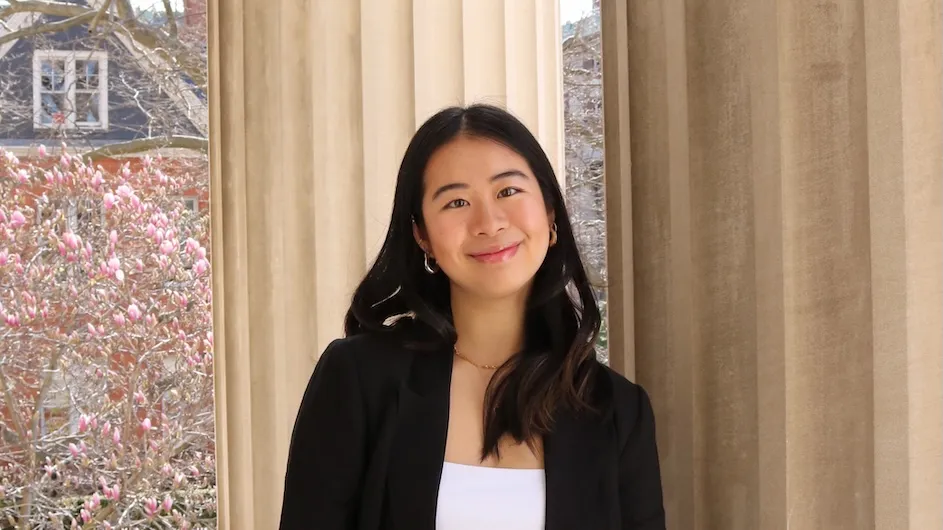
Janie Zhang, SEAS ’26, already has her next step lined up: She’s heading to California after she graduates this spring, and will work for Google as an associate product manager. At Columbia, Zhang has pursued both computer science and a minor in psychology. Columbia News spoke to her about her past work, her future plans, and how her intellectual pursuits inform her professional ones.
What made you choose Columbia?
I knew I wanted to live in a place like New York City where there is so much diversity of thought and culture. I’m also a very adventurous person, so I needed to be somewhere that is full of energy and opportunity, with stuff to do at every hour of the day. I know it sounds cheesy but I really did feel drawn to the Engineering School’s motto, “Engineering for Humanity,” because I deeply care about social justice and making a tangible impact on the world. Columbia offered an incredible interdisciplinary environment that allowed me to take classes across different fields and learn about how technology could be applied to solving complex, real-world problems.
You’re a Computer Science major with a Psychology minor. How do those two interests connect? Has one taught you skills for the other?
I believe there’s a really cool intersection between computer science and psychology, which allows me to explore the direct overlap between human behavior and artificial intelligence. Psychology has given me a deeper understanding of how the human brain processes information, which is essential when researching how to replicate those functions through computing. Courses I’ve taken, including Machine Intelligence and Computation and the Brain, have challenged me to think about how we perceive and communicate with machines, as well as how advances in technology have shaped those interactions. This combination has helped me prioritize human-centered design, ensuring that the technology I work on—especially AI—is created to better serve and reflect the way people actually think. Ultimately, my minor has taught me that truly impactful engineering requires a fundamental understanding of the people who will use it.
What made you choose a job at Google as your first post-graduation step?
I’m really excited to be returning to Google after my summer internship on the Gemini API team. This role is a perfect blend of technical skills, creativity, and my interest in how people interact with AI. While I'm focused on growing as a product manager for now, my long-term goal is to eventually leverage this experience to start my own company or organization!
Can you tell me about your work at the Engineering Student Council? How did you get involved and what is the Council responsible for?
Despite my high school self promising I wouldn’t do student government in college, I ran for the Engineering Student Council (ESC) with friends and have served on it since my freshman year. I’ve since moved through leadership roles as VP of DEI and VP of Policy, and I currently serve as the Student Body President. As council, we are responsible for everything from advocating for academic policy changes and managing club funding to promoting overall student life. We’ve organized iconic Columbia traditions like Tree Lighting, along with engineering-specific highlights like the SEAS Cruise and the ESC Cardboard Boat Contest. It has been an incredibly rewarding experience and one of the best decisions I’ve made during my time at Columbia.
Do you have any advice for Columbia students who are just starting?
My best advice is to avoid the trap of constantly comparing yourself to everyone around you. Imposter syndrome is incredibly real—I definitely felt it when I was struggling with Multivariable Calculus or watching my friends land research roles and internships their freshman year. But it’s important to remember that you earned your place here just as much as anyone else! One mindset shift that helped me was turning that sense of competition into a source of inspiration, instead of stressing and feeling behind, try viewing your friends’ incredible projects as motivation to pursue your own passions. Columbia is filled with talented, high-achieving people, and you are one of them.
What’s your favorite thing to do in New York City that has nothing to do with school?
I love going down to Soho or the Lower East Side and walking around Orchard Street, exploring the vintage stores there while grabbing a sweet treat at one of the bakeries nearby!