Can Capitalism Be Transformed Before It Is Too Late?
Yes, says Columbia Law School Professor Katharina Pistor, who shows in her book how the legal underpinnings of the system must be altered.

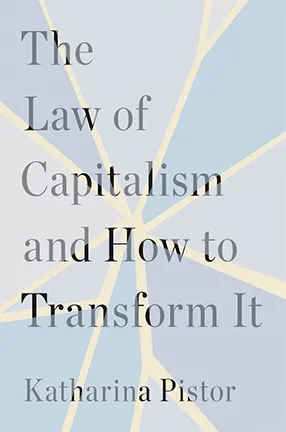
Even though capitalism has been described as an economic system, it is a deeply entrenched legal regime, argues Katharina Pistor, Edwin B. Parker Professor of Comparative Law at Columbia Law School, in her book, The Law of Capitalism and How to Transform It. Law provides the material for coding simple objects, promises, and ideas as capital assets. Law also provides the means for avoiding the legal constraints that societies have frequently imposed on capitalism. Often lauded for creating levels of astonishing wealth, capitalism is also largely responsible for two of the greatest problems now confronting humanity—the erosion of social and political cohesion, which undermines democratic self-governance, and the threats that emanate from climate change.
By exploring the ways that Western legal systems empower individuals to advance their interests against society, Pistor reveals how capitalism is an unsustainable system designed to foster inequity. She shows how the transformation of the law and the economy can help create a more just system.
In this interview with Columbia News, Pistor shares her thoughts about the book, as well as what she is working on and teaching this year at the Law School.
What was the impetus for this book?
I was puzzled by the fact that capitalism, a system that is coded law (as I argued in my previous book, The Code of Capital: How the Law Creates Wealth and Inequality), is so resistant to legal governance; that every time new regulations seek to limit its excesses, it manages to rear its head again, and subordinate society to its logic.
Why is capitalism an unsustainable system designed to foster inequity, and what are some of your ideas for how to transform law and the economy?
Capitalism empowers private actors to use critical social resources—the law and the money system, to list only the most obvious—to build private wealth and power at the exclusion of others, and with little accountability of those who have amassed this power over others they seek to control. A more just system would ensure that the benefits of law and money would be much more widely spread, and empower not only the few with access to sophisticated lawyers.
I argue in the book that this transformation must come from within the law—and, luckily, there are many openings in existing law that one could build on, including principles of equity and fairness, and defenses of unconscionability and duress. We would not need to change all of law, but we would change how we use it, and what impact our own use of this resource has on the lives of others.
Any books you have read lately that you would recommend, and if so, why?
Send in the Clowns by Sean Kennedy and James McNaughton uses the movie Joker to probe deeply into the state of society today and the forces that made it, also using (I should add) my previous book to guide them.
The Currency of Politics by Stefan Eich, who shows how ideas about what money is and which purposes it serves (or could serve) have changed over the millennia.
What’s next on your reading list?
Credit and Creed: A Critical Legal Theory of Money by Andreas Rahmatian. The title fascinates me, because I published over 10 years ago a paper on the “legal theory of finance.”
What are you teaching this semester, and in the spring?
I am teaching Entry Level Corporations, and Law and Development, both in the spring term. I have teaching relief of one course, because I chair the Lateral Appointments Committee this year.
What are you working on now?
I am working on another book project with Co-Pierre Georg, a professor at the Frankfurt School of Finance and Management. Entitled Coded Power, it unearths parallels between the legal code and the digital code as expressions of social power over our social relations.
Which three scholars/academics, dead or alive, would you invite to a dinner party, and why?
Hannah Arendt. Martha Nussbaum. Ingeborg Schwenzer. Arendt to me is a role model who, under enormous political and social pressure, including fear for her own life, never stopped searching for and speaking the truth and seeking dialogue with her opponents. Nussbaum, because she is a brilliant thinker, a feminist, and because I have learned a lot from her work on the capabilities approach. Schwenzer, because she was the first woman ever who was promoted to full professor at the University of Freiburg, Germany, in 1988, at the time when I graduated from that university (I never had a female professor in law school), and became a star in the world of international contract law.