Can Fairer Societies Be Built Without Undermining Economic Growth?
A new book co-written by Columbia SIPA professors answers that and other questions.

In many emerging economies, progress in reducing poverty has been overshadowed by persistent inequality and growing frustration with political elites. This widespread social discontent has driven governments to respond with short-term policies aimed at increasing equity, which, critics argue, run the risk of jeopardizing long-term development. Is it possible to build fairer societies without undermining economic growth?
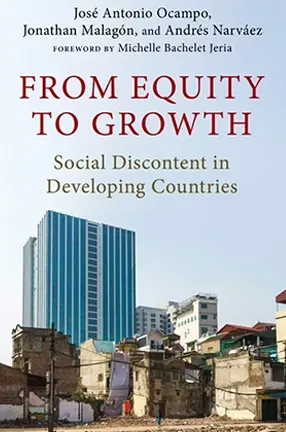
From Equity to Growth explores this dilemma, offering new perspectives on one of the current global defining challenges. Co-written by José Antonio Ocampo, a professor at Columbia’s School of International and Public Affairs (SIPA), Jonathan Malagón, an adjunct associate professor at SIPA, and Andrés Narváez, an economics professor in Colombia, the book combines economic theory, political analysis, and real-world case studies to contrast two potential outcomes. In one, poorly designed redistributive policies distort markets, weaken institutions, and trap countries in middle-income stagnation. In the other, well-crafted equity strategies boost investment, strengthen institutional trust, and spur sustainable development.
Rejecting simplistic binaries between equity and growth, the authors argue that inclusive development is not only possible, but essential. They highlight specific policy choices that can reconcile social demands with macroeconomic stability, providing a road map to escape the middle-income trap without sacrificing fairness.
Ocampo spoke about the book with Columbia News.
How did this book come about?
From Equity to Growth emerged from a series of discussions held in 2022—initially with Jonathan Malagón, and later with Andrés Narváez—about two major challenges that have shaped Colombia’s recent history and that, upon deeper analysis, we realized also affect many emerging and developing countries. The first is the apparent tradeoff between two policy objectives that any modern society would like to achieve simultaneously—higher economic growth and greater social equity. For many countries around the world, achieving both goals at the same time has proven extremely difficult.
The second challenge is the growing wave of social discontent—reflected in increasingly frequent protests, many of them violent—through which different sectors of society demand more prosperous economies and fairer social systems. We identified a direct connection between these two issues, and our goal was to analyze them rigorously, and provide insights that could help policymakers design strategies capable of addressing both challenges simultaneously.
What are some policy choices that can reconcile social demands with macroeconomic stability?
At their core, the policy choices that can help address the demands of increasingly dissatisfied societies, while also strengthening macroeconomic stability, are one of the book’s central arguments: Contrary to what much of traditional economic theory has suggested, equity should not only be seen as the result of growth, but also as one of its main drivers. From this perspective, building more equitable societies is not only a legitimate social demand, but also a foundation for stronger and more sustainable economic growth.
Throughout the book, we discuss several policy approaches aimed at achieving this dual objective, many of them focused on strengthening human capital in developing countries. This means expanding opportunities in education, healthcare, and housing so that people can improve their living conditions and fully develop their capabilities and skills. Reducing opportunity gaps not only contributes to fairer societies, but also to more productive economies, since a better prepared population can respond more effectively to labor market demands, and help generate higher rates of economic growth.
Can you cite some case studies from the book?
In the book, we analyze both successful experiences and others that produced negative economic and social outcomes. We believe that valuable lessons can be learned from both, either by identifying policies that contributed to welfare and sustained growth, or by understanding the decisions and behaviors that led to institutional instability, social discontent, and poor economic performance.
One of the most critical cases we examine is the Arab Spring, where high levels of corruption, inequality, poverty, and democratic deficits eventually triggered massive and often violent protests in which citizens demanded better socioeconomic conditions. We also analyze the protests in several Latin American countries, which, although they did not reach such dramatic levels, still revealed significant institutional weaknesses and important opportunities for improvement.
On the other hand, when discussing successful cases, an important reference point is several European countries that have implemented welfare state models. These are not states that intervene in every aspect of economic and social life, but rather institutions capable of guaranteeing basic opportunities in areas such as education, healthcare, and housing. Evidence shows that many of the countries with the highest levels of development and social stability built a significant part of their success on the basis of more equitable societies, stronger institutions, and a greater capacity to generate welfare for broad sectors of the population.
What was it like to co-write a book?
Fortunately, throughout my academic and professional career, I have had the opportunity to develop several editorial projects in collaboration with people from whom I have also learned a great deal. Over the years, that exchange of experiences and knowledge has allowed my various colleagues and me to build a broader understanding of the challenges affecting the emerging world, and of the possible alternatives to address them. In this particular case, I had previously worked with Jonathan Malagón on other academic projects. Our relationship goes back many years: First, he was my student and research assistant, and later, he became a joint researcher and a co-author. More recently, Andrés Narváez joined the project, bringing fresh and innovative perspectives.
That combination of trajectories, generations, and viewpoints made the writing process especially enriching. In fact, one interesting aspect of this book is that the three of us had some disagreements, but through open dialogue, we reached common views that strengthened the final result. The diversity of ideas, approaches, and experiences helped us create a work that is more provocative, critical, and constructive, a process that took us approximately two years to complete.
Any good books you’ve read lately that you would recommend, and why?
Because of my academic background and personal interests, I am constantly reading works related to economic policy, social development, and institutional transformation. One of the books I recently revisited—and which was also present during the writing of From Equity to Growth—was Power and Progress by Daron Acemoglu and Simon Johnson. I consider it an important volume for anyone interested in understanding how technological change has shaped the development of societies throughout history and, above all, how political and economic interests can influence the direction and benefits of technological progress.
At the same time, I have always tried to complement these technical and academic readings with literary works that, from a different perspective, also address many of the themes that are part of my intellectual agenda. Recently, I reread The House of the Spirits by Isabel Allende, a classic of Latin American literature that, although it belongs to a different genre closely associated with magical realism, explores issues deeply connected to economic and social analysis, such as social mobilization, political tensions, and economic transformation. It is a book I highly recommend to anyone interested in understanding Latin America beyond purely technical approaches.
What’s next on your reading list?
I have several books on my list. One is Max Bennett’s A Brief History of Intelligence, which analyzes the series of breakthroughs that led to the ongoing technological revolution associated with artificial intelligence. On the other hand, due to my interests in history, and particularly international cooperation, I want to read Jamie Martin’s The Meddlers, which analyzes the rise of global economic governance in the interwar period. This book would complement my knowledge of the history of international cooperation since the 1944 Bretton Woods Conference and the creation of the United Nations in 1945.
And as far as Columbia University Press publications and the work of Columbia colleagues go, I would add Climate Change Science by John C. Mutter, the second edition of which was recently published. I believe it is a particularly relevant work for reflecting on a major issue the whole world faces today.
Anything you would like to add?
I invite all readers interested in how to build societies that are not only more prosperous, but also more equitable to engage with From Equity to Growth. We live in a time in which societies are becoming increasingly demanding in terms of policies and actions from their states, and are calling for more opportunities, greater welfare, and better living conditions for all. Precisely for that reason, my co-authors and I believe this book can serve as a space to encourage dialogue and reflection on many of the challenges shared by emerging and developing countries. We hope the book will not only encourage critical thinking about economic growth with equity, but also inspire the collective construction of solutions capable of generating real and positive impact on those people that need it most.
Finally, I want to thank the former president of Chile and now candidate for UN Secretary General, Michelle Bachelet Jeria, for her foreword to the book. Thanks also to the former president of Mexico, Ernesto Zedillo, and two of the economists I admire, Mariana Mazzucato and Dani Rodrik, for their praise of the book.