Christopher Nolan’s ‘The Odyssey’ Is in Theaters This Summer. Columbia University ‘Lit Hum’ Professors Have Thoughts.
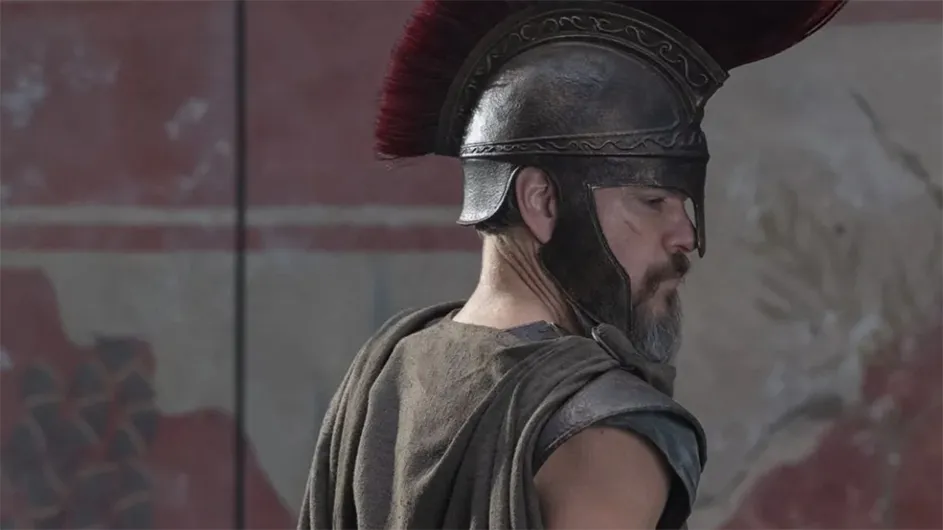
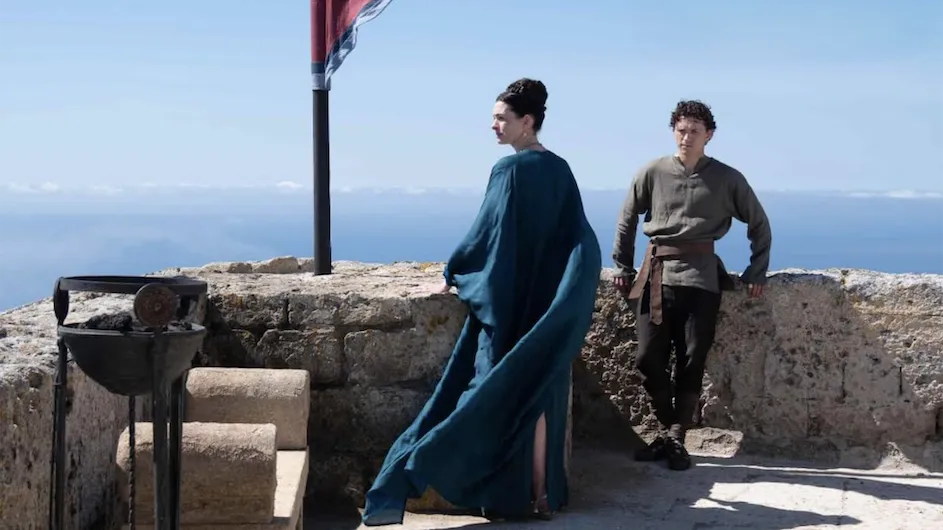
In anticipation of Christopher Nolan’s film version of The Odyssey, opening in theaters on July 17, Columbia News checked in with a few humanities professors who teach The Odyssey in the Columbia Core class, Literature Humanities, or “Lit Hum.” The prospect of seeing the movie, starring Matt Damon as Odysseus and Anne Hathaway as Penelope, elicited wildly different reactions.
“I’m sorry to disappoint you,” said Edward Mendelson, Lionel Trilling Professor in the Humanities, “but I never look at film or TV adaptions of books I love. It’s too depressing.”
On a more positive note, Denise Cruz, professor of English and comparative literature, reported that “I’m a Christopher Nolan fan, so I’m delighted.” Cruz is not a Lit Hum teacher, but she did organize the Senior Reread this past spring semester, in which graduating students were invited to return to the beginning of their time at Columbia, specifically to Lit Hum, and reflect on a number of key works that they read as freshmen in that class, including the first 11 lines of Emily Wilson’s much-lauded translation of The Odyssey:
“Tell me about a complicated man.
Muse, tell me how he wandered and was lost
when he had wrecked the holy town of Troy,
and where he went, and who he met, the pain
he suffered on the sea, and how he worked
to save his life and bring his men back home.
He failed, and for their own mistakes, they died.
They ate the Sun God’s cattle, and the god
kept them from home. Now goddess, child of Zeus,
tell the old story for our modern times.
Find the beginning.”
(The Odyssey, Homer, trans. Emily Wilson, 1-11)
“I read the book aloud to my son during the pandemic, and the process of rereading or revisiting it with him was fascinating,” said Cruz. “Regarding the Nolan film, I think that many of his films center on the power of memory and narrative, how one’s past might shape the decisions one makes in the present or the future, the tension between an individual and a community. In this context, how do individuals and collectives make ethical choices?”
Read on for more faculty reactions.
Will you see the movie version of The Odyssey?
Clémence Boulouque, Carl and Bernice Witten Associate Professor of Jewish and Israel Studies: Absolutely. Ever since I heard last year that Christopher Nolan was adapting The Odyssey, it has been at the top of my list for this summer. I already have July 17 circled in my calendar.
Julie Crawford, Mark Van Doren Professor of Humanities: But of course! In fact, three students from my 2004 (!) Lit Hum class are taking me this summer! In 2004, I took the entire class to see Troy, starring a young Brad Pitt.
Nicholas Dames, Theodore Kahan Professor of Humanities and Paul Brooke Program Chair for Literature Humanities: Despite my skepticism, I probably won’t be able to resist. I’m sure it’ll at least be pretty.
Matthew Hart, chair, Department of English and Comparative Literature and professor of English and comparative literature: Yes, it looks like a proper summer blockbuster. Who doesn’t like big-screen swords, sandals, and sorcery?
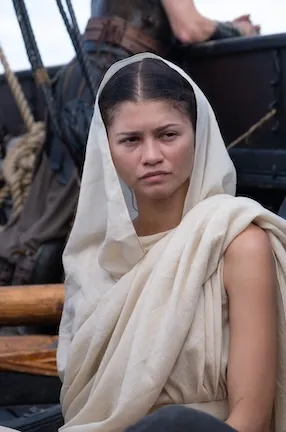
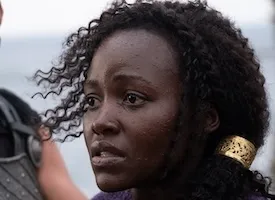
Zoë Henry, assistant professor of English and comparative literature: Yes. I’m curious, and I think casting Zendaya as Athena is a genius move. Ditto to casting Lupita Nyong’o as Helen of Troy! But in terms of the larger project, my expectations are low.
How do you think the film might affect your view of the poem, if at all?
Clémence Boulouque: I don’t think it will fundamentally change my view of the text. I’ve seen other adaptations before, including the very good The Return two years ago. After reading the epic so many times, I don’t expect a film to replace my understanding of it. But it will surely enrich my perspective by inviting me to reflect on Nolan’s interpretation and the particular choices he makes in bringing the story to the screen.
Julie Crawford: I have such a strong visual sense of the book—and years of readings (mine, the expert lecturers, my students)—that I’m simply happy to add to the portfolio.
Who doesn’t like big-screen swords, sandals, and sorcery?
Nicholas Dames: The temptation of almost every retelling of the poem is to reduce it to its most action-packed moments. But the real traction of the poem is the way all those famous adventures are set within so many quiet, tense, and hugely complex moments of human (and human-divine) interaction. It’s so often a poem of two people gauging each other warily, with so much weight of implication! I doubt that the film can, or even wants to, capture that. Having said that, there is one film version of The Odyssey, if a really unorthodox one, that avoids this trap: Godard’s Le Mépris (Contempt).
Matthew Hart: I’m always interested in popular takes on ancient literature. There are few better ways to understand the afterlife of ancient epics than to study their adaptation for stage and screen. But adaptations tend to tell us more about the people and cultures doing the adapting—or about the media into which an artwork is being adapted—than they do about ancient societies, ancient peoples, or ancient poems. I’ve watched many adaptations of The Odyssey over the years, but, ultimately, it’s a poem and not a movie—my view of the book is based on my reading of Homer’s verse.
Zoë Henry: From what I’ve read, Nolan seems to have drawn inspiration from Emily Wilson’s translation of The Odyssey, which I teach in Literature Humanities. I’m not sure it will change my view of the book, but it might bring up interesting questions around translation (both as a literary project and as a film adaptation).
Would you advise students to see the film?
Clémence Boulouque: Absolutely—preferably after they’ve read the book. I’ll encourage them to think critically about the adaptation: What choices did Nolan make? What works well? What do they disagree with? Why?
I also plan to use the film as a pedagogical tool. I always incorporate what I call “contemporary echoes” into my classes to show students that the classics remain a source of inspiration and continue to shape our culture. If a filmmaker like Christopher Nolan wants to revisit The Odyssey, and studios are willing to invest in such an ambitious project, it’s worth asking why this story still speaks to us.
More broadly, I enjoy showing students how the reception of a text evolves over time. Seeing what Nolan makes of The Odyssey will be fascinating—not only in light of his own body of work, but also as a reflection of how our own era understands Homer’s epic. Madeline Miller’s Circe is another example of the ongoing rewriting of classical texts, focusing on so-called minor characters. I like encouraging students to think about why each generation returns to these stories in different ways.
Julie Crawford: Of course!
Nicholas Dames: Why not? The act of comparison is a hugely useful intellectual tool. Seeing what’s been done to the poem, what’s been added or elided, is a way of seeing, by contrast, what the poem is.
Matthew Hart: Sure! But I generally advise students to go to a movie theater, especially something spectacular like Nolan’s Odyssey, which looks like it’ll repay watching it on a big screen, with stereo sound and the excitement of a crowd.
Zoë Henry: To each their own. But if they do see it, I would hope that they read the book first!
What are some lessons/takeaways from the poem that have affected your own life?
Clémence Boulouque: One of the questions that has stayed with me is what it means to return home. When Odysseus finally reaches Ithaca, he doesn’t immediately recognize the place he spent 20 years longing for. It raises profound questions: Do places ever live up to our memories or expectations of them? Can we truly go home again, or does home change because we have changed, which is especially the case of Odysseus, who suffers from what we would now call PTSD after the Trojan wars.
Read the book first!
There is a traditional contrast between two figures who have shaped Western culture: Abraham, in Genesis, who is defined by leaving home in response to a divine call, and Odysseus, who is defined by the long journey back home. Ithaca is his promised land. Which of those two philosophies of life do I (or anyone) feel closer to is a very meaningful question.
I’m also deeply disturbed by the ending of The Odyssey. The slaughter of the suitors is often treated as a triumphant return, yet the hanging of the 12 enslaved maidservants—women who had no agency and were themselves victims of sexual exploitation—is very troubling. Equally striking is how little attention readers seem to have paid to their fate. The epic appears to end happily, but it leaves unresolved the question of reconciliation. How do the families of the slain suitors move forward? What does justice look like after such violence? Those unanswered questions continue to resonate with me.
Julie Crawford: I think everyone wrestles with Proteus.
Nicholas Dames: Every time I return to the poem, I find myself confronting one of its paradoxes: First, that nothing is ever really over, that the past lingers in so many ways; second, that everything is always ending, drowning into time’s ocean.
Matthew Hart: It’s not an easy text from which to derive moral lessons. At its center, there’s a very moving love story between Odysseus and Penelope, the resolution of which depends on the idea that these two complicated individuals are perfect for one another, even if they are far from perfect as people. And there’s something very touching about Telemachus’s drive to be loved and taken seriously by a father he knows as a legend, rather than as a person.
But it’s also a poem full of terrible and inexplicable cruelties; Homer depicts a world in which neither gods nor men are prepared to take responsibility for their actions, a world in which small people are murdered for small sins and great men get away with almost anything. Even the reconciliation of Odysseus with his family—the emotional heart of the book in most adaptations—requires the brutal massacre of the suitors. And while we might not mourn those guys (the worst house guests in the world), we must surely cry for the enslaved women who are made to clean up the bodies, only to be slaughtered by Telemachus because they have polluted the household by sleeping with the enemy.
Zoë Henry: There is no such thing as an uncomplicated man. (This is a riff on the first line of Wilson’s translation.)
How do you approach such a classic text (and others) in terms of your students?
Clémence Boulouque: I want students to approach the text with both curiosity and irreverence. We don’t read the classics in order to worship them; we read them because they continue to challenge us, and in challenging us, they illuminate aspects of ourselves we wouldn’t otherwise be confronted with.
Julie Crawford: The only way is by reading—one book at a time, with some good questions heading in.
Zoë Henry: I try to keep an open mind. The associations that I bring to the text, and my own sense of what is significant, may be different from theirs—but that’s also a starting point for teasing out the text’s connection to the present. I like to stay as close to the sentences as possible, cozying up in the spaces between words, to appreciate the poetic cadence of the epic, and to slow down the process of interpretation.
Do you see The Odyssey as a living, breathing text that is still relevant today?
Clémence Boulouque: Absolutely. That’s precisely why I like bringing contemporary adaptations into the classroom. They remind students that the classics are living works that continue to inspire artists, filmmakers, and writers. Christopher Nolan’s adaptation is only the latest example, but the Coen brothers in O Brother Where Art Thou? took up the epic. The continued reinvention of The Odyssey—whether in film, literature, or popular culture—shows that Homer’s questions remain our questions: What is home? What does it mean to return? What do we owe one another after war?
Julie Crawford: Hollywood just spent $250 million making a movie about a story people of all nations and languages have been reading for nearly 3,000 years. My 16-year-old daughter, who read Gareth Hinds’s amazing graphic novel of the story when she was 6 years old, can hardly wait to see the movie.
Zoë Henry: Definitely. Its women characters, in particular, are some of the most compelling on the Lit Hum syllabus. The Odyssey also raises important questions around nationhood, belonging, colonialism, and the challenge of homemaking.
How many times have you read The Odyssey?
Clémence Boulouque: Probably around 10 times. I first read it in French in high school, fragments of it in Greek classes, and I always look forward to returning to it each year when I teach it. Every time I open the poem with students is like reading it anew.
Julie Crawford: I have taught Literature Humanities probably 20 times? But I also read the story myself as a teen, and read it aloud to both of my children.
I can’t wait to see what they do with ... the Cyclopes (of course).
Nicholas Dames: Since one of my children is named after one of the poem’s characters—I’ll let their identity remain shrouded, in the way Odysseus himself prefers—it’s fair to say that it’s been one of the texts closest to me since I was young. So at this point, I’ve lost count of the full rereadings, partial rereadings, times I’ve consulted a passage, or times I’ve tried to check a quote, and ended up feeling compelled to reread a scene.
Matthew Hart: I think I had read it twice before arriving at Columbia and starting to teach Lit Hum—always in translations, though; I’m no Greek scholar. I’ve now taught Lit Hum about 12 times, and tend to reread each text every couple of years, so I’ve probably read it right through eight or nine times by now, albeit in three or four different translations. I’ll also reread key sections every year as I refresh my seminar notes and teach the class.
Zoë Henry: Five times.
Do you have a favorite passage/s?
Clémence Boulouque: My favorite passage is Odysseus’s encounter with Achilles in the underworld. Achilles, the greatest warrior of The Iliad, famously says that he would rather be a living servant than rule over all the dead. It’s an extraordinary reversal of the heroic ideals celebrated in The Iliad. The Odyssey turns a critical eye on the values of its own society, asking what is truly worth sacrificing one’s life for, and asking us to question our own beliefs. That passage never fails to move me.
Julie Crawford: Two: Menelaus wrestling Proteus (Book 4), and Odysseus’s first simile. (He is compared to an octopus.)
Nicholas Dames: There are so many! Helen’s and Menelaus’s barbed marital disagreement in front of Telemachus; Eumaeus’s wary hospitality offered to the disguised stranger who happens to be Odysseus; Penelope’s countless subtleties. But finally, for me, it’s from Book 16, when Odysseus reveals himself to an incredulous, disbelieving Telemachus. He says the truest words about parenthood ever strung together. I like the way Robert Fagles renders it: “No other Odysseus will ever return to you.”
Matthew Hart: I’m a sucker for Robert Fitzgerald’s translation of Achilleus’s speech from Book 11, when Odysseus meets his shade in the underworld: “Let me hear no smooth talk / of death from you, Odysseus, light of councils. / Better, I say, to break sod as a farm hand / for some poor country man, on iron rations, / than lord it over all the exhausted dead.” More people ought to talk to Odysseus this way.
Anything you want to add?
Julie Crawford: I can’t wait to see what they do with: Demodocus (the singer), the enslaved characters (particularly the servant women who are executed near the end of the poem), the Cyclopes (of course), the bed (!), Scylla and Charybdis, Helen, and Hades, particularly the bowl of blood.