From Columbia’s School of General Studies to the University’s Top Ranks
Three of Columbia’s top leaders are graduates of the same school from three very different paths.
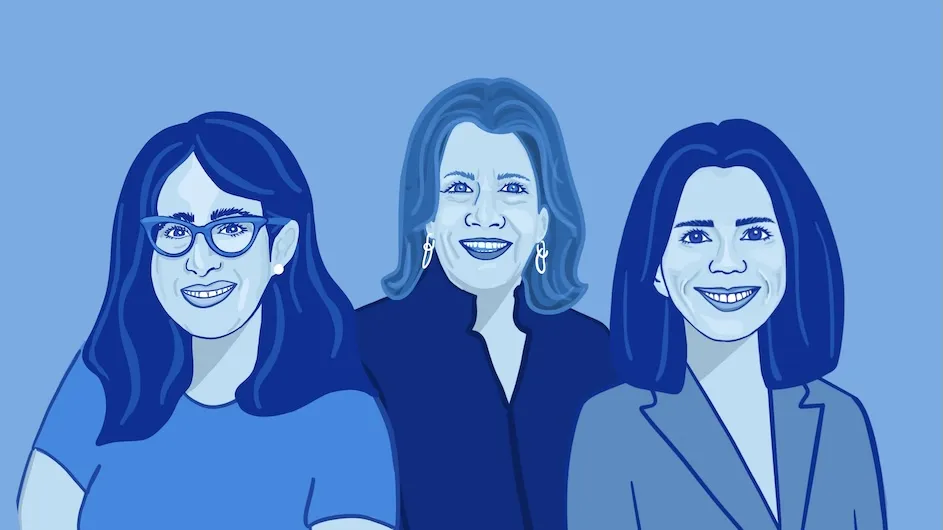
Susan Feagin (GS’74) first came to Columbia at a moment, she said, “when we felt like the world was on fire.”
It was 1968. In the spring, Martin Luther King, Jr, had been assassinated, the Vietnam War was in full swing, and student protests shut down Columbia’s campus, sending Feagin’s high school sweetheart, a student at Columbia College, back early to their hometown in East Texas.
Despite the unrest on campus and in the country at large, Feagin surprised her friends from home by marrying that Columbia student that summer. “No one expected it, we were the do-gooder kids, not the ones who were going to get married right out of high school,” she said in a recent interview.
So, in the fall of 1968, she got on an airplane for the first time in her life, and came to New York, where she found a job as a secretary in Low Library, and started classes at the School of General Studies (GS). Her enrollment at the school kickstarted a professional relationship with Columbia that Feagin has continued, on and off, from 1968 until this month, when she’ll step back from her job as interim executive vice president for development and alumni relations, the institution’s top fundraising role.
This moment marks a milestone in Feagin’s career, and a major transition for the University, too: During Feagin’s tenure, three GS alums have simultaneously held senior leadership roles: Feagin; Columbia School of General Studies Dean Lisa Rosen-Metsch (GS’90); and Columbia School of International and Public Affairs (SIPA) Dean Keren Yarhi-Milo (GS’03).
In conversations with Columbia News, the three leaders discussed how the School of General Studies—Columbia’s home for non-traditional undergraduate students—shaped them, and how its unconventional alumni have shaped the University at large.
Three Unique Paths to a Similar Destination
Feagin spent seven years working full-time for the University and simultaneously earning her BA in sociology at the School of General Studies, which begins celebrating its eightieth anniversary as a school this academic year.
The class Feagin said most shaped her was an anthropology course on the role of women in U.S. indigenous communities. When Feagin turned in her first paper, about indigenous women who married men from outside of their communities, the professor handed it back, and told her: “You’ve missed the point, and if you don’t find it, you’re going to fail.” It was an eye-opening moment for Feagin, who had always been a straight-A student in Texas.
“That class was when I really started to think critically for myself, which I think is the biggest gift that Columbia gave to me,” she said. “The specter of failure had an impact.”
At the time, she said, the School of General Studies was also defined by a large number of impressive and inspiring female lecturers who were teaching there because they, like many other women, couldn’t find tenured roles at other universities, or at Columbia’s Graduate School of Arts & Sciences (General Studies subsequently restructured; its faculty are now part of the Faculty of Arts & Sciences). “It’s unfortunate that these women hadn’t found tenure, but it made us very lucky students,” she said.
Perhaps as formative for Feagin as her time in the classroom was her professional work on campus. After starting as a junior secretary in the office of the president, she eventually landed the University’s first ever position dedicated to prospect research, or identifying potential donors.

Lisa Rosen-Metsch, now dean of the Columbia School of General Studies, was born in 1968, the year that Feagin arrived at Columbia. Rosen-Metsch, the daughter of New York City School teachers, grew up on Long Island. When looking for colleges, she was interested in getting both a liberal arts education and an education in Jewish studies, with a particular humanities focus on the question of how the atrocities of the Holocaust could happen. She found herself uniquely compelled by the School of General Studies’ joint degree with the Jewish Theological Seminary, which would allow her to explore both areas. She came with her father to visit campus for the first time in the fall of 1985, and fell in love with the campus.
Rosen-Metsch, who came straight from high school to Columbia, had a different experience than many General Studies students, who enroll at Columbia when they’re further removed from graduating high school. She lived in a dorm (that no longer exists) on 120th Street, between Amsterdam Avenue and Morningside Drive, and took at least six classes each semester, while working as a babysitter, a research assistant, and a Hebrew School teacher, among other jobs. “It was pretty intense,” she said of her years on campus.
Rosen-Metsch majored in sociology at Columbia. She speaks of two professors in the sociology department that were key teachers and mentors to her: Eugene Litwak, who introduced her to public health, and Harriet Zuckerman (GSAS’65, HON’26), the only tenured woman professor in sociology at the time, who was a role model to Rosen-Metsch and introduced her to the rigors of social science research.
The defining moment of Rosen-Metsch’s undergraduate years in the late 1980s came when a sociology professor connected her to a researcher, Karolynn Siegel, at Memorial Sloan Kettering Cancer Center (MSKCC), who was working on one of the first studies examining why gay men did or did not choose to get tested for HIV in an era when treatments were unavailable and a diagnosis could cause them to lose health insurance or their job. That research project proved the catalyst for a decades-long career in medical sociology, with a particular focus on HIV prevention in high-risk groups.
Keren Yarhi-Milo’s interest in Columbia began across the ocean, around the time that Rosen-Metsch was starting graduate school at the University of Florida. Yarhi-Milo grew up near Tel Aviv and first learned about the school when reading the biography of former Secretary of State Madeleine Albright (GSAS’76, HON’95). Yarhi-Milo and her mother visited New York when Yarhi-Milo was a young teenager, and checked out the campus: Even then, in ninth grade, Yarhi-Milo knew she wanted to attend. Years later, after completing her mandatory military service in Israel, Yarhi-Milo moved to New York to volunteer at the United Nations, where she met her future husband, Ariel Milo (GS’03). She decided to stay in New York and complete the undergraduate degree she had started in Israel. For Yarhi-Milo, who enrolled in her early twenties, the experience was shaped by her age. “We were a little older, and our closest friends came from General Studies and Columbia’s graduate schools. Our lives were deeply rooted in Columbia, even though we did not have the traditional residential college experience,” she said.
Two Columbia classes, in particular, shaped Yarhi-Milo’s trajectory. One was a course taught by Richard Betts, who ran the Arnold A. Saltzman Institute of War and Peace Studies (which Yarhi-Milo would go on to lead years later). It was a seminar on U.S. foreign policy and national security. Betts challenged the students at every turn, encouraging them to argue a viewpoint, without revealing his own. “It forced you to think better and challenge your assumptions, and incorporate counterarguments into your thinking,” Yarhi-Milo said. Another formative course was taught by the renowned political scientist Robert Jervis, a pioneer in political psychology—the field Yarhi-Milo would eventually enter. As she neared the end of her undergraduate career at Columbia, Yarhi-Milo talked to Jervis about what to do next. Recognizing her potential as a scholar, Jervis encouraged her to pursue a PhD and advised her to leave Columbia temporarily to broaden her intellectual horizons.
“I was disappointed when he told me to go elsewhere because I already felt so connected to Columbia,” Yarhi-Milo said. “But I understood his advice—and hoped I would eventually find my way back.”
A Campus Inflected by Its Non-Traditional Students
What defines a GS student? These three leaders exemplify the diversity of students in the school: Some transfer from other schools, in the United States and abroad; a smaller number enter through joint and dual degree programs, like that with the Jewish Theological Seminary. Others arrive to Morningside Heights after spending years in other careers that don’t require a degree, like the military or the performing arts. Some come from the very tops of their fields: One alum, Thomas Reardon, worked for Microsoft for a decade and spearheaded the creation of Internet Explorer before coming to Columbia General Studies to get a grounding in the liberal arts.
“GS students are courageous. They’re bold. They’re ready to have the unexpected happen,” said Rosen-Metsch. “There’s a thousand different stories of how someone comes to GS, some of which involve overcoming failure or adversity.”
People often ask Rosen-Metsch, who has three daughters, ages 18 to 28, with her husband, Benjamin Metsch (GS’89), if being a parent makes her a better dean. “I always say, being dean of the School of General Studies made me a better parent, because in life there’s a lot that’s unexpected, and working with non-traditional students has shown me that taking the unexpected in stride just makes you better and stronger in all that you do.
The culture of GS was integral to Yarhi-Milo’s decision to attend Columbia, and to her desire to come back. “What drew me to Columbia was its combination of extraordinary excellence and genuine openness,” Yarhi-Milo said. “General Studies embodies that ideal: the conviction that talent can follow many paths, and that students’ experiences before arriving on campus can deepen the education of everyone around them. I felt that respect as a student, and it is one of the reasons I always wanted to return.”
From Columbia to the World Beyond
After Columbia, Rosen-Metsch pursued her graduate work at the University of Florida and worked for nearly two decades at the University of Miami, continuing her research on HIV in high-risk groups. Rosen-Metsch felt settled in Florida, and never particularly expected to come back to Columbia, but when she was recruited to be the chair of sociomedical sciences at Mailman School of Public Health in 2012, it felt like an opportunity she couldn’t pass up. Notably, when she arrived at Mailman, she reunited with the MSKCC researcher she had worked with as an undergraduate who had moved to Columbia. And then, when the position of dean of the School of General Studies opened, Rosen-Metsch asked to join the search committee. “One thing led to another, and I was invited to apply for the position,” she said. For Rosen-Metsch, this was truly coming full circle and just this past Columbia Commencement, she watched Zuckerman, her undergraduate mentor and former professor, being awarded an honorary degree.
As dean, Rosen-Metsch has aimed to strengthen international dual-degree programs with universities around the world, and to improve accessibility by raising money to improve financial aid packages, and to increase housing for GS students, as demonstrated in the opening this fall of the first-ever GS Residence Hall at 99 Claremont Avenue. She has a particular interest in making the school accessible for military veterans, community college students, and students who have faced adversity such as students who are formerly incarcerated. GS recently launched New York City Scholars, which is providing full-cost attendance scholarships to select students from the Borough of Manhattan Community College. Rosen-Metsch also continues to teach a class on AIDS in U.S. Society, which she developed with a GS student (and now alumnus), Peter Trevino (GS’22), as well as co-teaching a class on Philanthropy and Just Societies with Professor Geraldine Downey in the Psychology Department.
Unlike Rosen-Metsch, Yarhi-Milo always knew she’d come back to Columbia. After completing her PhD at the University of Pennsylvania, she held fellowships at Harvard, and then was recruited by Princeton University, where she worked for a decade and earned tenure. Then came the call she’d been waiting for. She joined the faculty in 2019 and also served as director of the Saltzman Institute before becoming dean of SIPA in 2022.
In her role, Yarhi-Milo has focused on bridging the gap between academia and policymaking. She recruited former Secretary of State Hillary Rodham Clinton to join Columbia as a professor of practice and co-founded the Institute of Global Politics, which has become a University-wide hub for policy research, public engagement, and dialogue across political and national divides. She has also led a major redesign of SIPA’s graduate curriculum and spearheaded the creation of Columbia’s new undergraduate major in Global Affairs and Public Policy, based at SIPA and open to Columbia College and GS students.
Yarhi-Milo and SIPA’s fundraising team had a record-breaking year in 2025–26, raising more than $70 million, including two transformative gifts: one to expand instructional and advising support for the new undergraduate major, and another to name the Ann F. Kaplan Women’s Initiative at the Institute of Global Politics.
Her fundraising vision has always been ambitious: The school has secured more total commitments in every successive year since Yarhi-Milo became dean. When she was first tapped for the role of dean, with fundraising top of mind, one of Yarhi-Milo’s first calls for advice was to someone who knew the landscape completely: Susan Feagin.
All Roads Lead to General Studies
After Susan Feagin completed her degree at GS, she took a development job at Harvard, then returned to Columbia, then went to Harvard again, before decamping to the University of Michigan. She returned to Columbia for her longest and most senior stint when Lee Bollinger took on the role of president. She led the University’s alumni and development office for eight years, during which she oversaw a capital campaign that aimed to raise $4 billion and netted over $6 billion. She left Columbia in 2010, remaining an adviser as she maintained an independent consulting practice, but came back to the University in 2025 on an interim basis, as the University searched for a new president. She has served for years as a volunteer for General Studies and currently serves as co-chair of the School’s Board of Visitors.
In 2005, Feagin helped found what she said was her proudest legacy at Columbia: the Columbia Alumni Association, a global organization dedicated to connecting alumni from across the University.
Last fall, shortly after returning to Columbia, Feagin took part in a leadership weekend that brings global alumni back to campus. Feagin gave remarks at the event. When she addressed the group from the podium, she told them it was worth coming back to the University for a fourth time just to stand there and tell them that there are three senior leaders at Columbia who are graduates of the School of General Studies.
“Columbia is the kind of place that, yes, accepts lots of high school students with excellent grades and SATs and extracurriculars, but it also takes people with the same intellectual potential who follow different journeys, and have other, less traditional strengths,” Feagin said. “I couldn’t have been prouder to stand there and represent that legacy and that ethos, and how far it can take you, and how far it can take our University.”