The Continuing Relevance of John Dewey
In her book, Natalia Rogach Alexander discusses how the celebrated thinker on democracy and education can still enlighten today.
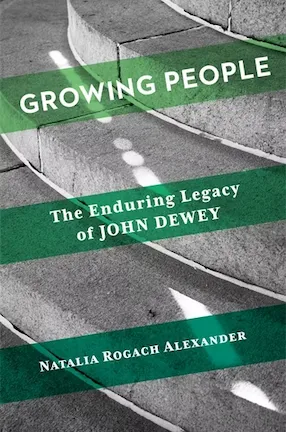
John Dewey (1859-1952) is one of the most celebrated thinkers on democracy and education, yet he has often been underappreciated and misunderstood as a philosopher. Growing People by Natalia Rogach Alexander, a lecturer in philosophy, paints a fresh portrait of Dewey. He is presented as not only a reformer of schooling, but also a profound theorist of human development, whose vision of the centrality of education to democracy, philosophy, and flourishing can still inspire today.
What lessons from this great thinker can help with such current challenges as widespread drudgery and disaffection, estrangement among individuals and groups, and a crisis of democracy? Growing People supplies the answers by offering a new account of Dewey as a still-essential educational theorist. By revealing the scope of his educational vision, the book provides a fresh perspective on a neglected aspect of the philosophical tradition. Alexander’s alternative canon—running from Plato to Rousseau to Du Bois—recasts philosophy in terms of education and, in so doing, opens new pathways for social critique and the liberation of human potential.
Alexander discusses the book with Columbia News, along with a special volume of poetry she recently read that affected her deeply, and the three ancient guests she would invite to her ideal dinner party.
Why did you write this book?
Dewey is among the most famous philosophers of education. But his best contributions to the field have never been fully appreciated. A superficial reading suggests a picture of Dewey as a kindly educational reformer who wasn’t a particularly deep philosopher. I wanted to show that this incomplete picture is wrong. Of course, Dewey’s fame as an educational reformer is well-founded. But we cannot understand his views on schooling apart from his overarching inquiry into human development in all spheres of life.
No study to date has fully captured Dewey’s engagement in (and vision of) this ambitious project. No study has shown how this inquiry informed Dewey’s work in other areas—political philosophy, aesthetics—connecting them in a coherent oeuvre that focuses on human growth. I wanted to show that this was his most important contribution to the philosophy of education—and that it’s still relevant today.
Can you give some examples from the book of Dewey’s continued importance, as a thinker of democracy, education, and philosophy?
Dewey reminds us that democracy isn’t merely a matter of the organization and institutions of government. It’s a culture, a way of life for which we are personally responsible: As he said, “Democracy is a personal way of individual life.” Democracy is more than government. It is an ethos: “Without this basis, it [government] is worth nothing. A gust of prejudice, a blow of despotism, and it falls like a card house.”
Were Dewey alive today, he’d tell us that there’s still plenty of work to be done. We shouldn’t act as if “our ancestors had succeeded in setting up a machine that solved the problem of perpetual motion in politics.” Institutions by themselves won’t magically realize all of our hopes and keep democracy safe for us forever. There is no room for complacency. Dewey learned this hard lesson by witnessing the rise of totalitarianism in his lifetime. Reflecting on its menace in 1939, he wrote that “powerful present enemies of democracy can be successfully met only by the creation of personal attitudes in individual human beings.” Part of the answer lies in every individual’s hands. Another part requires large-scale efforts. Thinking about how education can enhance democratic culture is crucial.
What have you read lately that you recommend, and why?
Rainer Maria Rilke’s Book of Hours. His poems often inhabit overlooked perspectives—the homeless, the poor, the blind, children: “And, since otherwise people will pass them by the way they pass things, they have to sing.” The poems don’t just disclose suffering. They celebrate the beauty, dignity, and strength of these lives. The Book of Hours envisages a world in which “[…] the poor are no longer / despised and thrown away. / Look at them standing about — / like wildflowers, which have nowhere else to grow.”
In Rilke’s incandescent poems, the predicaments of marginalized communities are reimagined in ways that challenge indifference: “Evicted from wherever they lived, / they wander the night like ghosts, / […] If there exists a mouth for their protection, may it open now and speak.” Rilke’s sensitivity to the suffering and richness of other lives, his ability to look at the world from underestimated vantage points, was extraordinary. And it wasn’t limited to human beings. His poetry explores “[…] the suffering of birds on freezing nights, / of dogs who go hungry for days. / […] the long sad waiting of animals / who are locked up and forgotten.”
What’s next on your reading list?
The fifth volume of Robert Caro’s majestic Years of Lyndon Johnson—when he finishes writing it! Anyone interested in the sources of power in a democracy should read Caro’s books.
What are you teaching this semester?
Starting in the fall, the year-long sequence of great books in the philosophy portion of the Core Curriculum (Contemporary Civilization). It’s an extraordinary intellectual journey from Plato to modernity, illuminating and interrogating the genealogy of the ideas that have shaped our world.
What are you working on now?
My second book, Cultivating Individuality. Talk of being or becoming yourself is all around us. But what exactly does it mean? One influential answer calls on us to get in touch with our true selves. In this widespread view, cultivating individuality means recovering our lost connection with the inner core hidden deep within.
I argue that this influential view rests on mistaken assumptions about the nature of individuality and its development. There are no true selves. Does skepticism about the true self make cultivating individuality meaningless? I think not. This book offers a new way of understanding our yearning for authenticity—without postulating mystical entities beyond the biological organism. Drawing on a wide range of philosophical sources, it builds a novel conceptual map of the ideals and aspirations hidden behind misleading true self rhetoric.
Which three academics/scholars, dead or alive, would you invite to a dinner party, and why?
As I’m sure you know, the word “academy” originally referred to the group of scholars assembled by Plato on the outskirts of Athens. I’d pick three scholars from that original Academy—Plato, Axiothea, and Eudoxus.
Plato, because of his uncompromising defense of inquiry and the examined life. Axiothea, because she had the courage to pursue philosophy at a time when prejudice against women barred them from education and scholarship. Eudoxus, because he took up Plato’s challenge to attempt a mathematically rigorous astronomy. At Plato’s academy, there was no separation between philosophy, mathematics, and science—a welcome reminder that academics in the humanities and the sciences have a lot to learn from one another.
There will be a panel discussion about Growing People: The Enduring Legacy of John Dewey on February 12 at 6:15 pm at the Society of Fellows/Heyman Center for the Humanities.