Did You Know Vacuums Aren’t Actually Empty? A Columbia Physics Grad Student Explains.
According to Lucia Rondini, they are ‘fizzy’ with quantum objects, popping in and out of existence all the time.
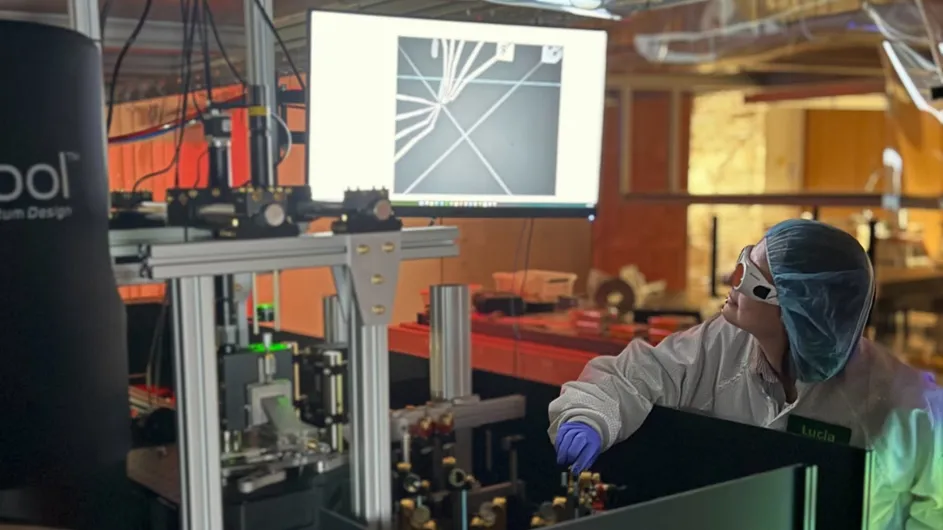
When Lucia Rondini took her first physics class in high school in Milwaukee, she didn’t expect the subject to click. “History was my favorite subject, and I actually wanted to be a doctor. But, I remember very clearly learning the equations to describe the trajectory of a ball, or a pencil falling off a table, for things like airplanes and the Earth’s motion,” she recalled. “How incredible that we have this language to make predictions about the natural world! I felt like I was unlocking this code to the world around me.”
Her questions quickly outpaced her class, but her physics teacher wouldn’t just give her the answers. “I got so mad about that, so I’d go figure things out on my own,” she said. “I owe my teacher a lot of credit.”
Now a second-year physics graduate student, Rondini is tackling entirely new questions about light-matter interactions in atomically thin materials and a rapidly emerging area of physics called cavity engineering with James McIver, assistant professor of physics. McIver joined Columbia in 2022 as part of the Max Planck-New York Center, a collaboration between Columbia University and the Flatiron Institute in New York City, the Max Planck Institutes for the Structure and Dynamics of Matter (MPSD) in Hamburg and Polymer Research in Mainz, Germany, and Cornell University in Ithaca, New York. Together, the center studies two-dimensional quantum materials and how to control and manipulate their unique properties.
McIver’s lab explores how light interacts with materials at terahertz frequencies and ultrafast timescales. He recently received an Accelerate seed award to study how cavities can influence the properties of an ultra-thin form of carbon called twisted trilayer graphene. Cavities are special environments bounded by surfaces that confine particles and excitations, allowing them to bounce back and forth without immediately escaping. This amplifies some while eliminating others, altering material properties in drastic and often unexpected ways.
The simplest form of a cavity is two mirrors that scientists place facing each other, but researchers like McIver are increasingly finding that 2D materials, atom-thin layers that are often stacked together, can form cavities as well, and that what was once thought of as an empty vacuum in between two stacked 2D layers isn’t so empty after all. At its essence, cavity engineering with 2D materials is changing the way we think about “nothing.” In this Q&A, Rondini explains more about what that means, why researchers are interested, and why she chose Columbia for her undergraduate and graduate degrees.
What is cavity engineering?
In the theory of quantum mechanics, the math we use to describe certain observables means we cannot have infinite precision. It’s not a measurement issue, but a mathematical fact. The most common is the position-momentum uncertainty principle: To know an object’s position, you need to mathematically treat it like a particle. But to know its momentum, you treat it like a wave. At the extremes, you can have a pure wave with no position, or a pure particle with no momentum, with a sliding scale in between.
The same idea is true for energy and time: as mathematical objects, they are treated similarly. That means you can pull some amount of energy from nothing, from a vacuum, as long as you give it back. A vacuum isn’t just empty space: It is “fizzy,” with quantum objects popping in and out of existence all the time. We call these vacuum fluctuations.
The simplest example of a cavity is the space between two mirrors. Anything bouncing in between, like light, can combine with vacuum fluctuations and be amplified, or interfere with them, dampening or even causing them to disappear. In some cool cases, there doesn’t need to be anything in between! The vacuum fluctuations can interfere with themselves.
These different interactions modify the energy available, simply based on the size of the cavity or what it is made of.
Cavity engineering is still a relatively new field: What’s a day in your life like?
It really depends on the stage. During fabrication, I spend most of the day in the lab or the clean room. It’s a lot of hamster wheel energy: It isn’t easy to make cavity devices, and we’re still figuring out the best ways. I imagine myself in the same shoes as someone doing science 500 years ago, when they did everything by hand. I’m living that! There are so many ways to mess up, but what matters is that you try again.

Developments in the field are coming fast, but it’s still pretty uncharted territory. Exactly where we go will depend on what we observe, but we are exploring the cavity properties of different 2D materials and testing how much we can force interactions between light and a given material. Those answers should provide stepping stones for understanding how cavities can be used to modify material properties, such as superconductivity—a state of matter in which electrons move with essentially zero resistance.
Why is that important?
By understanding what makes materials behave in certain ways, we can help applied scientists find materials to better suit humanity’s needs.
Clean energy is one thing that’s important to me. The vast majority of energy that is used is actually lost due to resistance in the wires that transmit electricity. We could reduce a lot of energy use if we could figure out ways to make wires less resistive. One way is to better understand and engineer superconductivity.
What have you enjoyed about being at Columbia?
I like that there’s so much scientific interest and discoveries happening here, but, being in the middle of New York City, it doesn’t feel like some cloistered retreat.
I came here for college and took solid-state physics with [Professor] James [McIver] in my junior year, and I loved it. When I was thinking about graduate school, Columbia was one of the places I considered. In the end, I wanted the opportunity to help set up a lab and really understand how things are put together. The physics department here is also very communicative and collaborative in a way that’s very special.
Being in a position of, comparatively, having a lot of knowledge about physics, it’s been important to me to try to expand access to science. One thing I find really rewarding is the Columbia Physics Scholars Program, which helps undergraduates with coursework and their first research projects. I also run a colloquium for women in STEM, an informal space for grad students and postdocs to talk about and support each other's research.
And there’s always something to do in New York—I’m a musician and have played with various ensembles at Columbia and around the city. I’ve also gotten involved in lots of community outreach. One is a soup kitchen on Broadway. You make a meal from donations, then everyone sits and enjoys it together. I like that practice, and think it’s important to get to know the people in your neighborhood.