A First-Generation Immigrant Sets His Sights on Inclusivity and Leadership
For Felipe Gatos, the future of business is all about social impact as well as climate and resilience.
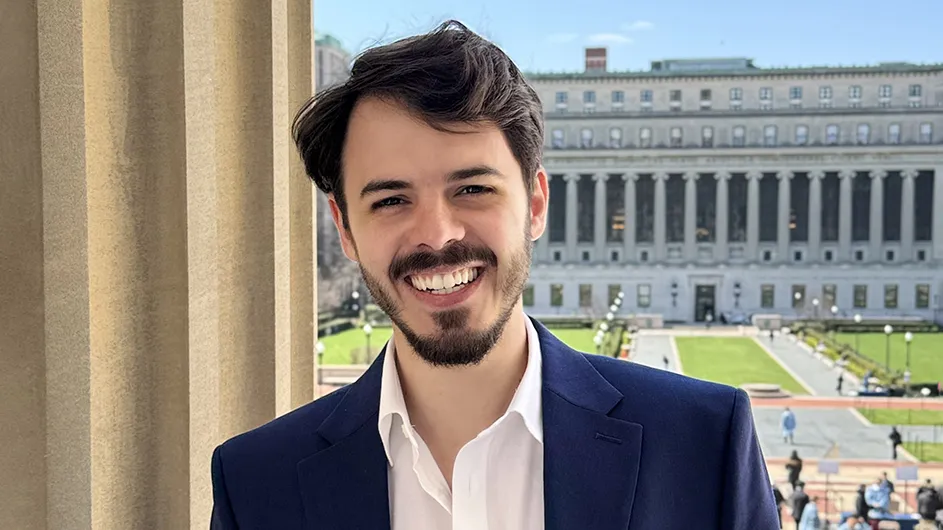
Felipe Gatos lived and worked in New York for several years before attending graduate school at Columbia. Since becoming a student again, he has enjoyed rediscovering the city—culturally and culinarily—with his business school classmates.
When will you graduate from the Business School, and is there any special track for your MBA?
I’ll be graduating with an MBA from Columbia Business School (CBS) in May 2026. While CBS doesn’t have formal majors, I’ve focused on classes that build on my background in finance and strategy, with a tilt toward social impact. It’s been a mix of courses in investment finance, impact investing, climate and resilience, and management for the future of work.
What was your path to pursuing graduate work at Columbia?
It actually goes back quite a while. I applied to Columbia as a deferred-enrollment applicant during my senior year at the University of Florida, knowing I’d be moving to New York for work after graduation. The program allowed me to defer admission for up to five years, and I loved the idea of returning to school after a few years in the city—to grow, reconnect with the classroom, and meet people from all over the world. After working in New York for four years, it felt like the perfect time to take a step back and explore topics that had become increasingly meaningful to me, like climate finance and impact investing.
Has there been a special mentor or professor during your time here? Or a particular class that inspired you?
Definitely! To name just a few (not a comprehensive list):
Kevin Erixson, senior associate director of The Hub at CBS, has been an incredible mentor. The Hub serves as the business school’s think tank for business and society, which connects scholars, practitioners, policymakers, and the public to explore pressing issues. I’ve worked closely with Kevin in my role as co-president of The Hub’s Student Advisory Board.
Adina Sterling’s Equity by Design course helped me think more deeply about inclusive leadership and the systems that shape opportunity. We even collaborated on a student-led roundtable on the future of inclusive leadership and the policies business leaders should be thinking about today.
Mabel Abraham’s Power and Influence class made a big impression. She met with me one-on-one to talk about my professional development goals, which was especially meaningful as a first-generation immigrant learning to navigate the unspoken rules of business and leadership.
How have your extracurricular activities shaped your experience at Columbia?
This work has been one of the best parts of my time at the Business School. As I already mentioned, I serve as co-president of The Hub Student Advisory Board, where we organize student-centered discussions on topics at the intersection of business and society, such as renewable energy policy, artificial intelligence, and inclusive leadership.
I’ve been involved in a number of initiatives around social impact. I’ve been on the board of the Green Business Club since starting at CBS. Earlier this year, I was named a ClimateCAP Fellow, for which I’m leading an independent study project focused on investment vehicles for financing climate resilience in vulnerable markets. Additionally, I’m a Three Cairns Fellow, working with a team of four CBS students to advise the Capital for Climate fund on its investment strategy for nature-based solutions in Latin America.
In Spring 2025, as part of Columbia Pangea Advisors, I participated in a pro-bono consulting project in Brazil, where my team and I worked with a literacy-focused social venture to explore growth opportunities across Latin America.
Finally, I was selected as one of two MBA Fellows at Columbia for the National Association of Investment Companies, a trade association focused on driving capital to emerging fund managers from underrepresented backgrounds. In this role, I work with NAIC to connect emerging fund managers with large institutional investors, and to support key projects that advance the association’s mission of increasing diversity in private equity.
How do you like studying in the city? What are your favorite urban pastimes?
I absolutely love it! Having lived in New York before business school, it’s refreshing to experience the city through a new lens, as a student rather than a professional. The flexibility of student life has given me the chance to explore more of New York’s neighborhoods, food, and culture. I’ve also appreciated the chance to enjoy the city in new ways, now accompanied by classmates from different industries and countries who help me see it with fresh eyes.
Any specific recommendations for things to do beyond campus?
Get outside whenever you can. I spend a lot of time at the Brooklyn Botanic Garden and Prospect Park, which are great escapes from the pace of Manhattan. And definitely check out the food scene in Queens: The Queens Night Market is one of my favorites for trying dishes from around the world in one place.
What is the most special thing about studying at Columbia?
I know it sounds corny, but, without a doubt, the people. My classmates come from every corner of the world, each with their own story and purpose. There’s an energy here that makes you want to do more and think bigger, whether it’s through investing, social impact, or entrepreneurship. The faculty, staff, and alumni I’ve met from being a part of the Columbia community have been wonderfully supportive and generous with their time and advice.
What are your plans post-graduation?
I’ll be returning to Bain & Company in New York, where I spent my summer internship. I’m excited to keep working at the intersection of strategy and private equity, helping companies grow with both performance and purpose in mind.