A Former Postdoc Returns as a Professor
Mark Ross-Lonergan is an experimental neutrino physicist with a passion for oysters.
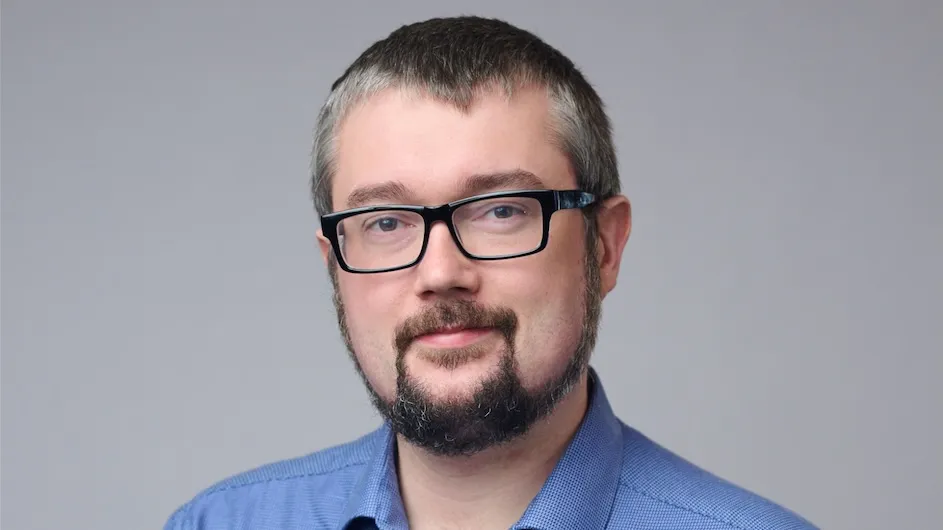
Mark Ross-Lonergan first arrived at Columbia as a postdoctoral researcher in 2017, eager to pivot from his previous work on theoretical physics to a career focused on physics experiments. After spending five years as a postdoc at Columbia, Ross-Lonergan decamped for New Mexico, where he worked for several years as an Oppenheimer Distinguished Fellow at Los Alamos National Laboratory. He returned to Columbia last summer as an assistant professor. Columbia News caught up with Ross-Lonergan to talk about his research focus, his latest findings, and his love of oysters.
How do you describe your work broadly?
I’m an experimental particle physicist, and, more specifically, an experimental neutrino physicist. On a daily basis, we’re really just trying to learn as much as possible about a fundamental particle called the neutrino, one of the most abundant particles in the universe.
The reason you may not have heard much about neutrinos, though, is that, unlike protons and electrons and other more familiar particles, they barely interact. They basically go straight through things. Hundreds of trillions of neutrinos pass through you per second, and you don’t even notice.
That’s what makes them so hard to study, and so much fun. To catch even a few, we have to build huge, incredibly sensitive detectors, filled with hundreds of tons of liquid argon cooled to -186°C, and place them in the path of intense neutrino beams made by particle accelerators. Even then, almost every neutrino sails straight through. The rare one that does interact is what we are looking for to study.
If neutrinos barely interact with other particles, why is it important to understand them?
One reason is that they play a huge role in how our universe evolved. In the first moments after the Big Bang, neutrinos carried an enormous share of the universe’s energy, and that shaped how matter later clumped together into the galaxies we see today. Without them, the universe would look completely different.
They’re also incredibly important for understanding nuclear processes all around us. The sun shines because protons in its core are turning into neutrons, releasing a neutrino each time. Any time a proton becomes a neutron, or vice versa, a neutrino is involved. Without them, we couldn’t understand how stars burn or where our elements came from.
There are other reasons that neutrinos are important, but they get esoteric quickly.
A lot of particle physics is about building knowledge for knowledge’s sake. Occasionally the things we learn in these labs lead to major breakthroughs—like the MRI or the internet—but other times they just help us understand how the world works at its smallest scales.
You’re very involved in the MicroBooNE experiment, which just had a major result. What did you find?
MicroBooNE was built at Fermilab, in Illinois, a major particle physics accelerator and lab. One of its main goals is to put to bed a longstanding anomaly in neutrino physics that suggested that there was a fourth kind of neutrino, in addition to the three we know about: the electron neutrino, the muon neutrino, and the tau neutrino. We got the first hint that there might be a fourth neutrino in 1995, and then further research from an experiment called MiniBooNE lent more credence to that theory.
The existence of a light fourth neutrino would be outside the Standard Model of Physics, and would really up-end our current understanding of how physics works.
Anomalies are often a hint that something is going on that we don’t quite understand, and many anomalies have led to big discoveries.
What we found last fall, after many years of searching, is that our data strongly disfavor a fourth, “sterile” neutrino as the explanation for these anomalies.
We’re closing the door on one longstanding interpretation but that’s just focusing the community’s attention on what remains. There still has to be a reason for these consistent anomalies we’re seeing, it’s just not a fourth neutrino. Now that that’s not viable, we have to start exploring some more complex but equally exciting ideas.
We’re slowly but surely reducing the space where this anomaly could hide.
You worked at Los Alamos, where the first nuclear bomb was constructed. What was that like?
The original lab that J. Robert Oppenheimer and his colleagues worked at during the Second World War is now the town of Los Alamos, and new, state-of-the-art lab facilities have been built nearby. It’s a huge lab, with well over 15,000 employees, and they do all kinds of research, including weapons research that I am not allowed to be privy to because I’m not a U.S. citizen (I was born in Ireland). I worked on unclassified work. People were working on everything there. It was very interdisciplinary, with people doing things like soil science, fluid mechanics, and then also neutrino research.
When I told my family back in Ireland that I was an Oppenheimer fellow at Los Alamos, the movie Oppenheimer had just come out, and I think they felt they finally understood a bit more what I did—though the movie was probably a little misleading.
Do you have any hobbies?
My biggest love outside of all of this is oysters.
We had a thing when I was a postdoc here called Bivalves Bi-Weekly, where we’d eat oysters every two weeks. I’m bringing it back. Whenever there’s a work party I bring a giant box of them and I shuck them. I grew up in coastal Ireland, and the oysters are great there, but New York has an unusual amount of variety. You can get everything here.
Do you have a favorite variety?
Fishers Island oysters are excellent, and anything from the Damariscotta river estuary, in Maine.
One thing I learned during COVID is that you can buy oysters directly from a farm, and get them overnight. I continued that when I moved to Los Alamos because I missed the oysters so much. New Mexico is pretty landlocked, and New York has some of the best oyster options in the world.