On a Mission to Make Healthcare More Equitable
The health disparities that Sebastian Cota observed in his native Los Angeles led him to Columbia University’s Mailman School of Public Health.
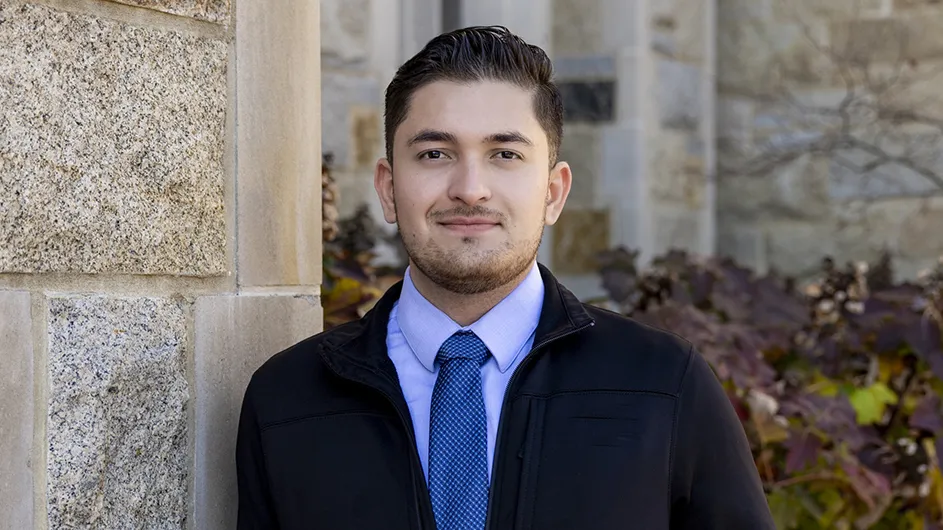
Sebastian Cota’s initial interest in public health and medicine was sparked in high school when he volunteered at a Los Angeles hospital where he learned about challenges affecting U.S. healthcare, and became especially aware that his own community of Spanish-speaking Los Angeles residents was experiencing much higher than average rates of preventable chronic illness. A desire to help fix those inequities led him first to Boston College, where he studied public health as an undergraduate, and then to Columbia, where he is set to graduate with a master’s in public health this spring.
Columbia News spoke to Cota about where he’s been so far, and what he plans to get up to next.
What made you choose Columbia for graduate school?
In the summer of 2023, when I was an undergraduate at Boston College, I participated in the Summer Public Health Scholars Program (SPHSP) hosted at Columbia’s Mailman School of Public Health. SPHSP gave me a deep immersion into the field of public health through our didactics, community project placements, and by being in a cohort of remarkable students sharing big ideas and a desire to make a difference in public health. When I was applying to Master of Public Health programs, I knew Columbia was the perfect place not only because I was already familiar with the incredible staff and faculty that would support me, but also for its location in Washington Heights, which resembled the neighborhood where I grew up in South Los Angeles. The Heights and South LA face similar disparities in health outcomes, and my goal with pursuing my MPH is learning how to mitigate these disparities to allow anyone to live a healthy life regardless of their zip code that may predispose them to worse health.
I knew that there was so much to learn from the amazing faculty like Dr. “Bob” Fullilove and my current thesis advisor, Dr. Paris Adkins-Jackson—or Dr. AJ—who have not only shaped me to become a competent public health professional but also provided a space where I could realize my full potential and execute my big ideas through assignments and now my thesis project. I also knew that by being in New York City, and Washington Heights specifically, I would have access to many opportunities for engaging with community organizations and gaining experience to understand how major health systems tackle the same health issues that pushed me to pursue a career in public health.
In college, you worked on a project that examined prices of groceries in bodegas in Upper Manhattan. Have you always felt an affinity for Upper Manhattan, and is that what drew you to Mailman?
I would say it is both a perfect coincidence and an affinity to Uptown Manhattan. Although my project placement for SPHSP was in Washington Heights, I had always known about the similarities between Uptown Manhattan and South Los Angeles which not only include health status, but also the culture. Growing up in a Spanish-speaking household with family roots in Sinaloa, México, listening to the sounds of bachata, salsa, and the Spanish language while walking down the streets of “Little Dominican Republic” in Washington Heights felt like home. I would say 90% of my interactions in the Heights are in Spanish, from ordering a plate of tres golpes and a morir soñando for breakfast, buying plantains and groceries at the store, and speaking to my patients in the emergency department at Columbia’s medical center.
Aside from this comfort, I know that the work I am doing uptown makes a big difference because one of the core goals in my career includes advancing language concordance in health. Whether as a Spanish interpreter for the ECHO Free Clinic in the Bronx, conducting interviews in Spanish to understand the experiences of utilizing telemedicine, or increasing the health literacy of my patients while addressing their social needs as a public health intern with Columbia's Department of Emergency Medicine ENGAGE program: This is the place where I have a platform to address the differences in health outcomes that drove me into this career.
What kind of work do you hope to pursue after graduation?
Between graduation and beginning medical school, I hope to continue my thesis project to quantify the stories of barriers in accessing healthcare among Bronx residents so their voices can inform targeted policy. I also hope to continue my work in the ENGAGE program as a public health intern at Columbia’s emergency department. The ENGAGE program provided an answer to my question of addressing the health injustices that led me to this career, by directly increasing the health literacy of community members and addressing their social needs. This has solidified my commitment to becoming a physician either practicing in family medicine or social emergency medicine where I can also fill gaps in language concordance for Spanish-speaking patients, reduce the shortage of primary care, introduce community health programming reducing preventable adverse health outcomes, and advocate for my patients in spaces of policy.
I will continue utilizing my skills in public health to systematically address the disproportionate prevalence of preventable chronic illness in neighborhoods like Washington Heights, The Bronx, South Los Angeles, and beyond. I also hope to advocate as a physician for systematic reform in healthcare, such as reforming Medicaid reimbursement to sustainably maintain the financial integrity of safety-net healthcare facilities, expanding access to primary healthcare, and providing access to fresh food in communities experiencing food apartheid.
Do you have a favorite thing to do outside of class and school around the city?
I love to use the Citi Bikes and ride around the city, especially the protected bike paths along the West Side Highway and across the bridges into Brooklyn. I’ve taken a study break ride from the Morningside campus to Central Park where I completed three-quarters of the full loop around the park then made my way back. It’s a very nice way to cruise through the city, enjoy the scenery, and relax while getting some physical activity.
I also really enjoy Latin dance! Whether it is with the Columbia Latin Dance Club on the medical center campus offering free salsa and bachata workshops on Wednesday evenings or an occasional salsa night somewhere in the city, it is nice to celebrate my culture through music and movement.