A Neuroscientist and a Playwright Discuss Memory
At a recent School of the Arts event, Daphna Shohamy and Sarah Ruhl share how memory affects their work.
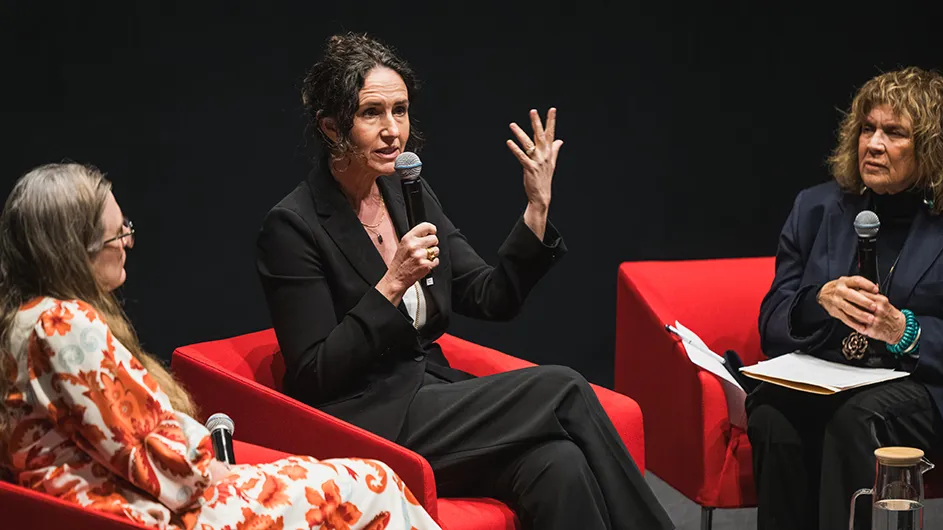
“In university structures, we study what we are emotionally, psychologically, and intuitively drawn to,” said Carol Becker, professor and dean emerita of School of the Arts. “As we go along, and spend years and years studying, we become more and more structured by the way in which we’ve studied.”
Becker was speaking on a recent evening at the Lenfest Center for the Arts. The event, Art, Neuroscience, and Memory, was part of a School of the Arts lecture series, Where Ideas Come From, which Becker curates. The series bridges disciplines by putting practitioners in conversation with one another on the origin and evolution of ideas. In addition to Becker, the speakers were Daphna Shohamy, Kavli Professor of Brain Science, and director/CEO of the Zuckerman Institute, which is dedicated to the study of the brain, and playwright, author, and professor Sarah Ruhl, Alan Kanzer Writer-in-Residence at Zuckerman.
The Theatre Program at School of the Arts and the Zuckerman Institute co-presented the program.
The Relationship Between Experience and Memory
Prior to the conversation, each woman gave a short talk that identified the relationship that experience and memory play in their respective fields. Both women showed how, in their work, memory surpasses mere cognitive function.
Ruhl shared a short essay about her most recent production of Eurydice at Signature Theatre in New York, starting with a discussion of the fourth wall—the invisible border separating performers from audience members. One day, during the run of the play, Ruhl had to step in for an actor with COVID. This was a task for which she was not totally prepared; while the playwright is responsible for the material an actor will say, seldom do they speak it themselves: “Learning to act is learning to move. Learning to write is learning to sit still,” said Ruhl. Without enough time to memorize, Ruhl went on stage with a script in hand, and waded through the performance as best she could.
Once on stage, she found herself in a strange liminal state. While part of the performance, she felt as if she was on the periphery. The fourth wall—which, when understood from the performer’s side, turns the ordinariness of language into an enlivened act—did not exist for Ruhl. While it would be easy to have discarded the distinction between herself and her cast mates as a difference of line familiarity, Ruhl said the moment instead expanded her perception of what memory can be. The actors around her were not just speaking words, but embodying them. Her incongruity as a cast member was her inability to tap into the potential of memory as a physical experience.
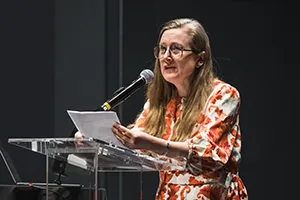
Ruhl, in an unusual twist, ended this anecdote by discussing forgetting. Actors, she said, must forget the audience in order to carry out their task. If aware of eyes upon them, the fourth wall blurs, and they no longer stand in contrast to their observers, or within the lived reality they’re attempting to portray.
Tracing Moments of Space and Time
As slides lit up behind her, Shohamy introduced the work of her colleague Dmitriy Aronov on the black-capped chickadee, specifically, his attempt to understand the birds’ “extraordinary spatial memory,” she said. The black-capped chickadee hides up to 5,000 food items a day throughout its habitat, with the ability to recall the location of each item. “How does this happen?” she asked. The chickadees are able to trace moments of space and time. By holding on to these neurological composites—which these birds can retain for up to a month—they are able to return to the sites where their items are hidden.
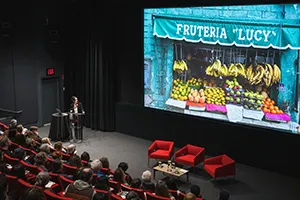
“Black-cap chickadees are not the only ones who can create long-term traces of memory in their brains,” Shohamy said, before flipping to an image of a fruit stand in Lima, Peru, a photo that she’d taken on a recent trip. “I remember the mango I had from this food market,” she said. Her memory of the fruit, and of consuming it, was only part of her memory of that place. The fruit itself may have been the impetus for other contextual memories, but Shohamy could also remember where the fruit stand was, where she’d been prior to arriving there, and the market’s layout. If you dropped her there, she said, she’d be able to navigate the area. “Even though there was nothing in the sensory world to indicate any of the information somewhere in my mind,” Shohamy said, she would be able to use that moment at the fruit market as a starting point to explain the rest of her day.
These types of memories—which include not only events, but the particularities of an event in space and time—are what neuroscientists call episodic memories: Memories of events that surpass the event and lend themselves to a type of layout that enable us to hold onto them for “days, weeks, months,” even if the event occurred only once. “The ability to create these memories,” Shohamy said, before flipping to another slide, depends on a “remarkable structure” called the hippocampus, “a seahorse-shaped structure right behind the ears.” The hippocampus, as the site and source for this memory-making and storing, has long been an object of study. Large strides were made in this research in the 1950s, but, in trying to understand how the brain accomplishes the creation of these episodic traces, on the level of neurons and circuits, an early conception of memory’s function was challenged: “That’s what happens when we are stuck using the brain to study the brain,” said Shohamy.
The hippocampus, as it turns out, is as important for spatial navigation—functioning almost as an internal GPS—as it is for a conception of time. “When we remove the hippocampus, we learn that it is not just the creation of memories that is impaired. It is also the ability to imagine ourselves in the future,” explained Shohamy. This structure’s ability to create maps of time and space allows us to relive not only rich memories, but our relation to them. Memory can serve as an archive of experience.
Grief for a Father
There are personal reasons why memory plays such an important role in the work of both Ruhl and Shohamy. Ruhl wrote Eurydice—a re-telling of the Greek myth from Eurydice’s perspective—as a young woman in the wake of her father’s death. At the time, she was drawn to the ancient myth without understanding why. “We don’t always know why we’re doing what we’re doing,” Ruhl said, but eventually she saw this attraction as a container for the grief over her father, and a means of making sense of the afterlife. “I wanted to remember what he taught me.”
While writing Eurydice, Ruhl reflected on childhood memories of weekly trips to a pancake house with her father in her native Chicago. Her father would teach her words, emphasizing etymology. “My father loved and was very playful with language,” she said. “There’s a sequence in Eurydice that’s based on those conversations.” In writing the play, Ruhl imagined a realm in which Eurydice enters the underworld, loses her memory and her ability to speak, and encounters her father. Their reunion invites her father to teach her to speak and help her reformulate her identity: “The play is about the relationship between language, memory, and the bonds we have with people.”
Eurydice premiered in 2003 when Ruhl was a resident playwright at New Dramatists. After the play’s first reading, she fled to the bathroom, refusing to greet anyone. But throughout the play’s lifespan, as it transformed from script to production, the consistent exposure allowed Ruhl to grow comfortable. “Every time I saw the play, it was like another funeral for my father,” she said. But this repetition offered her an outlet to lessen her grief’s intensity. Today, she added, the grief of the play belongs to her collaborators, the people who help her to continually reimagine Eurydice, most recently as an opera in 2020. Ultimately, though, the play has grounded and contained what was an indescribable experience: “It’s so interesting to me, because the discipline of being a writer or an artist, or being a scientist, looks so different from the outside, but there is a way in which giving something structure allows you to move beyond it.”
Pursuing a PhD in Neuroscience
Shohamy is currently at work on a forthcoming book about memory. Prior to the evening, Becker had read the first few chapters of the book, and offered that the book may contain insight into Shohamy’s choice to pursue neuroscience. Shohamy was a bit out of her comfort zone when asked to discuss this portion of the book. It was the first time she’d ever discussed the material in public.
Fifteen years into running a lab, she felt she wanted to engage in a “big deep project of thought and writing.” She sought to take a reflective view of her lab’s work and accomplishments in the field of memory. But when she sat down to write the book, she found herself plagued by a personal story that wouldn’t let up. “I didn't want to write about it, but I did, and that reminds me a bit,” Shohamy continued, turning to Ruhl, “of your reflection sitting here—the way in which we don’t know ourselves.”
“My choice to pursue a PhD in neuroscience, and in particular, to learn about memory, was very much influenced by my fascination with change—that we change, how we change, and how our experiences shape us. That came out of my growing up in many different cities and countries. The idea that this is implemented in biology blew my mind.” However, that was only half the story.
When Shohamy was in graduate school, her sister, with whom she was very close, got into a car accident and suffered brain damage. When Shohamy arrived at the hospital, the doctors showed her her sister’s brain scans, which were analogous to those she’d been studying for her coursework. Shohamy’s immediate thought was that she’d be unable to finish her PhD. Her sister didn’t survive the crash, but Shohamy did return to her lab. “I found the opposite, that the science gave life meaning and continuity, and pulled me forward,” she said. “Until I started writing the book, I did not connect the idea that I was trying to figure out how to build a life with this experience of loss, and the answer to how to build that life was the science of memory.”
How to Archive the Experience of Loss
Toward the end of the evening, Becker identified a similarity between the women’s work. Ruhl’s Eurydice experiences immediate disorientation upon arriving in the underworld. “That’s similar to Daphna’s discussion of navigation,” Becker said. “Eurydice can’t navigate space, and she can’t navigate language; it’s almost as if you were writing about amnesia or someone with a hippocampus disorder. If I read Daphna’s work, and then I read the play, I think, well, that’s exactly what you’re talking about.”
At the start of the program, Becker had said that artists tend to be on the scene first. Throughout the night, it seemed as if the discussion laid out a type of cosmological scientific method, where the inquiry about existing in the world created enough curiosity for an artist to opine and create, and then for a scientist to come in and comprehend. The two, in this system, work in tandem.
Shohamy, when explaining embodied memories, was quick to bring up Proust. Ruhl replied by recounting a recent run-in she’d had with a postdoc at the Zuckerman Institute: “She was talking about Proust, the passage with the madeleines, and what literature can do in describing memory. I think it’s wild that scientists are sometimes better read than writers.”
Eve Bromberg is pursuing her MFA in the Theatre Program, with a concentration in dramaturgy, at School of the Arts.