A New History of World War II
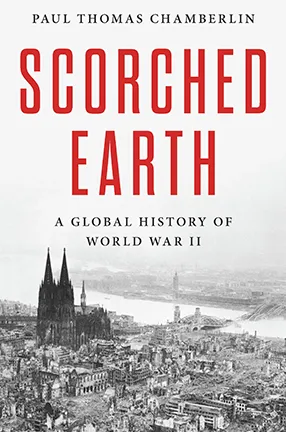
Paul Thomas Chamberlin’s book, Scorched Earth, recasts the conflict as a brutal struggle for survival among declining and ascendant imperial powers.
In popular memory, the Second World War was an unalloyed victory for freedom over totalitarianism, marking the demise of the age of empires and the triumph of an American-led democratic order.
In Scorched Earth, Associate History Professor Paul Thomas Chamberlindispatches the myth of World War II as a good war. Instead, he depicts the conflict as it truly was—a massive battle beset by racial atrocities, fought between rival empires across huge stretches of Asia and Europe. The war was sparked by German and Japanese invasions that threatened the old powers’ dominance, not by Allied opposition to fascism. The Allies achieved victory not through pluck and democratic idealism, but through savage firebombing raids on civilian targets and the slaughter of millions of Soviet soldiers. The Soviet Union and the United States emerged as hyper-militarized new imperial powers, each laying claim to former Axis holdings across the globe before turning on one another and triggering a new forever war.
Chamberlin shares his thoughts on the book with Columbia News, along with what he’ll do this summer and what he’ll teach in the fall.
What was the impetus behind this book?
I teach a lot of classes on the history of U.S. foreign relations, and World War II is a critical topic. I prefer to present a range of competing interpretations to my students as a way of inviting class discussion. For example, in a given week I might have students read one piece that argues that the Soviet Union started the Cold War, one arguing that the Americans started it, and one arguing that the entire history of the Cold War was secondary to the worldwide process of decolonization.
However, I was having a difficult time finding class readings that offered challenging new interpretations of the Second World War at the broad international level. The overwhelming majority of histories essentially conformed to the good war interpretation of the conflict that emerged out of the 1950s. This orthodox interpretation cast the war as a noble struggle between democratic and fascist nations, downplaying racial and colonial dynamics that no longer seemed relevant in the early-Cold War world. These histories marginalized the central roles of the Soviet Union and China—neither of which fits cleanly into the democracy versus fascism dynamic—and focused on the American and British contributions to the war. It’s a version of World War II that transforms empires into nation-states and conquerors into liberators.
How does your book differ from previous histories of World War II?
Unlike most earlier histories, I argue that we should understand World War II as a conflict that emerged from the imperial world order of the late-19th and early-20th centuries. All of the major belligerents were empires, and their aims need to be understood in that context. Germany, Japan, and Italy each sought to create colonial empires that would allow them to challenge existing imperial powers like Britain and France. The United States had conquered a continental empire over the 19th century, and held overseas colonies; leaders in Moscow had also conquered huge stretches of Eurasia during the 19th century, and were seeking to expand further into Eastern Europe. It was these imperial power struggles—rather than ideological disagreements between fascism and democratic-capitalism—that triggered the war. It was only after 1945 that the ideological dimension became preeminent, as scholars looked backward through the lens of the Cold War at World War II.
Likewise, the Allies fought the war as empires. Britain relied on its global network of colonies to mount counterattacks against Hitler’s Europe. The United States drew upon the vast resources of the North American continent to arm the Allies and construct a worldwide system of bases that would give Washington the ability to launch military strikes around the globe. And the Soviet Union fought the war as a massive land empire that rolled across Eastern Europe to conquer the same territories that Germany had tried to claim as colonial Lebensraum.
Moreover, colonial warfare provided a blueprint for many of the war’s most notorious forms of violence. History’s first concentration camps were created by the British Empire during the Boer War (1899-1902). Germany’s first extermination campaign took place in the South West Africa colony between 1904 and 1908. The first use of large-scale aerial bombing against cities took place in the colonial world during the 1920s. And U.S. and British forces first learned how to stage amphibious operations not on the beaches of Sicily and Normandy, but in the colonial wars of past centuries.
More broadly, the notion of civilized versus savage warfare is a binary that emerged from older dynamics of imperial warfare in the Western world. Axis leaders claimed that their campaigns in Eastern Europe, Africa, and Asia constituted savage colonial wars, and, as such, did not need to conform to the limitations of civilized war fought between nation-states. The result, tragically, was a conflict that made little distinction between soldiers and civilians. Indeed, two out of every three people killed in the war were non-combatants.
Finally, by placing the Second World War in the larger narrative of imperial history, the book frames the conflict as the culmination of five centuries of colonial expansion, and the catalyst for the creation of a neo-imperial world order dominated by the superpowers.
What have you read lately that you would recommend, and why?
I read hundreds of books in the course of researching World War II, and there are too many great ones to give a comprehensive list. But a few of the lesser-known and/or older books that had a big impact on my thinking include: Christopher Thorne, The Issue of War (1985), which explores complex questions of race and empire in the context of the Second World War; Tsuyoshi Hasegawa, Racing the Enemy (1995), which reframes debates about the atomic bombings, placing the Soviet invasion of northeast China center stage; Mark Stoler, Allies and Adversaries (2000), which transforms what we thought we knew about American strategy and inter-Allied politics; and S.C.M. Paine, The Wars for China (2011), which reveals China’s central importance to the world wars and the emergence of postcolonial Asia.
What's next on your reading list?
I’m hoping to do some lighter reading over the summer, and am interested in narrative nonfiction. I’m planning to look at some of Erik Larson’s work and the newest volume of Rick Atkinson’s history of the American Revolution, The Fate of the Day: The War for America, Fort Ticonderoga to Charleston, 1777 to 1780.
What are you working on now?
I haven’t started a new project yet, but I’m kicking around a few ideas. My second book grew out of my first book, the World War II book grew out of my second book, and there’s a good chance my next book will follow a similar trajectory.
Summer plans?
I’ll be doing a bit of conference and family travel, and trying to figure out what to write next.
What are you teaching in the fall?
A graduate seminar on international and world history, and a topics seminar on U.S. foreign relations history.