Think ‘Badges,’ Not Diverging Paths: A Columbia Professor’s Advice for Finding What You Actually Want in College
Associate Professor of Computer Science Brian A. Smith has four Columbia degrees. How did he find his path, and what advice does he have for the rest of us, who are looking for one as well?
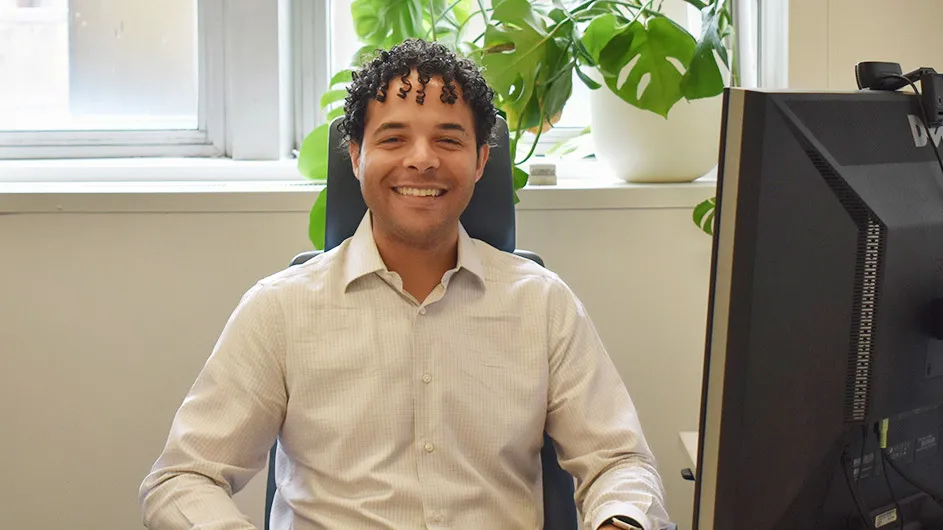
Whether you’ve come to Columbia completely sure of your path or completely insecure about where you’re going next, Brian A. Smith is a faculty member you need to meet. His four Columbia degrees are just the starting point; his unexpected philosophy about the journey to finding meaning in life is something everyone should hear.
Smith grew up in Lincoln County, New Mexico, a place he describes as “‘Billy the Kid’ country”: three hours south of Albuquerque and 75 miles west of Roswell. He came to Columbia for undergrad as a first-generation college student taking a chance on engineering without understanding its full scope of possibility.
Today, he is an associate professor of computer science and directs the Computer-Enabled Abilities Laboratory (CEAL, for short), which works on accessibility and assistive technology, social computing, and human-centered design.
In between, he picked up a Master’s, an M.Phil, and a PhD, spent time at Google, and worked for four years as a research scientist at Snapchat on the smart glasses hardware team, all before returning to Columbia to teach and research.
That’s why we at Columbia News asked Brian to be one of our guides for this year’s “Choose Your Own Adventure”-focused Columbia Welcome series. We asked him about how he found his way through all of those iterations and the advice he has for students on their higher ed journey.
How did your Columbia journey start?
I grew up in rural New Mexico, and a lot of people I knew there had never seen an airplane, a traffic light, or an escalator. I had family near New York and always considered myself a city person, but visiting campus is what sealed it. The people were the real draw: you could feel the energy and how people celebrated our differences, everyone coming here for different reasons. That energy was contagious.
Those first few weeks were both exciting and scary. I did my K-12 at public school, and so stepping up to a place like Columbia, the level of rigor and accomplishment in the classroom, was very intimidating. I remember my first few homework assignments here—I think the first one I got back was Calculus III, and I got a 3/10. Very shortly after that assignment, my first physics homework came back, and it was 12/20. There was certainly a wake-up call there, and it was pretty scary.
What helped you get through the hard parts?
The first conversations I had with my advising dean Lavinia Lorch, I remember being so anxious about what version of chemistry I should be taking. We’ve all been so conditioned in high school to achieve more and more and push ourselves as much as possible. More is more and more is better.
Even though I knew I was moving toward something like computer science, my mindset was still like “if I’m taking a chemistry course, I’m going all the way: notorious organic chemistry.” That’s more, so that’s better.
So my first meeting with my advising dean was actually the long process of unlearning some of those things. Dean Lorch basically said: “Wait, why are you taking orgo? That makes no sense. Take the easier one. That will meet the requirement, and it will give you confidence, time, and freedom of mind to be thinking and planning what your next steps look like.”
“Columbia was the first time I got to see that more holistic, almost human-centered perspective. And that empowered me.”
And honestly, when I got that advice, I was so shocked. I had never heard anything like this from my high school counselors. But Columbia was the first time I got to see that more holistic, almost human-centered perspective. And that empowered me. That kicked off a long process of discovery: of self-discovery, learning what it is that really makes me tick, and what it is that I want in the long run.
How did you first connect with the professor who became your PhD advisor?
Only during my very last year here as an undergrad did I start to work with a faculty member who later became my PhD advisor. It’s okay for these types of connections to take time, to feel right.
I took Shree K. Nayar's computer vision course, and that's when I first got to know him and the subject area. He invited me to help him finish a long-term project that he had started in his group. I was part of a team of students that worked on this project, and along the way we developed a liking for each other and had a lot of conversations about long-term goals and what our meaningful calling is.
That's when Shree floated the idea of graduate school and research. I didn't really know what research was, so I didn't consider that as an option for me until I got the exposure of being in a lab and seeing this process from a much more day-to-day human level.
Now I realize: Anytime you're doing something truly new, whether it works or not, that counts as research.
What does CEAL actually do, and what is professor life like day-to-day?
These days at Columbia, I'm a professor in the computer science department, and I direct the Computer-Enabled Abilities Laboratory. CEAL aims to make it so that computer advancements don't just make computers smarter and more capable, but that they actually improve our own capability as human beings.
We're trying to change the culture of computer science so that we treat people's end experiences and outcomes as things that can be computed and supported by computers. Our lab is most known for our work in accessibility and assistive technology. For example, audio soundscapes that let blind users actually visualize a video game world, or what's happening in a movie. But we've expanded into social computing, helping people connect and form meaningful relationships, and also smart cities and games.
One of the biggest and most meaningful parts of being a faculty member is the focus on mentoring and helping cultivate the next generation of talent. I'm an oldie already, the spotlight isn't on me anymore. What I get to do is meet students, get to know them, and help them find their calling.
How did you figure out that this was your calling?
Something I found really helpful, and that I've worked to get better at, is noticing at a more precise level what is getting me excited and what's dragging me down. Almost on a minute-by-minute basis!
For me, outside of work, I love playing video games. I used to play a lot growing up, almost an escape from being in the countryside, where I could go on adventures and do the things I couldn't do in real life. It wasn't until maybe toward the end of college that I connected the dots and realized there was power in computers to enable experiences for people. It doesn't have to be segmented or excluded from our actual work.

How did you build community here?
Those first weeks were tough. The first round of midterms was tough. The first end of semester was tough. What helped me, looking back, was getting to know the other people around me.
I lived in Carman Hall my first year, in a four-person suite, and I got to know my suitemates, people down the hall, across the hall. I'm an introvert, so not one to create the group and initiative, but I'll attach myself to one—and it helps!
I also made a habit of showing up to office hours for classes I found challenging. Interestingly, there weren't a lot of people at these office hours, even for my larger classes. But getting the help you need is really important.
That's something I teach my PhD students today. We write it up on the whiteboard really big in the lab: GET THE HELP YOU NEED.
You mentioned thinking about majors and careers as ‘badges’ rather than fixed paths. What do you mean by that?
A lot of people think that once you major in some subject area, you're locked into that for life. That's totally not true. I tend to think of these junctures in life—what major you choose, what internship you get, whether you get into a graduate program—not as diverging paths that lead to completely different lives, but rather as badges that we collect over time. You still have all of those interests and skills that you had before at that original juncture. And more experience on top of that. So you're not locked in: now you have this badge, and you can collect a different badge now.
“I tend to think of these junctures in life not as diverging paths that lead to completely different lives, but rather as badges that we collect over time.”
When I was an undergrad in engineering, finance and consulting were really hot: over two-thirds of engineering graduates were going into finance or consulting. I even tried a finance internship—not for me. Computer science was very small back then, but I still found it interesting. Before I declared my major, I went through the entire Columbia Engineering bulletin and read every course title, and put a little checkmark next to every title that sounded interesting. I majored in the thing that had the most checks: computer science. I'm glad I went with that, even though it was not popular and not cool at the time.
Fast forward ten years, and computer science became really, really hot. It's Columbia's largest, if not second-largest, major on campus. But you can't predict these things.
What matters at the end of the day is: do you want to get up out of bed and work on this thing, and to listen to yourself?
Quick Local Tips With Professor Smith
Favorite spot on campus?

I’ve always loved the little sky lounge on the top of the ramps in Lerner, the one that floats above, especially on a rainy day.
I like the overpass in front of the Law School, Revson Plaza, a lot too—just sitting there and looking up Amsterdam Ave., while reading or thinking.
A part of New York that all students should experience?
Definitely explore Brooklyn. Since it is a bit further away, it often goes overlooked, but it is an amazing place—it feels a lot more homey, more of a neighborhood vibe than Manhattan. Brooklyn’s also massive; there’s no singular “I saw Brooklyn.” You can keep exploring different parts on different weekends.
Missing the big Southwestern sky?

Central Park is amazing, and it is only a 15-minute walk from campus. It’s so large and so interesting that you can explore different corners and pieces of it.
I also like Lower Manhattan a lot. There are a couple of piers down there that have been converted into public parks. One of them has a mini golf course on it! You get a lot of sky, and you get the water too. You’ll see sailboats, and in the winter they have figure skating. A lot of fun to go with friends, and very affordable.
Any video games lighting you up right now?
I’ve been diving pretty deep into Pokémon Pokopia. It’s an interesting cross between Animal Crossing and Stardew Valley. I like following Nintendo because they have these amazing game designers, and it is really interesting how they’ve made a great gameplay loop out of gift-giving and making characters happy.
Anything else you want students to know?
It is possible, and could be easy, for folks to just get caught up in class and go through all of undergrad just as a series of classes you take, you learn this stuff, and you’re done, and you get the degree.
But college can be a lot more than that. I think the real value in moving to a place like New York, and a campus like Columbia, and actually living here, is the exploration. All of the conversations with other students, advisors, and faculty members power those explorations.
“I think the real value in moving to a place like New York, and a campus like Columbia, and actually living here, is the exploration.”