Two Columbia Librarians on the Hacks, Etiquette, and Best Spots Inside the University’s Libraries
Everything you need to know (plus some of the secrets you should know) to supercharge your time at any one of Columbia's 18 libraries.
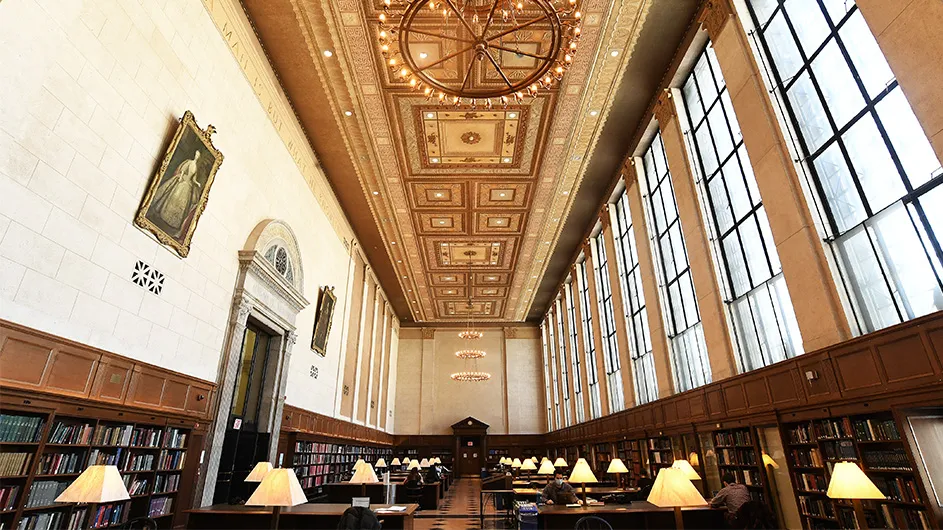
Ask any Columbian about their favorite spot on Columbia's campuses, and nine times out of 10, the answer is one of the University's libraries. Most common? You guessed it, Butler, with its many cozy, wood-paneled reading rooms, inspiring art, and, of course, the majestic chandelier-adorned Lawrence A. Wien Reference Room.
But the Columbia Libraries are more than just their holdings and aesthetic; they are the people who work within them. And you can take it from this writer: Columbia’s librarians are some of the smartest and coolest people at the University. They know all the secrets. They know all the resources. And if there is a minor piece of Columbiana or esoteric information that you can't stop thinking about, they’re the people you should share it with. They'll nerd out right there with you.
That's why, when we were conceiving of this year's “Choose Your Own Adventure”-focused Columbia Welcome package, we decided to ask two librarians (with completely different and fascinating backgrounds) about the many ways Columbians can utilize our libraries—beyond the obvious. And, yes, we did also ask about the aesthetics.
Enter: Jeffrey Wayno (GSAS’11,’12,’16) and Sydni Meyer (GSAS’16).
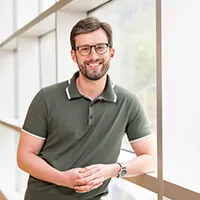
Wayno, Columbia's librarian for Ancient, Medieval, and Religious Studies, is also the Collection Services Librarian at the Burke Library at Union Theological Seminary, one of the largest theological libraries in the Western Hemisphere, where he curates a rare book and manuscript collection. Wayno also coordinates a program where librarians and curators teach in almost half of all of the Core Curriculum’s Literature Humanities sections, where they guide 800-900 students a year through hands-on encounters with rare materials. He also teaches in the Core Corriculum!
Meyer is the Teaching and Undergraduate Services Librarian in the Humanities and History department, embedded in Butler Library, running the FLI Partnership Library, which gets first-generation and low-income students the textbooks they need, and co-teaching research skills alongside University Writing instructors. She also collects for the Milstein Undergraduate Collection.
Both found their way into library work in unusual ways. Wayno arrived at Columbia in 2009 as a PhD student in medieval history and, after finishing his doctorate, landed a rare postdoctoral fellowship designed to bring researchers into library work. Meyer came to Columbia for a graduate program in South Asian studies, starting work in Avery Library's archives almost by accident. She found herself drawn more to the people doing the work in the archives than her thesis topic.
Between the two of them, they have spent a combined two decades helping students learn a library system that, by Wayno's count, spans some 18 different locations across Columbia's campuses and affiliates (many of which, the average student might never step foot in).
Here's what they say Columbians need to know to make the most of the libraries during their time here.
Library Hacks You Need to Know
- First and foremost: don't stop at Butler. “Get to know Butler, explore Butler, it's going to be what you think of as the library, because it is the 24-hour one,” Meyer said. “But also explore really widely. We have some amazing libraries.” For her own work, that means the Butler stacks when she needs pure quiet and Avery Architectural & Fine Arts Library when she wants something more artful. Wayno admits his bias toward Burke Library at Union Theological Seminary (his home base), but notes Lehman Social Science Library is a great place if unbroken concentration is needed.
- Check out the Library Passport Program. Handed out at orientation tables, Butler's lobby, and the student activities fair, “the passport is quite literally a little booklet that helps get you to visit all the different locations.” Stickers! Need we say more?
- The Golden Rule applies. Pay attention to which floors and rooms allow calls or food, and be mindful that food “attracts rodents and pests,” said Wayno. “That's bad for books and the people around them.” So take what you bring with you when you leave (or to the trash).
- Break the habit: DON'T reshelve your books. “Everybody thinks they're doing us a favor, which is very sweet,” Meyer said. “But if you leave the books out, it is actually better, because we can count that. Collecting has a lot of data-informed processes.”
- Butler Library gets quieter the higher up you go. On the sixth floor, researchers and those studying will visibly bristle if you make a lot of noise.
- What's off-limits? Almost nothing. The new Li Lu Law Library has more restricted access for those not enrolled in Law School classes, and the S. Steven Pan '88 Business Library on the Manhattanville campus has a similar restriction, but both loan books across locations. And the C.V. Starr East Asian Library is currently closed for renovation (expected to reopen this year). Other than that, Columbians (students, staff, faculty) are welcome at all Columbia Libraries during their open hours.
- Keep an eye out for series, exhibitions, and meet-ups for low-lift ways to meet other people. Wayno pointed to the Rare Book & Manuscript Library's “Wholesome Book Time,” which offers the chance to spend some time with a seriously cool, rare book. Also in Butler, Meyer pointed out the featured book display in 214 by Blue Java. Last year, she helped with a “Take Back the Internet” display that had an associated Wikipedia edit-a-thon. Student Life also runs library-adjacent programming, including de-stress events where students read lighter fiction over the course of a semester. You can keep track of what is happening here.
How to Level Up Your Research
Once a student has a sense of their field of study, both librarians point to the same underused resource: people.
“The library, we employ dozens, literally, of subject specialists,” Wayno said. Pick a discipline, and you will likely find a dedicated librarian—findable through the (bookmark this!) Ask A Librarian page. Reach out early, even before your research question is fully formed.
“We're not the last person you should talk to as you're trying to figure it out,” Wayno continued. “We're probably one of the first people you should talk to.”
Meyer's advice is similar, destroying the illusion that research should be a solitary pursuit.
“A lot of people imagine this Jude the Obscure-style scholar, where you're tucked away and not talking to anybody,” she said. “Research is an eminently social process.”
“A lot of people imagine this Jude the Obscure-style scholar, where you're tucked away and not talking to anybody. Research is an eminently social process.”
Librarians across departments run regular workshops on the library catalog CLIO, the citation tool Zotero, and even R and Python. Find all the workshops here. Seriously, bookmark this page.
The skill Wayno and Meyer agree all students should leave Columbia with has less to do with mastering a specific database and more to do with building critical judgment.
“In a world where information is everywhere and seems to be readily accessible, we sometimes associate ease of access to information with quality of information,” Wayno said. Knowing the difference between a peer-reviewed source and something an LLM serves up is a skill that “continues to reverberate well beyond your time at a university like this.”
“Trust your own research question over what a database serves up first,” Meyer said. “The most cited thing is not always the best thing.”
Quick Tips From Our Intrepid Librarians
Best library in New York outside of Columbia?
Wayno's pick: The Rose Main Reading Room inside the Stephen A. Schwarzman Building of the New York Public Library on Fifth Ave. “You can't really beat it,” he said, but also flagged Morgan Library as the prettiest, even if it is more a museum than a library these days.
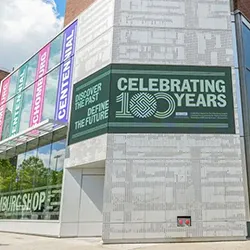
Meyer's pick: New York Public Library's Schomburg Center for Research in Black Culture. “James Baldwin spent time there as a kid, rewriting on a piece of paper the books he was reading, to feel how it felt to write that kind of prose,” Meyer said. “Please go East a bit!”
One fun piece of homework they both agreed on? Get a New York Public Library card! “There's quite literally one right there on Broadway,” Wayno said. It is probably a little less crowded than Butler during finals week.
Undersung library spots on campus?
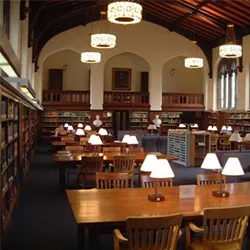
Wayno's pick: The Burke Library Reading Room itself. “It's very Harry Potter and rarely overcrowded,” he said.
Meyer's pick: Lehman Social Sciences Library for a room that reminds her of “the house in The Big Lebowski where Jackie Treehorn lives.” Plus, a surprising pick just off campus: Teachers College's Gottesman Libraries, which is open to any Columbia student and has standing desks, walking pads, and egg-shaped chairs that Meyer says feel like you're being enveloped.
The coolest thing you've recently touched in Columbia's collections?
Wayno's pick: A recently acquired 11th-century fragment of an apocryphal text called The Passion of Peter and Paul, a version of events that don't match the standard biblical account. He now uses it when teaching LitHum in the Core.
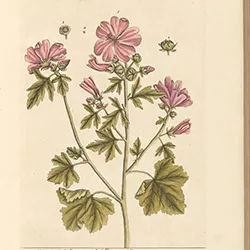
Meyer's pick: An 18th-century pictorial, A Curious Herbal, by Elizabeth Blackwell (the first woman to receive a medical degree in the United States), who illustrated it to fund her husband's release from debtor's prison. The book contains the earnest claim that geese are born from plants rather than other geese (!).
What book do you return to time and again when you need a little reassurance?

Wayno's pick, without hesitation: Man's Search for Meaning by Viktor Frankl, which he’s read five times. “There's always something in it that I find, I don't know, it always gets you in some way,” he said.
Meyer's pick: Reaching back to her Kentucky roots, The Collected Essays of Wendell Berry. “They're really meditations on land,” Meyer said. “I find those to be really grounding, because they remind me of where I'm from and also just connections to the future too, and thinking about how we work to create a better one every day.”