The Story Behind African Immigration to America
In her book, Neeraj Kaushal chronicles how the rise in African immigrants to the U.S. can be a positive force for change.
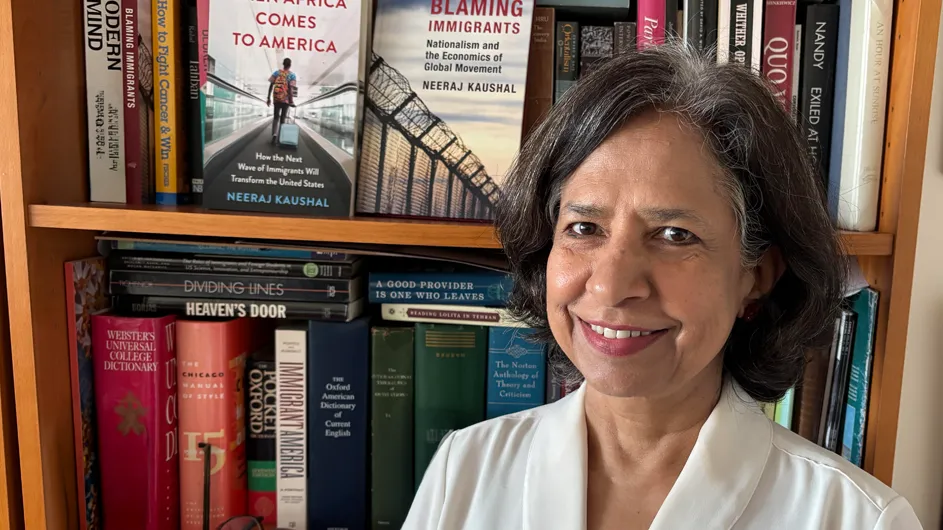
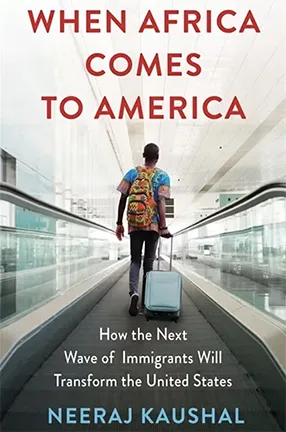
Africans are the fastest-growing immigrant group to the United States. Only a tiny fraction in the 1960s, they represented 10% of documented immigration in 2022. Without attracting much notice, immigration from Africa has the potential to change American society for the better, as Neeraj Kaushal, a professor of Social Work, documents in When Africa Comes to America: How the Next Wave of Immigrants Will Shape the United States.
The book provides an analysis of the myths and realities surrounding African immigration today. Kaushal argues that in the second half of the century, Africans will account for the largest share of immigrants to the U.S. Challenging the view that African emigration is driven by poverty, war, and disaster, she demonstrates that the continent’s sizable and growing middle-class has both the aspirations and the means to relocate. First- and second-generation African immigrants are often highly skilled, and the children of Black African immigrants reach higher educational attainment than U.S.-born whites, and earn comparable incomes.
Kaushal explores the political, economic, and demographic consequences, considering to what extent African immigrants can overcome American racial hierarchies, and how their presence might change what it means to be Black in America. Through empirical data, she makes an optimistic case that the United States will continue to be a nation of immigrants.
Why did you write this book?
For a number of reasons. It all started a few years ago, when I began thinking about the future of immigration—not just over the next five or 10 years, but over the next 25 or 50 years. I started studying population projections from the United Nations, the U.S. Census Bureau, and other organizations. The trajectory of these forecasts pointed unmistakably toward Africa. The data seemed to be validating the old adage that demography is destiny. As I studied the changing demography of our world, I became increasingly convinced that the future of immigration—and, in many ways, the future of the United States—lies in Africa. That’s how the book began, quite literally, with this sentence: “The future of the United States is in Black Africa.”
My curiosity about the future of immigration then led me to the present, and from there to the past—specifically, the past three decades of African immigration. What I found was starkly different from the narratives we typically hear about African immigrants. Those narratives are almost uniformly negative; the reality of African immigration is remarkably positive.
I wanted to set the record straight. First, I wanted to examine the forces driving the rise in African immigration. As I document in the book, I believe these forces are no different from those that drive immigration from other parts of the world, whether India, China, or Europe—a rising middle class with both the aspirations and the resources to migrate in search of opportunity.
Second, I wanted to look at who African immigrants and their U.S.-born children really are. The popular narratives often portray them in deeply negative terms. But the data, including surveys conducted by the U.S. government, tell a very different story. African immigrants are highly educated, disproportionately employed in professional occupations, and their children show remarkable intergenerational progress.
And third, I wanted to explore how African immigration will transform the United States. I see African immigrants not as a problem to be managed, but as a force for positive change—one that will play an increasingly important role in shaping America’s demographic, economic, and social future.
What are some of the consequences you cite in the book of African immigration increasing to the U.S.?
Demographically, Black immigration has stalled and reversed the long-term decline in the share of Black people in the U.S. population, while dramatically increasing their geographic dispersion across the country. In the book, I document how African immigration is raising the educational profile of this country—and why that trend is likely to continue. Over the past few decades, immigration has become the primary source of new additions to the U.S. workforce. I argue that Black immigration will increasingly play that role in the second half of the 21st century.
I also contend that immigration is beginning to break down the hierarchy of color in the United States. The process is slow, but there are signs of it in corporate America, something that would have been difficult to imagine three or four decades ago. I believe that Black immigrants have many of the characteristics that could make them the next “model minority,” and I hope that, together with the native-born Black population, their rise to the top will further disrupt and ultimately dismantle the country’s color hierarchy.
One chapter of the book traces the history of immigration, immigration policy, and American public opinion toward immigration. The political consequences are difficult to determine: It is hard to know whether politicians are responding to public opinion, or using their influence to shape it. Nevertheless, the chapter provides evidence of how immigration has moved from being a largely bipartisan issue to a highly partisan one, and how this transformation is connected to the changing composition of the new waves of immigration.
What books have you read lately that you would recommend, and why?
I recently finished reading Bury My Heart at Wounded Knee: An Indian History of the American West by Dee Brown. It is an old book, published in 1971. I came across the book this summer, as I was taking my first trip to South Dakota and Yellowstone National Park in Wyoming. Brown used reports of the treaties with Native American tribes, first-person statements by American Indians, and autobiographies to record the Native American story. It is a sad, yet fascinating account, and I recommend this book to anyone who wants to learn about the history of the United States.
Born in Blackness: Africa, Africans, and the Making of the Modern World, 1471 to the Second World War by Howard French, a book that I read a couple of years ago, made a deep impression on me. It tells a story of the world with Africa and Africans being at the center of it. We rarely look at the world with an Africa-centric lens. A must read if you want to understand the history of Africa.
Mother Mary Comes to Me, an autobiography by Arundhati Roy that I read this summer, has also stayed with me for some time.
What’s next on your reading list?
I am currently reading several books, among them: Slow Poison: Idi Amin, Yoweri Museveni, and the Making of the Ugandan State by Mahmood Mamdani and A Sixth of Humanity: Independent India’s Development Odyssey by Devesh Kapur and Arvind Subramanian.
What are you working on now?
A number of projects, mostly related to immigration. When Africa Comes to America has opened a new world of research for me. I am working on a few projects on Black immigration: The first is how growing up in America affects the lives of Black immigrant men—there are many positives, but a few negatives as well. The second project is about the residential patterns of Black immigrants, and how these patterns affect their lives. The third is about how immigration is affecting the Black-white wage gap in the U.S. Readers will find some answers to all of this research in When Africa Comes to America.
Another interesting project of mine is how immigration affects prices. Immigration interacts with prices in complex ways. The U.S. government is restricting immigration, but is also worried about inflation. The fact is, restricting immigration may itself cause prices to rise.
Yet another area of research on which I have been spending a lot of time is to study the emigration aspirations of young people. This is based on online surveys of young people from five countries. I use survey data to learn about their aspirations. The study has important implications for immigration policy.
What are you teaching in the fall and spring semesters?
I am the convener of a course on U.S. social policy in the fall, and I will teach a course on immigration and family in the spring.
Which three scholars, dead or alive, would you invite to a dinner party, and why?
I have a list of famous artists and statesmen, if you allow me, whom I would like to invite to a dinner party. The first is Nelson Mandela, the South African leader, who needs no introduction. Next is Bhimrao Ramji Ambedkar, a social reformer and the principal architect of India’s Constitution (also a Columbia graduate).
I imagine, at this dinner, these two towering figures from the past would draw parallels between apartheid in South Africa and India’s caste hierarchies. But I would be even more interested in hearing about the best and worst moments of their struggles, and what they would make of the world that has unfolded since their passing.
I would also invite M.F. Husain, who, to me, was India’s greatest artist. He was known for drawing paintings for his dinner hosts, and I can see him capturing the evening on canvas: a conversation reflecting on the past, contemplating the present, and imagining the future.