A Toast to Michael Woodford, Columbia University’s Newest Nobel Laureate
“Columbia is the kind of place where we are allowed to try ambitious things,” said Woodford at an Oct. 12 reception in Low Library to celebrate his Nobel Prize.
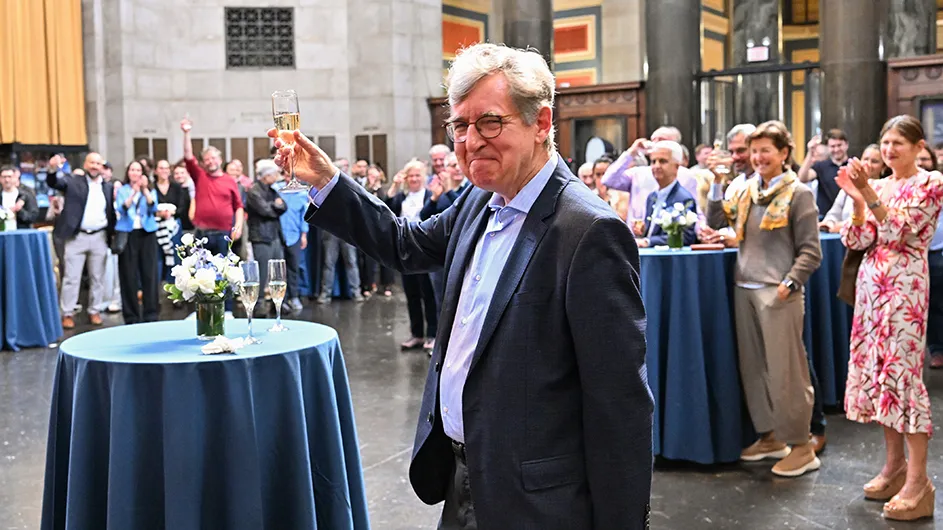
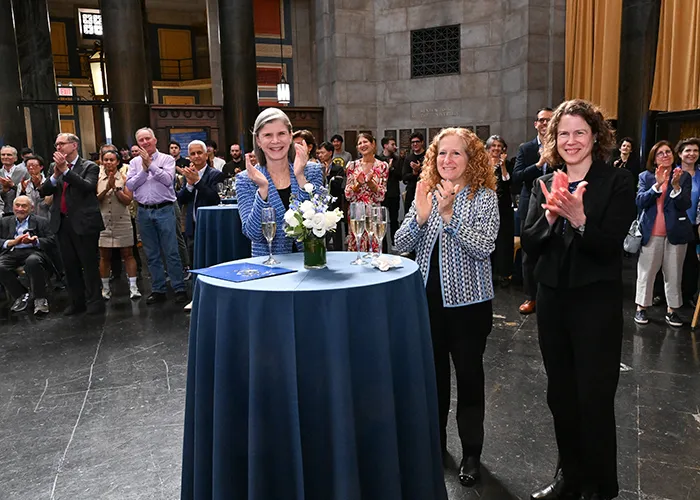
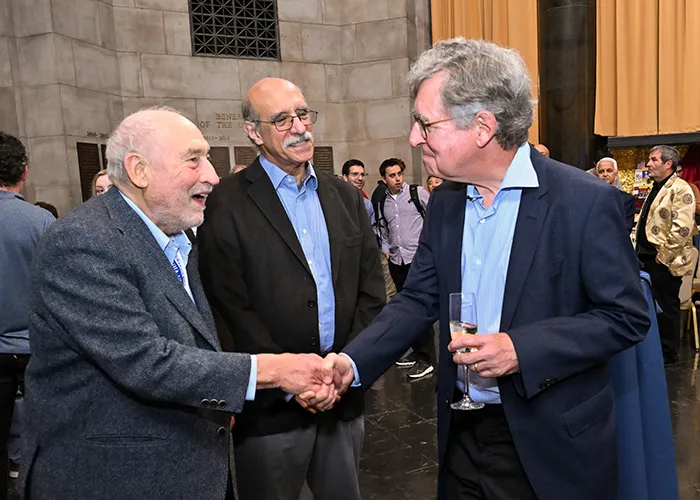
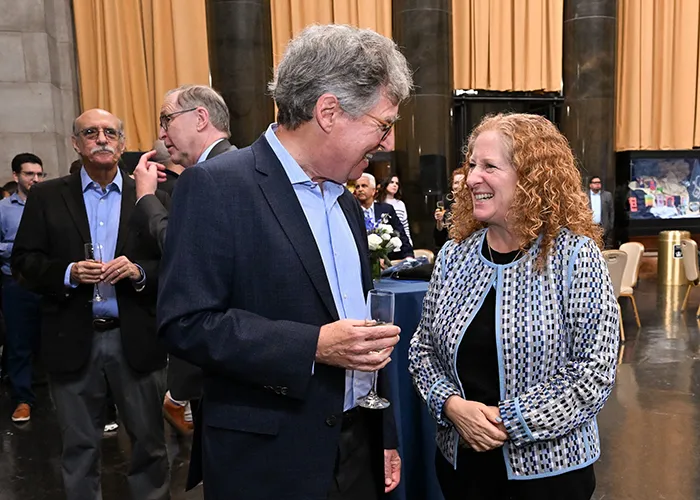
In the Low Library Rotunda on Columbia University’s Morningside campus, surrounded by more than 100 family members, friends, students, University colleagues, and well-wishers, including fellow Nobel laureates Joseph Stiglitz and Martin Chalfie, Michael Woodford, John Bates Clark Professor of Political Economy and recipient of the 2026 Sveriges Riksbank Prize in Economic Sciences in Memory of Alfred Nobel, had an important group to thank.
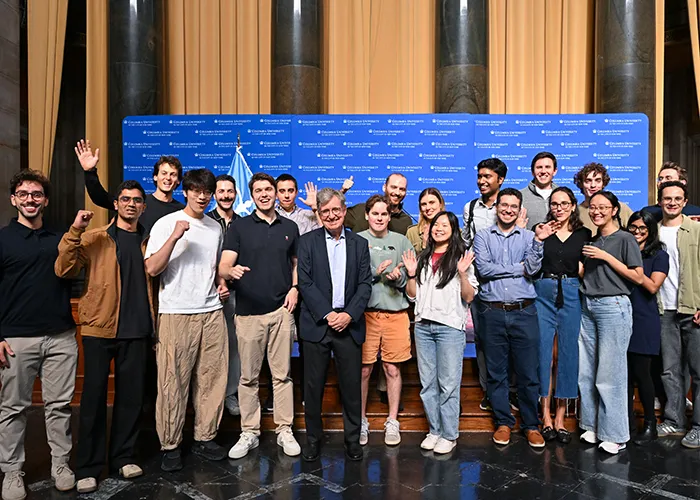
“A number of students of mine are here,” Woodford said with a smile. “A lot of what I have done has only been possible thanks to my students, because it was hard for me to work these things out except by trying to explain them to people and having students who are willing to put up with that. It is essential to the intellectual process, at least in my case. I’ve been gratified that many went on to have distinguished careers and I hope I have some responsibility for that, but, really, I’m grateful just to have had them as students. That’s really been essential to me.”
Woodford shares this year’s prize with Robert E. Hall of Stanford University for their work on the microeconomic foundations of macroeconomic stabilization. His research has reshaped the theoretical foundations of stabilization policy, strengthening the tools policymakers use to respond to economic shocks.
Columbia University President Jennifer L. Mnookin opened the celebration and the champagne toasts by telling Woodford, “this community just said how proud we are of you and how happy we are for you and for all of us,” as thunderous applause filled the rotunda.
“It’s even more notable that the Nobel Memorial Prize in Economic Sciences was only established in 1968, and since that time 16 Columbians have been awarded this prize,” Mnookin said. “So, if you do the rough math, that means Columbians are represented in more than a quarter of the years that the prize has been given, a statistic that cements us as a powerhouse of economics, as if there were any doubt.”
She shared that in her early morning call with Woodford, he was concerned about giving an exam later that day and was already questioning whether the timing of his trip to Stockholm to receive the prize, which falls during the end-of-semester rush, would work.
“It shows you his seriousness of purpose, not just about doing extraordinary work, but also his commitment to this institution and our students,” Mnookin said.
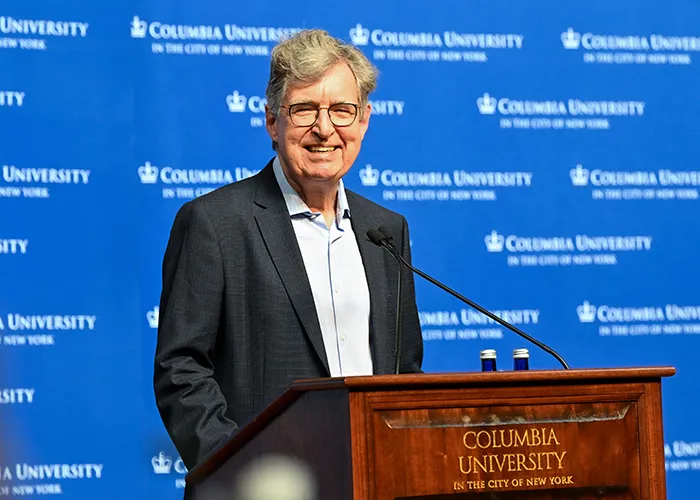
Provost Angela Olinto, who said she had been smiling since early that morning, told Woodford the prize “recognizes the depth, originality, and the impact of your scholarship and the power of sustained inquiry to change a field and impact the whole world.”
Amy Hungerford, dean and executive vice president of the Faculty of Arts and Sciences, called Woodford “the complete package,” citing his research, his teaching, and his service to the University.
“Students flock to your classes because they are hungry for that knowledge in their own lives,” she said. “I’m hearing the consistent theme that your work has helped decision-makers in policy-making, but at its core, it is about individual human beings planning for the stability of their society—individual people making decisions better because they have more information about what might come down the pike. And at that level, I see you centering the human person. ...
“That beautiful layering of your research, your teaching, your citizenship, it comes together around how people can come together to create a stable society where everyone can thrive.”
“Columbia is the kind of place where we are allowed to try ambitious things. ... I’m very grateful to have had such a home.”
Woodford thanked Columbia for hiring him at the start of his career in 1984, “when it was much less obvious what I would accomplish.” After teaching at Princeton and the University of Chicago, he returned to Columbia in 2004.
“I appreciate that Columbia is the kind of place where we are allowed to try ambitious things,” Woodford said. “It is certainly an expensive thing for an institution to do, but I think it is important to our society that there are at least a few institutions that believe that this is worthwhile. I’m very grateful to have had such a home.”
As glasses were raised, Mnookin offered a special toast: “To your present, your future, your Nobel, and to Columbia. Cheers!”