What Can Animals Teach Us About Families?
In her new book, Beth Berkowitz looks at the Bible and rabbinic literature to reimagine the bonds between animals.
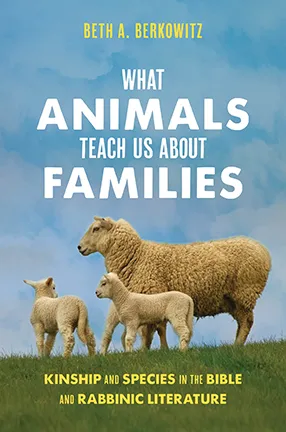
In What Animals Teach Us About Families, Beth Berkowitz, Ingeborg Rennert Professor of Judaic Studies, moves beyond debates about the ethics of animal consumption to focus on animals’ intimate lives. She examines the contribution of religious traditions and sacred texts to contemporary conversations about animals. Reading the four animal family laws of the Bible alongside their rabbinic interpretations from ancient times to today, Berkowitz explores the bonds that animals form with each other, and reimagines family to include new forms of life and alternative modes of kinship.
Humanitarian politics—and biblical law—tend to take for granted that human interests supersede animal interests, and that our moral obligation extends only to avoiding unnecessary suffering, but necessity is determined by humans. What Animals Teach Us About Families looks at animal emotions, animal agency, family diversity, and human response to reconsider the obligations and opportunities the animal family presents.
What was the impetus behind this book?
I’ve long been fascinated by the laws in the Bible about what I call “animal families,” or the parent-child relationship with animals: Do not cook a kid in his mother’s milk (Exodus 23:19, 34:26; Deuteronomy 14:21); Leave a baby with the mother for the first week of life (Exodus 22:29, 22:27); Do not slaughter a parent and child on the same day (Leviticus 22:28); Chase the mother bird away before taking her eggs or chicks (Deuteronomy 22:6-7).
Why is the Bible interested in animal families? What is the nature of its concern with animal kinship? But I was frustrated with the standard line on these laws, which is that they’re meant to foster compassion for animals. Out of respect for the parent-child bond among animals, one refrains from behaviors that violate it. But if compassion is the purpose of these laws, then it seems at best an empty performance, at worst hypocrisy, or simply nonsensical. A Jew must not slaughter an animal mother and the child on the same day, but they can slaughter the child the day after. How is that compassionate? It seems a strange and attenuated lesson in compassion if the recipient in no way experiences it. In this book, I wanted to get to the bottom of these curious laws, and explore their implications for today.
Are there lessons that can be drawn from the book and applied to contemporary society at large, in addition to family?
It was important to me that this book be explicit about its lessons for contemporary society. In past books, I haven’t been very up front about my own positions, or offered suggestions or solutions. I’ve found over the years, though, that readers want to know what I really think and how I see the work’s relevance. For this book, I invited Melissa Hoffman, a rabbi who directs the Center for Jewish Food Ethics, to co-write an epilogue with me that offers concrete steps readers can take to carry on the spirit of the Bible’s animal family laws, even if they’re not exactly following those laws. (One can’t exactly follow laws about sacrifice today!) The biblical and rabbinic materials I discuss in the book affect my own practice, and I wanted to share that with readers.
What books have you read lately that you would recommend, and why?
My Brown University colleague Saul Olyan argues in a recent book, Animal Rights and the Hebrew Bible, that the Bible provides a basis for animal rights. Saul’s book is an excellent model of connecting ancient religious texts to today without distorting them or polemicizing. I’ll pass on a book recommendation Saul gave to me, which is Chloe Dalton’s memoir Raising Hare, in which Dalton recounts her run-in with an abandoned baby hare in the English countryside. After some hesitation, Dalton rescues the “leveret,” as young hares are called, and feeds and raises it. What struck me about Dalton’s story is how respectful she is of the hare’s wildness, even while she’s getting to know its needs and habits intimately. The fine drawings of the hare that begin each chapter do a beautiful job of capturing Dalton’s admiration for the animal and curiosity about it. The book is a how-to for overcoming anthropocentrism.
That’s true also of Carl Safina’s Alfie & Me, in which this great ecologist rescues a baby owl–Alfie–who unexpectedly becomes part of the Safina family menagerie. Both Dalton’s and Safina’s books are as much about how they changed the animals’ lives, as how the animals changed theirs. Both stories take place during the pandemic, which, as devastating as it was, seemed to open up new possibilities for relationships across species.
What’s next on your reading list?
Suzanna Millar, a Bible scholar at the University of Edinburgh, has a book coming out this summer, Animals, Power, and Intersectionality in the Books of Samuel, which I’m excited to read. The Books of Samuel rival Shakespeare in their narrative drama, but Millar is the first to examine the role of animals in them. My own book concludes with an episode from Samuel in which a pair of mother cows pulls the ark back to the Israelites, and I’m particularly interested to see how Millar treats that episode.
A colleague in Morningside Heights, David Carr of Union Theological Seminary, is coming out with a book this fall that I’m eager to read, Unmaking Eden: Genesis and the Domestication of the World. Carr will be exploring the complexities of animal domestication as they play out in Genesis 1-11, a section of the Bible he has written extensively about. Having spoken with David about the book, I know he has an innovative take on animal domestication: It’s not just about humans controlling animals, but also animals controlling us. I’ll be responding to the book in a session at the Society for Biblical Literature in November, and am looking forward to the conversation. This is a great year for books in animal studies and the Bible!
What did you teach in the spring, and what about the fall?
In the spring, I taught Theory of Religion, a seminar required for religion majors and minors. The course introduces students to classic theorists of religion (e.g., Freud, Durkheim, Weber) and contemporary adaptations of those approaches. We talk about what theory is, how scholars use it in religious studies, and how to use it ourselves. It’s a harder task than you might think, since theory is a very amorphous concept. Every time I teach the course, my own understanding of theory evolves. Students develop their own research projects, and it’s always fun to see what they come up with.
Here’s a sampling of the research topics this time around—quasi-religious rituals of soccer in post-war Germany; the role of scent in the Qingming Festival in Shanghai; the emotional intensity of Korean-American church teenage youth retreats; Jewish messianic elements in a work of 1990s Japanese anime; exemptions from religious fasting for people with Type 1 Diabetes; indigenous Hawaiian religious responses to colonization; Islamic law’s application to AI tools; and Japanese Zen Buddhist approaches to military violence in World War II, among other great projects. The students always inspire me with their enthusiasm, and they expose me to a lot of things I’d never learn about otherwise.
I’m on sabbatical in the fall–hurray! My husband, who runs the MFA program in fiction at Brooklyn College, will be on sabbatical too, and our plan is to spend the time in Montreal.
What are you working on now?
I’ll be writing the entry on “halakhah” (Jewish law) for the forthcoming Oxford Handbook of Rabbinic Literature. My summer project is to figure out how to organize the discussion and what to include. Another project I’ve got in the pipeline is for an issue of the journal Modern Criminal Law Review, which will be devoted to ancient criminal law. My first book, Execution and Invention, was about early rabbinic criminal law, so the piece will take me back to material I haven’t worked on in a while.
I’ll be teaming up with photographer Marc Asnin, whose book Final Words features photographs of men and women executed in Texas, along with a transcription of their last words. We’ll be looking together at last words in Jewish antiquity and today, comparing them to see what we can learn about execution practices across time. In the long term, I hope to undertake a wide-ranging treatment of the relationships and intersections between Jews and animals throughout Jewish history.
Which three scholars/writers, dead or alive, would you invite to a dinner party, and why?
Continuing with the animal studies theme, I’d invite–of course, to a vegan dinner party!–Carol Adams, Jacques Derrida, and Peter Singer. They embody for me three major streams in modern thought about animals—feminist, continental, and analytic. I’d want to hear them reflect on what it means to be human in 2026.