Astronomers Discover the Earliest Known Flickering Quasar
When the universe was just 850 million years old, this voracious black hole was already surprisingly mature, a new study finds.
This story was adapted from an article on MIT News.
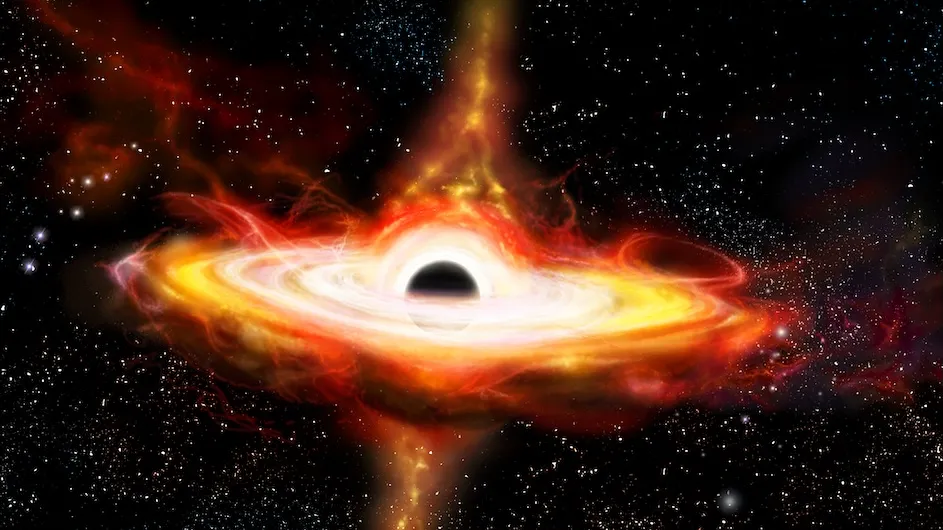
A supermassive black hole lies at the heart of every galaxy, including the Milky Way. When a black hole is active, it pulls material in as a whirpool of high-temperature gas and dust. As this cosmic material piles up and falls onto a black hole, it lights up its vicinity, radiating a huge amount of energy.
The most energetic supermassive black holes are known as quasars, and they are some of the most active and luminous objects in the universe. These voracious systems take in so much material that the energy they emit can outshine all the light in the surrounding galaxy. The pattern of light from a quasar can give scientists clues to how active supermassive black holes shape the galaxies around them.
Now astronomers at MIT, Columbia University, and other institutions have detected a quasar flickering from the very early universe. The scientists traced the light from the quasar back to the “cosmic dawn,” just 850 million years after the Big Bang. The discovery represents the earliest flickering quasar detected to date.
“Flickering caused by gas falling into a supermassive black hole is one of the best ways to study the mechanisms by which black holes grow in size—yet this has been nearly impossible to do so far for the youngest quasars found in the early universe,” said Kishalay De, an assistant professor of astronomy at Columbia University.
“Although there have been a lot of quasars found in the cosmic dawn, this is the first time we actually see one flickering,” said Gene Leung, a postdoc in the MIT Kavli Institute for Astrophysics and Space Research.
The quasar’s flicker enabled the researchers to determine that, surprisingly, the ancient quasar’s whirlpool of gas and dust, known as an accretion disk, resembled a flat pancake, similar in shape to that of more modern-day quasars.
Their findings add to a longstanding mystery in cosmology: Why do supermassive black holes exist so early in the universe’s history? Physicists have assumed that a flat accretion disk reflects a relatively mature black hole that is in a calm and stable state. Black holes that are just starting to form, like those in the very early universe, should be more unsettled systems, with accretion disks that appear more puffy and chaotic.
The flat accretion disk around this very early quasar heightens the mystery of how supermassive black holes can grow and mature in a very short amount of cosmic time.
“I think what this suggests is that all the messy, very rapid growth phases that we expect all black holes to go through at some point happen very, very early on, before we see them as these very bright luminous quasars,” said Anna-Christina Eilers, assistant professor of physics at MIT. “That’s the picture that’s emerging.”
De, Eilers, Leung, and their colleagues report their results in a paper appearing today in Nature Astronomy.
The team ultimately found a flicker in data collected by NASA’s Near-Earth Object Wide-field Infrared Survey Explorer (NEOWISE) mission—a space-based infrared telescope that scanned the entire sky over a total of about 14 years. De, who was formerly a postdoc at MIT, had launched a project to re-process archival data from NEOWISE. Based on the re-processed data, the team unearthed a signal, from just 850 million years after the Big Bang, which was confirmed to be the earliest flickering quasar.
Using NEOWISE data, the team analyzed the quasar’s flicker to determine the shape of the accretion disk surrounding the central supermassive black hole. They found that the disk is surprisingly thin and flat—a structure that astronomers mostly see around nearby, older black holes, that have had much longer to settle and mature.
The team hopes to peer even further back in cosmic time to catch a quasar’s earlier, premature development. Then, scientists can start to piece together the conditions that brewed up the first supermassive black holes.
This research was supported in part by NASA.
“The NEOWISE data have opened up an entirely new field of studying quasar variability in the early universe, and sets the benchmark for similar large-scale studies that will soon be possible with upcoming ground and space-based infrared survey telescopes," De said.