How Do Order and Collective Behavior Emerge From Chaos?
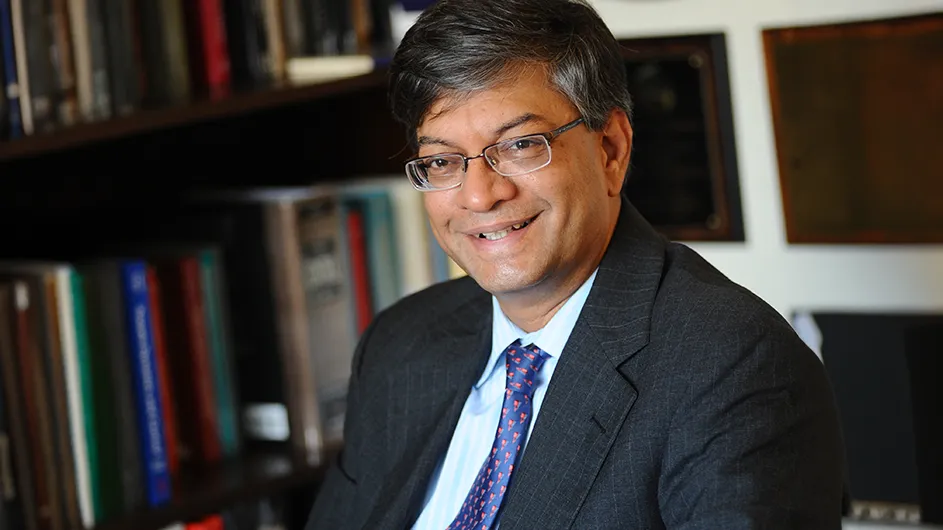
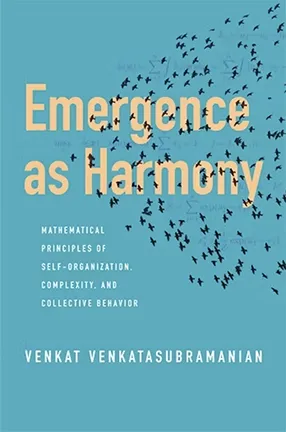
Venkat Venkatasubramanian explores this and related questions in his book, Emergence as Harmony.
Emergent phenomena arise when complex systems exhibit properties that are absent in their constituent parts. They span scales and disciplines, from the collective intelligence of bird flocks in biology to the patterns of inequality and segregation in economics and sociology. Do these disparate examples share unifying principles? How do order and collective behavior emerge from chaos through self-organization?
In Emergence as Harmony, Venkat Venkatasubramanian, Samuel Ruben-Peter G. Viele Professor of Engineering, shows that a novel paradigm—statistical teleodynamics—can explain emergence. This unified theory represents a transdisciplinary synthesis integrating concepts from various fields. Venkatasubramanian formulates a mathematical framework for understanding emergent phenomena across domains, spanning physics, biology, ecology, economics, sociology, and artificial intelligence. He demonstrates that the organizational principle of emergent systems is maximizing harmony, which he examines various ways to measure. Emergence as Harmony offers new answers to fundamental questions on topics ranging from income inequality to large language models and neural networks.
How did this book come about?
In a sense, this book took me more than 40 years to write. The question behind it first occurred to me in 1982–83, when I was a PhD student working on statistical mechanics. I was using statistical-mechanical methods to understand how the microscopic behavior of molecules gives rise to macroscopic properties of matter. At the same time, I had become fascinated by artificial intelligence and neural networks. I began wondering: Could there be something like statistical mechanics for a large collection of intelligent, goal-driven agents?
I could not find such a general framework, so I began thinking about how to construct one. I had no idea that the question would follow me for most of my professional career. The first major breakthrough came about 20 years later, when I was studying self-organizing complex networks. That work helped me understand how microscopic interactions, environmental constraints, and trade-offs between competing objectives can produce an organized macroscopic structure. This eventually led me to economics, Adam Smith’s “invisible hand,” entropy, game theory, and the question of income inequality.
Over time, these ideas converged into what I call statistical teleodynamics—a bottom-up, micro-to-macro framework for understanding the collective behavior of large numbers of competing and cooperating goal-driven agents. The word teleodynamics is important. Thermodynamics deals with systems such as molecules that do not have goals. Teleodynamics extends the statistical-mechanical way of thinking by combining it with key concepts from game theory, applying them to agents with varying degrees of agency, from bacteria and birds to human beings and artificial intelligence.
What surprised me was that the same mathematical structure seemed to appear in phenomena that, superficially, have almost nothing in common—bacterial chemotaxis, ant colonies, bird flocks, ecological communities, social segregation, income inequality, neural networks, and other complex systems. Emergence as Harmony is my attempt to bring those results together, and ask whether a common mathematical principle underlies them.
Is the book geared toward the general reader or a specialized audience not intimidated by mathematics?
I have tried to write it for both. The basic question of the book is very simple to state: How does the whole acquire properties that the individual parts do not possess? An individual bird does not make a flock. An individual person does not create an economy. A neuron by itself does not produce intelligence. Yet organized collective behavior emerges when very large numbers of such entities interact. A general reader should be able to follow that story without working through the mathematics.
At the same time, the book’s principal contribution is a mathematical theory, so I did not want to remove the mathematics entirely and replace it with a metaphor. I have used as much mathematics as I thought necessary, while deliberately avoiding the highly formal style of axioms, lemmas, and proofs.
So I hope there are really two books within the book: A general reader can follow the conceptual argument and the examples, while a mathematically inclined reader can go deeper into the equations and see precisely how the theory works.
Can you give some examples from the book of how statistical teleodynamics can help solve issues such as income inequality?
Income inequality is actually one of the problems that played a central role in the development of the theory. The conventional debate often begins by asking, how much inequality should society permit? Statistical teleodynamics allows us to first ask a somewhat different question: What income distribution would emerge naturally in an ideal competitive system in which individuals pursue their own interests, but must also operate under collective constraints?
One of the surprising insights that emerged from my work is that entropy can be interpreted not merely as “disorder,” as it is often popularly described, but as a measure of fairness in a distribution. Using that idea, I showed that under an idealized set of free-market assumptions, the fairest equilibrium distribution of income is not one in which everyone has exactly the same income. It is a log-normal distribution. So some inequality emerges naturally, even in an ideal system. Scandinavia comes very close to the ideal society predicted by my theory. People might be surprised to learn that between 1945 and 1975, the U.S. also had a Scandinavian-like fair distribution of income.
The game-theoretic formulation led to another important idea. At equilibrium, competing agents reach what we call an arbitrage equilibrium, in which their effective utilities become equal. Roughly speaking, if one group had a systematically better opportunity available, people would have an incentive to move toward that opportunity. The redistribution continues until those advantages have been arbitraged away. This gives us a mathematical way of separating inequality from unfair inequality.
That distinction is important. The theory does not say that every observed income distribution is fair, nor does it tell society what its ethical values ought to be. Instead, the theory gives us an idealized benchmark against which reality can be compared. Deviations can then lead us to ask about barriers to mobility, unequal opportunity, market power, discrimination, inherited advantages, and other mechanisms that prevent the system from reaching a fair equilibrium.
So I see statistical teleodynamics as complementing, rather than replacing, moral and political discussions about inequality. My theory can help us understand what distributions particular rules generate. Society must still decide what rules it considers desirable.
Any good books you’ve read lately that you would recommend, and why?
I read very broadly, often outside my immediate research area. Recently, three different books—or, in one case, a very substantial series of books—have occupied me.
The first is Jagdish Mehra’s monumental, six-volume history of the development of quantum mechanics, totaling about 2,500 pages. I have always been fascinated not simply by finished scientific theories, but by how great theories actually come into being—the wrong turns, competing ideas, personalities, arguments, and flashes of insight that eventually produce a conceptual revolution. The discovery process enthralls me. Quantum mechanics is perhaps the greatest example of this in modern science. Reading its development in such detail gives one a very different appreciation of what scientific discovery really looks like. This is particularly timely, as in 2025-26 we are celebrating the centenary of quantum mechanics. Also, I find that the conceptual problems faced at the birth of quantum mechanics are like those we face today in developing a science of large language models.
The second is Herbert Simon's The Sciences of the Artificial. Simon was one of the great intellectuals of the 20th century, with extraordinary contributions to artificial intelligence, economics, cognitive science, organizations, and complex systems. What I particularly admire is his ability to move across disciplinary boundaries, while continually asking fundamental questions about design, rationality, and complexity. Those are questions that have also interested me throughout my career.
The third book is The Collected Works of Ramana Maharshi, edited by Arthur Osborne. I have also read this in its original language, Tamil. That is obviously a very different kind of reading. Maharshi’s inquiry into the nature of the self—his deceptively simple question, Who am I?—approaches some of the deepest questions of consciousness and existence from an entirely different direction. I am stunned by the insights of Hindu seers into the nature of reality and consciousness gained thousands of years ago. I find Hindu theology and philosophy helpful in my grappling with questions about whether AI can achieve consciousness. Their insights are surprisingly modern and relevant today.
I suppose these three choices say something about my reading habits. I enjoy moving among science, artificial intelligence, history, philosophy, and questions about the nature of the mind. I find that ideas from one area often illuminate another in completely unexpected ways. My theory of emergence, for example, is a synthesis integrating concepts and techniques from fields such as statistical mechanics, game theory, economics, biology, systems engineering, and AI.
What’s next on your reading list?
There are three books on my immediate reading list, and, interestingly, all three approach questions of emergence and complexity from rather different directions. The first is Ernst Mayr’s The Growth of Biological Thought: Diversity, Evolution, and Inheritance. Having immersed myself in the historical development of quantum mechanics, I would now like to do something similar with biology. I am particularly interested in how the ideas of species, evolution, and inheritance developed historically, and how Darwinian thinking changed our understanding of how complex order can emerge without being centrally designed.
The second is Daniel Dennett’s From Bacteria to Bach and Back. Dennett asks a question closely related to one that fascinates me: How can processes that are individually without understanding eventually produce minds capable of understanding? His path from biological evolution to culture, consciousness, and intelligence naturally intersects with my own interests in emergence and, more recently, artificial intelligence.
The third book is Nexus: A Brief History of Information Networks From the Stone Age to AI by Yuval Noah Harari. I am interested in its broad historical perspective on how information networks have shaped human societies, and how that long history leads into the present age of artificial intelligence. Information is obviously central to both biological and artificial systems, but networks also raise the quintessential problem of emergence: How interactions among many individuals produce institutions, collective knowledge, coordinated behavior, and, sometimes, unexpected consequences at the societal level.
In a way, the three books approach related questions at three different levels: Mayr asks how biological complexity evolves; Dennett asks how mind and intelligence emerge; and Harari asks how information and networks organize societies and ultimately lead us to AI. Those questions are so close to the ones that have occupied me throughout my career.
What are you working on now?
I am developing a mathematical theory of large language models (LLMs). The current state of LLMs reminds me of that of steam engines at the dawn of the Industrial Revolution in the 17th century. Engineers discovered steam power and put it to all kinds of uses before they fully understood what was going on. It took about 150 years for the science of steam engines to develop, namely, statistical thermodynamics. At the dawn of the automated cognition (i.e., AI) revolution, we are in a similar state—many applications of LLMs, but limited understanding!
So just as statistical thermodynamics is the science of steam engines, what is the corresponding science of LLMs? This is the question I am trying to address. LLMs present a remarkable scientific situation. We know how to build them, and that they work astonishingly well, but we still lack a satisfactory theoretical understanding of why they work, and how their enormous number of microscopic parameters collectively produce concepts, associations, reasoning, and coherent language.
The analogy that interests me is statistical mechanics. A gas contains something like (10^{23}) molecules, and it would be hopeless to track them individually. Yet statistical mechanics allows us to describe the collective system using a relatively small number of concepts, such as temperature, pressure, entropy, phases, and phase transitions.
Can we develop an analogous theory for large language models? Emergence as Harmony already applies statistical teleodynamics to deep neural networks. I am now trying to push those ideas much further, and develop a more fundamental theory of how knowledge and meaning are organized inside large language models.
I am interested in whether there can be something like a statistical mechanics of the mind. That question has brought me almost full circle to the question I first asked as a graduate student in 1982.
What are you teaching this fall and in the spring?
This fall, I am teaching Process Dynamics and Control to undergraduate students. It is one of the foundational subjects in chemical engineering: How do we understand the dynamic behavior of complex processes, and how do we design feedback systems that make these processes behave safely and optimally?
In the spring, I will teach Artificial Intelligence in Chemical Engineering to graduate students. This is a course I have taught for 40 years, starting in 1986. As the field of AI evolved, this course also evolved from its symbolic-logic origins to the modern machine-learning framework. The contrast between the two courses is compelling. Process control represents a mature field with a beautiful and well-developed mathematical foundation, whereas AI is developing at an extraordinary speed, and many of its fundamental theoretical questions remain open. Teaching both is a nice reminder of how engineering evolves: Today’s frontier eventually becomes tomorrow’s foundation.
Which three thinkers/scholars, dead or alive, would you invite to a dinner party, and why?
Ludwig Boltzmann, Charles Darwin, and Adam Smith. In a way, all three discovered profound principles of emergence, although in completely different domains.
Boltzmann would be my first choice because he helped develop statistical mechanics, and showed how macroscopic properties can emerge from the collective behavior of an enormous number of microscopic particles. His work fundamentally changed the way we understand the relationship between the parts and the whole, and it has deeply influenced my own thinking. In fact, I visited his grave in Vienna last year to pay my respects. My academic lineage also goes back to him.
My second guest would be Charles Darwin. Evolution by natural selection is perhaps the most spectacular theory of emergence ever conceived. Enormously complex and beautifully adapted biological structures can arise through relatively simple local mechanisms, without anyone designing the final outcome. I would be fascinated to hear Darwin and Boltzmann compare their views of how order and complexity arise from the bottom up.
And my third guest would be Adam Smith. His invisible hand is another remarkable insight into emergence: Under appropriate conditions, individuals pursuing their own interests can collectively generate an organized outcome that no individual planned. Statistical teleodynamics attempts, among other things, to put a mathematical structure beneath that intuition, and to connect Boltzmann, Darwin, and Smith mathematically.
What makes the imaginary dinner especially appealing is that Boltzmann, Darwin, and Smith were studying very different things—molecules, living organisms, and human societies—but all three were ultimately wrestling with versions of the same profound question: How can organized macroscopic order emerge from the decentralized interactions of many individual entities?
That is also the central question of Emergence as Harmony. So I think I would mostly listen.