See ‘Drawn by a Columbian’ at the Rare Book & Manuscript Library
The exhibition features the work of famous artists and cartoonists created while they were students at the University.
Columbia has produced a number of significant cartoonists and artists who got their start illustrating work for Columbia student publications. Drawn by a Columbian is an exhibition on view at the Rare Book & Manuscript Library’s Chang Octagon Room through December 14, 2026, which showcases the early works and artistic legacy of several of these well-known cartoonists and artists.
Columbia News discussed the exhibition with its co-curators, University Archivist Jocelyn Wilk and Karen L. Green, curator for comics and cartoons.
How did this exhibition come about?
Jocelyn Wilk: When Ed Koren died in 2023, staff from Columbia College Today asked me to look for cartoons he drew for Jester to publish in a tribute article. Jester was a student humor magazine that ran from 1901 through 1997, with a few attempts to revive it until it ceased publication in 2019. I was familiar with Koren's work in The New Yorker, but at that time, I had no idea he had been at Columbia nor that he had worked on Jester. As I went through issues looking for content, I was blown away by how much he contributed, and how many of the cartoons he drew in the 1950s still made me laugh. I knew we had the work of other alumni who went on to important art/cartooning careers, and thought there was probably enough on hand that it might make for a fun exhibit. So I asked Karen L. Green to co-curate this exhibition with me.
Who are the artists in the show, and which Columbia publications did they contribute work to when they were students?
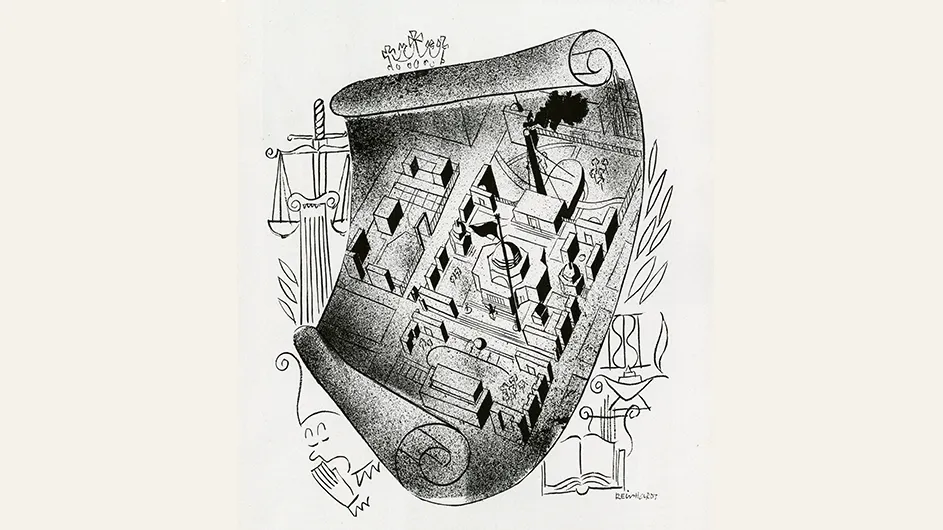
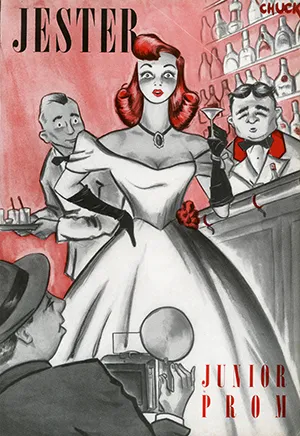
JW: The exhibit spotlights the visuals done by four Columbia alumni artists: Charles Alston (CC 1929, TC 1931), Ad Reinhardt (CC 1935), Charles Saxon (CC 1940), and Edward Koren (CC 1957). They all contributed artwork to the Columbia Jester, with Reinhardt, Saxon, and Koren also taking on editorial positions at the magazine. In addition to Jester, Alston drew for a short-lived literary publication called Morningside and the Columbian yearbook, which started in the 19th century and still exists. Reinhardt drew images for another literary publication, the Columbia Review, which was founded in 1815 as the first college literary magazine in the country, and is also still around. Reinhardt produced as well a cover for a stand-alone Varsity Show (founded in 1894 and still going strong) program, and contributed most of the artwork for the 1933 Columbian.
How did these artists then go on to become famous in their careers?
Karen L. Green: All four came to Columbia with some artistic experience and took formal art classes both at Columbia and afterwards. Alston and Reinhardt gained further experience working on Works Progress Administration projects; Alston’s murals are still on display in Harlem Hospital. Reinhardt ultimately changed his artistic style from his distinctive abstract look to a reduced color palette of blue, red, and black, but he died young at age 53, just as his artistic career was taking off. Both Alston and Reinhardt ultimately produced noted artworks, which have subsequently been displayed in various galleries and museums in New York and beyond.
After graduating from Columbia, Saxon and Koren had prominent careers drawing cartoons for The New Yorker. Their styles were so recognizable that, in addition to a myriad of other magazines, their work was heavily used in advertising. Saxon, in particular, became to The New Yorker what Peter Arno had been to the magazine 20 to 30 years earlier: the chronicler of a certain slice of society.
How did you decide which works/artists to include in the exhibition?
JW: It was a bit of a treasure hunt. Some work had been previously identified and scanned, while other pieces were just waiting to be discovered. Based on the years these individuals were at Columbia, we literally turned the pages of every publication we knew they worked on—especially Jester issues—to find attributed artwork and cartoons. We were also helped by finding mentions of some of their work in articles found in the Spectator Digital Archive.
I took photos of the artwork, and then Karen and I went through the options together, picking the pieces we thought would work best. The choices continued to be refined as content was scanned, and we began to see patterns. It also came down to how much space is in a display case. There are plenty of pieces we would have liked to show off, but we just don’t have room to display it all. Though, in the end, I think we have a good representation of the work these four individuals produced while students and as alumni.
Do you have a favorite work/s in the show, and if so, why?
JW: The content of this exhibit is wonderful, but there is a Reinhardt Jester cover depicting a student studying by candlelight, which I think is just stunning—colorful and distinctive. I also love that I find myself giggling at the various Koren and Saxon cartoons on display.
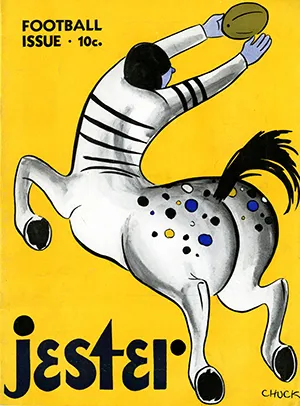
KLG: I’m fond of Saxon’s Jester cover with the football-playing centaur, and vastly prefer the original blue background to the yellow chosen for print. But Reinhardt’s student work was a true revelation; I’d be hard-pressed to identify a single favorite!
Anything you want to add?
KLG: We also hold a significant amount of Saxon’s original art, donated by his widow.