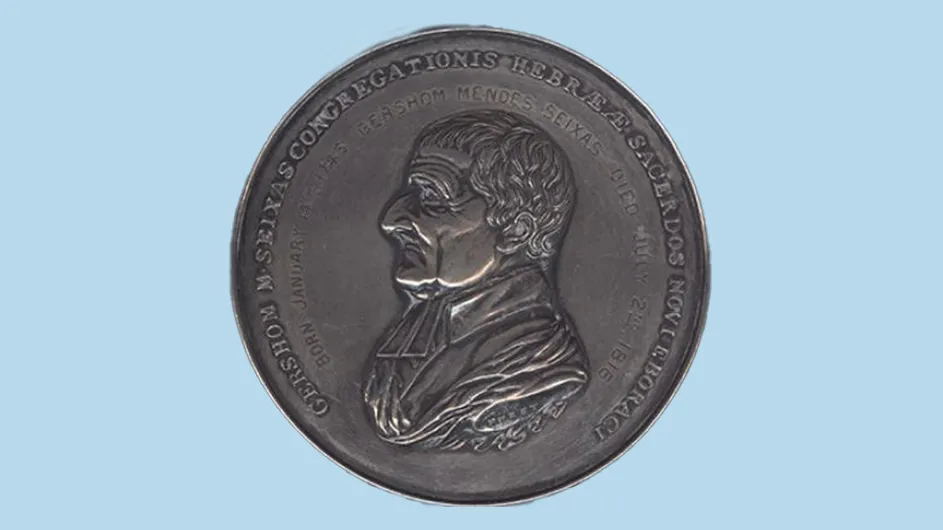
The Shearith Israel congregation was the center of cultural life for the city’s tight-knit Jewish community, which at the time numbered fewer than 300 people. As its religious leader, he developed friendships with the ministers of other denominations, particularly the Episcopal clergy, many of whom visited the synagogue and invited Seixas to address their congregations.
In 1776, when the British occupied New York City during the Revolutionary War, Seixas chose to close the synagogue and leave the city rather than give allegiance to King George III. He packed up prayer books and Torah scrolls and moved first to Connecticut and then to Philadelphia, where he led Congregation Mikveh Israel. At its dedication, he invoked God’s blessing upon “the members of these states in Congress assembled and on His Excellency George Washington, commander general of these Colonies.” Returning to New York in 1784, Seixas reopened Shearith Israel and, five years later, he and other religious leaders participated in the nation's first inauguration.
Columbia/Barnard Hillel, The Kraft Center for Jewish Student Life created the Seixas Award in 2001, bestowing it annually upon “those who have made outstanding contributions to Jewish life at Columbia University and Barnard College.” The medal, which bears Seixas’ likeness, is a copy of an early 19th-century portrait medal acquired by the University in 1933.
Last year, the award was given to Ronald O. Perelman at a ceremony in Low Rotunda in recognition of his donation to support the construction of Columbia Business School’s new facilities on the Manhattanville campus. One of the school’s two new buildings will be named for him.
Previous honorees have included the author Herman Wouk (CC’34), former Barnard President Judith Shapiro (GSAS’72), former FCC Chairman Julius Genachowski (CC’85), and the former Columbia University presidents Michael I. Sovern (CC’53, Law’55) and George E. Rupp. The 2017 awardee will be recognized at a dinner on May 10.
When Seixas died in 1816, a memorial tablet erected by his congregation described him as “the Patriot Jewish minister of the American Revolution.”