If ‘Rosemary’s Baby’ Made You Scream, Read This
In her new book, Eleanor Johnson makes frightening connections between horror films and feminism.
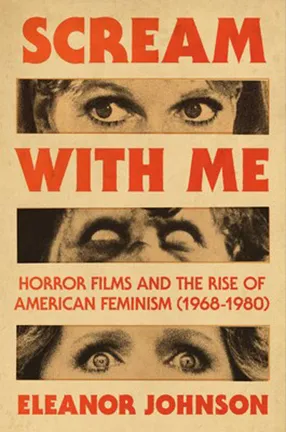
Scream With Me by Eleanor Johnson, a professor of English and comparative literature, sheds light on how classic horror films demonstrate larger cultural attitudes about women’s rights, bodily autonomy, and more. In May 2022, as the Supreme Court reversed Roe v. Wade, Johnson’s students were examining the 1968 film Rosemary’s Baby. She had a sudden epiphany: Horror cinema engages directly with the politics of women’s rights.
Johnson reveals how classic films like Rosemary’s Baby, The Exorcist, and The Shining expose and critique issues of reproductive control, domestic violence, and patriarchal oppression. Scream With Me weaves these iconic films into the fabric of American feminism, showing that true horror often lies not in the supernatural, but in the familiar confines of the home, exposing the deep fears and realities of women’s lives. While the book is a celebration of seminal horror movies, Scream With Me also offers timely recognition of how this genre shapes and reflects cultural dialogues about gender and power.
Johnson discusses the book with Columbia News, along with what she’s reading and teaching now, her current projects, and who she would invite to a dream dinner party.
Why did you write this book?
I wrote Scream With Me because in the spring of 2022, I was teaching my History of Horror class, and I gave a lecture on the film Rosemary’s Baby. I taught it as a horror film about reproductive violence and coercion, and a parable about the dangers of denying women their reproductive autonomy. The next day, the Supreme Court leaked its decision to reverse Roe v. Wade. I had a sabbatical after that, and decided to explore the possibility of doing a book about horror in relation to reproductive rights. As I researched, the scope of the book expanded to include women’s rights writ large, though reproductive rights are still at the book’s core.
Can you give some examples from the book of how horror films expose and critique these sorts of issues?
In Rosemary’s Baby, Rosemary (Mia Farrow) has been raped and impregnated by Satan. She doesn't know this, but her witchy neighbors and abusive husband do know it. So she is reproductively coerced by them into giving birth to the antichrist. This, of course, is a kind of limit case for being anti-abortion: Even the most Christian and notionally anti-abortion person in the world would have to root for Rosemary to terminate that pregnancy, since it was with the antichrist. So the film performs a meditation on the absolute limit of being against abortion, and makes clear that reproductive coercion is, in itself, Satanic.
To turn to another film, The Exorcist shows how a violent, controlling male demon in a household can terrorize a woman and her child. The iconic scene of Chris (Ellen Burstyn) appearing to Father Damien in the film highlights the iconography of the domestic abuse victim in a time period that almost totally lacked a vocabulary for describing such a thing: She wears a trench coat, a head scarf, and big dark sunglasses to cover facial bruising.
What books have you read lately that you would recommend, and why?
Everyone Knows Your Mother Is a Witch by Rivka Galchen, Down Girl by Kate Manne, and Girl on Girl by Sophie Gilbert. Together, these three works give a nice presentation of misogyny in history and in modern American culture. The first is a novel; the latter two are nonfiction social philosophy.
What’s next on your reading list?
The B-list novels of Mary Shelley; I’m in the early stages of drafting a new book about Mary Shelley, so I have to read everything she wrote!
What are you working on now?
I’m working on edits of a new book forthcoming in fall 2026 about depictions of monstrous women in Western culture going back to ancient Mesopotamia, and I’m drafting the book I mentioned above, about Mary Shelley and Frankenstein. Both are concerned with the demonization of women and with reproductive violence, loss, and coercion.
What are you teaching this semester, and in the spring?
This semester I'm teaching Literature Humanities and the History of American Horror Cinema; in the spring, it’s Canterbury Tales and Lit Hum. Next year I think I’m going to teach a class about zombies and the undead throughout history, going back at least to ancient Rome.
Which three writers, dead or alive, would you invite to a dinner party, and why?
St. Augustine, Mary Shelley, and Virginia Woolf. I love them all, and I think they’d have a fascinating discussion about what it means to write about oneself, and how best to do it.