Astronomers Discover a Superheated Star Factory in the Early Universe
The discovery indicates how galaxies could have grown quickly when the universe was very young, solving a long-standing puzzle.
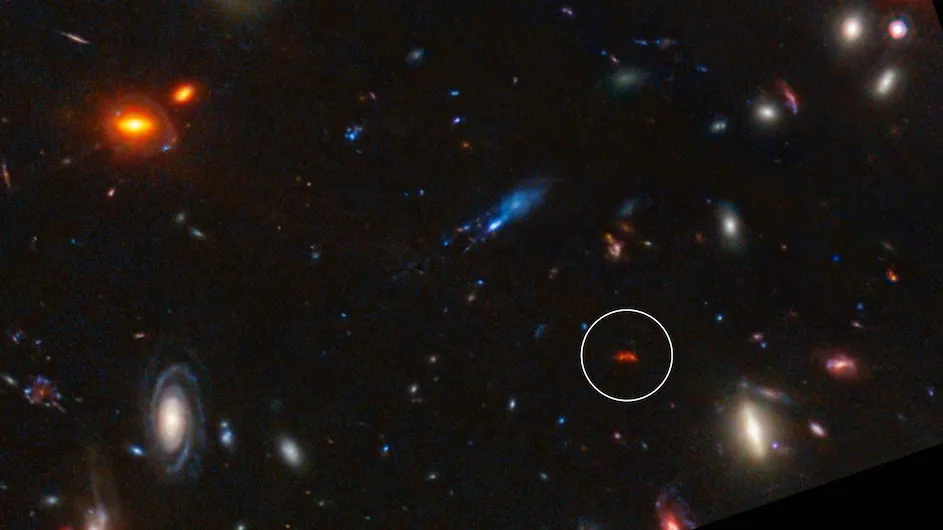
The first generations of stars formed under conditions very different from any we can see in the nearby universe today. Astronomers are studying these differences using powerful telescopes that can detect galaxies so far away their light has taken billions of years to reach us.
Now, an international team of astronomers led by Tom Bakx at Chalmers University of Technology in Gothenburg, Sweden, has measured the temperature of one of the most distant known star factories. The galaxy, known as Y1, is so far away that its light has taken more than 13 billion years to reach us.
Postdoc Laura Sommovigo, who joined Columbia in September, is a co-author on the research.
“We’re looking back to a time when the universe was making stars much faster than today. Previous observations revealed the presence of dust in this galaxy, making it the furthest away we’ve ever directly detected light from glowing dust. That made us suspect that this galaxy might be running a different, superheated kind of star factory. To be sure, we set out to measure its temperature,” said Bakx.
“Our previous views of these galaxies from telescopes like James Webb and Hubble relied only on rest-frame UV light, which is a bit like trying to estimate how big a city is from a night-time photograph: You only see the buildings with their lights on,” Sommovigo said. “For this paper, we looked at these galaxies with millimeter and submillimeter telescopes, which is like switching to an infrared camera: Suddenly you can see all the other buildings that are dark but still full of people. These instruments reveal the dust-enshrouded stars hidden from our UV view, giving a much fuller picture of how massive and evolved these early galaxies really are.”
Stars like our Sun are forged in huge, dense clouds of gas in space. The Orion Nebula and the Carina Nebula are two examples of such star factories. They shine brightly in the night sky, powered by their youngest and most massive stars, which light up clouds of gas and dust in many different colors.
At wavelengths longer than the human eye can see, star factories shine brightly thanks to huge numbers of tiny grains of cosmic dust, heated by starlight.
To be able to probe the galaxy's temperature, the scientists needed the superior sensitivity of ALMA, one of the world’s largest telescopes. ALMA’s dry, high-altitude location made it possible to image the galaxy in just the right color, at a wavelength of 0.44 millimeters using its Band 9 instrument.
“At wavelengths like this, the galaxy is lit up by billowing clouds of glowing dust grains. When we saw how bright this galaxy shines compared to other wavelengths, we immediately knew we were looking at something truly special,” Bakx said.
The detection showed the galaxy’s dust glowing at a temperature of 90 Kelvin, around -180 degrees Celsius.
“For me, this result feels like closing a personal circle. My very first paper in 2020 suggested that dust in some of the earliest galaxies might be much hotter than expected. At the time, this idea met with a bit of skepticism,” said Sommovigo.
“After years of work with Tom and our collaborators, we’ve been able to confirm that hot dust really is present in at least some galaxies in the very early Universe,” Sommovigo said. “This means that a large fraction of their light actually shines in the infrared—beyond the reach of telescopes like the James Webb and Hubble space telescopes that first discovered these galaxies in the ultraviolet—so we may be underestimating how massive and evolved they already are at Cosmic Dawn.”
This news article was adapted from a press release by Chalmers University of Technology. Read more about the news on their website.