A Book About the Interplay Among Jewishness, Gender, and Animality
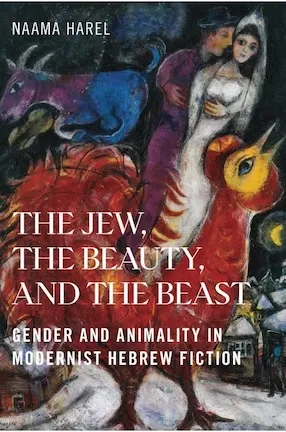
Naama Harel explores this triangular connection in The Jew, the Beauty, and the Beast.

Jews, women, and animals have been notoriously considered in Western thought as antithetical to the “civilized,” and therefore parallel. The trope of the womanized Jewish man has been widely recognized as a staple in otherizing portrayals of European Jews, as well as their self-perception. Similarly, ecofeminist critique has addressed the ubiquitous depiction of the animalized woman throughout history. Yet, the interconnection between the effeminization of Jews and the animalization of women has been overlooked.
The Jew, the Beauty, and the Beast by Naama Harel, a professor in the Department of Middle Eastern, South Asian, and African Studies, critically explores the tangled interplay among Jewishness, gender, and animality, and its manifestation in modernist Hebrew fiction. Through analysis and close readings, the effeminate Jew is examined vis-à-vis the animalized woman. Intertwining theoretical frameworks of posthumanism and animal studies with established scholarship of Hebrew literature, Jewish studies, and gender studies, Harel offers new Hebrew literary historiography and innovative perspectives on canonical works by Shmuel Yosef Agnon, Devorah Baron, Micha Yosef Berdichevsky, Yosef Haim Brenner, Uri Nissan Gnessin, and David Vogel.
Haarel talks about the book with Columbia News, along with the best book she ever received as a child, and her favorite book that no one else knows about.
How did this book come about?
As my ongoing scholarship is at the intersection of modern Jewish literature and human-animal studies, this book seeks to synthesize these two disciplines. The topos of the womanized Jewish man has become a staple in otherizing portrayals of Jews, and also occupied a central position in the self-perception of European Jews. Likewise, the emerging critique of the androcentric underpinnings of the linked oppression and objectification of women and animals has significantly increased with the rise of ecofeminism. However, the interconnection between the effeminization of Jewish men and women’s animalization has been largely overlooked. In this book, I thus aim to fill this lacuna.
Can you give some examples from the book of the interplay among Jewishness, gender, and animality, and its manifestation in modernist Hebrew fiction?
Hunting is considered a noble masculine pursuit in Western culture, and notorious representations of women as prey to be hunted by men are ubiquitous. Due to the Jewish anti-hunting stance, in modernist Hebrew literature, the counter paradigm (which is likewise misogynistic) of women—and gentile women in particular—as sexual predators abounds. Harking back to the biblical figure of Potiphar’s wife, in works like Shmuel Yosef Agnon’s short story, “The Lady and the Peddler” (1943), the emblematic predatory gentile woman is not just a sexual predator, but an actual animalistic man-eater.
In contrast, Devorah Baron, the only woman author in the modernist Jewish canon, depicted several bovinized heroines, critically pointing to the parallel biopolitical management of women and cows. In stories like “Shifra” (1928) and “Sunbeams” (1948), she emphatically depicts disadvantaged women and cows, deprived of their personhood and reduced to their reproductive systems and maternal functions.
What was the best book you ever received as a child, and why?
It was a children’s illustrated edition of Aesop’s Fables. Already as a child, I remember being critical of the anthropocentric moral lessons of these fables. I always thought animal stories can teach us about animals and our relations with them, even if the animals are anthropomorphized. The theoretical terminology obviously came much later, but the basic insight was always there.
What is your favorite book that no one else has heard of?
Israel in the Year 2000 is a Hebrew novel, published in Israel in 1951 by S. Goldflus. This is the first dystopian Hebrew novel, depicting cows rising up against humans. For many years, the identity of the author was unknown, and only recently it was revealed that it is Stanislaw Goldflus, who originally wrote the book in Polish.
What did you teach last semester, and what are you teaching this spring?
This past semester, I taught two classes on modern Hebrew culture. One focused on narratives of ethnicity and immigration, and the other on representations in various media (textual and visual alike) of the Hebrew bible. This spring, I’ll teach a course on crossing boundaries in modern Hebrew fiction, and another class, Beyond Human in Modern Hebrew Literature, which explores human-animal relations, as well as animalization.
What are you working on now?
A new manuscript, Of Slaughter, which deals with Hebrew and Yiddish literary works that probe—ethically, religiously, emotionally, and politically—the question of animal slaughter against the background of antisemitic dehumanization of the Jews, as well as their persecution and social vulnerability. The first part of the manuscript examines the anti-slaughter stance, taken by marginalized protagonists—animals, victims of persecutions, and children. The second part traces two antithetical types—ruthless and merciful—of ritual slaughterers, standing at the threshold of corporeality and spirituality.
Which three writers/academics, dead or alive, would you invite to a dinner party, and why?
(Un?)fortunately, I have written only about dead authors, who cannot respond to my analysis of their works. I’ll therefore invite Franz Kafka, Shmuel Yosef Agnon, and Devorah Baron for dinner. All are acclaimed Jewish authors, whose writings go back to the turn of the 20th century and innovatively delve into human-animal relations.