Can Economic Growth and Egalitarianism Become Balanced?
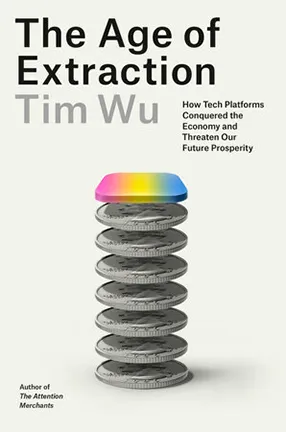
Timothy Wu tries to answer that question in The Age of Extraction.

The world is dominated by a handful of tech platforms. They provide convenience and entertainment, but are also some of the most effective instruments of wealth extraction ever invented, seizing immense amounts of money, data, and attention. An economy driven by digital platforms and AI influence offers the potential to enrich people, but also threatens to marginalize entire industries, widen the wealth gap, and foster a two-class nation.
In The Age of Extraction, Timothy Wu, Julius Silver Professor of Law, Science, and Technology, explores the rise of platform power and details the risks and rewards of working within such systems. The book tells the story of the internet, which promised widespread wealth and democracy in the 1990s and 2000s, only to create new economic classes and aid the spread of autocracy instead. Wu frames the current moment with lessons from recent history—from generative AI and predictive social data to the antimonopoly and crypto movements—and envisions a future where technological advances can serve the greatest possible good. The Age of Extraction offers consequential proposals for balancing economic growth and egalitarianism.
Why did you write this book?
I wanted to understand what happened to that dream of the ’90s—the idea that the internet was going to make everyone rich, create an outlet for every talent, and also ensure world peace and democracy across the globe.
Well, that didn’t quite happen. The interesting question is: Why? The book answers that question, and suggests that we can get back to that original vision.
Can you give some examples from the book of how the internet went from, as you say, “enablement” to “extraction”?
In the early days, the ’90s through the aughts, the internet actually delivered on many of the promises of a better future. For a while, for example, Amazon was a good place for a lot of small sellers to make money. Facebook was, in the beginning, privacy-protective and a great way to find lost friends. Google had almost no ads and a mindset of trying to make the ecosystem better.
Things flipped in the 2010s—the extraction phase—and this flip is what the book chronicles. Once the major platforms achieved monopolies, they started changing. Facebook broke most of its privacy promises and flooded the site with ads. Amazon kept ratcheting up the fees and started its “advertising” programs. Ultimately, these platforms have flipped the original vision 180 degrees, and have become the most extraordinary technologies of extraction ever invented.
What books have you read lately that you recommend, and why?
This great new book, The Second Estate: How the Tax Code Made an American Aristocracy by Ray Madoff, is a straightforward and authoritative explanation of how we let the tax system create a special, effectively tax-free haven for the 0.1%. The book is simultaneously illuminating and infuriating.
I also read Jude the Obscure by Thomas Hardy, an insightful novel for those with an interest in joining academia.
What’s next on your reading list?
I’ve started Far From the Madding Crowd, also by Hardy. As for non-fiction, one of my interests lies in political-economic approaches that seem to have gotten lost, so I’m also reading a book by Kenneth Dyson, Conservative Liberalism, Ordo-liberalism, and the State.
What are you teaching this semester?
Antitrust, from a new book that I’ve co-authored with Lina Khan, Shaoul Sussman, and Zephyr Teachout.
What are you working on now?
I am finishing a paper on antitrust and industrial policy and their misunderstood relationship. I’m also writing a manifesto on the idea behind popular capitalism.
Which three academics/scholars would you invite to a dinner party, and why?
It would be interesting to invite over Hannah Arendt, John Stuart Mill, and John Milton, and see what they think of our times and whether we’ve made any real progress on their terms.