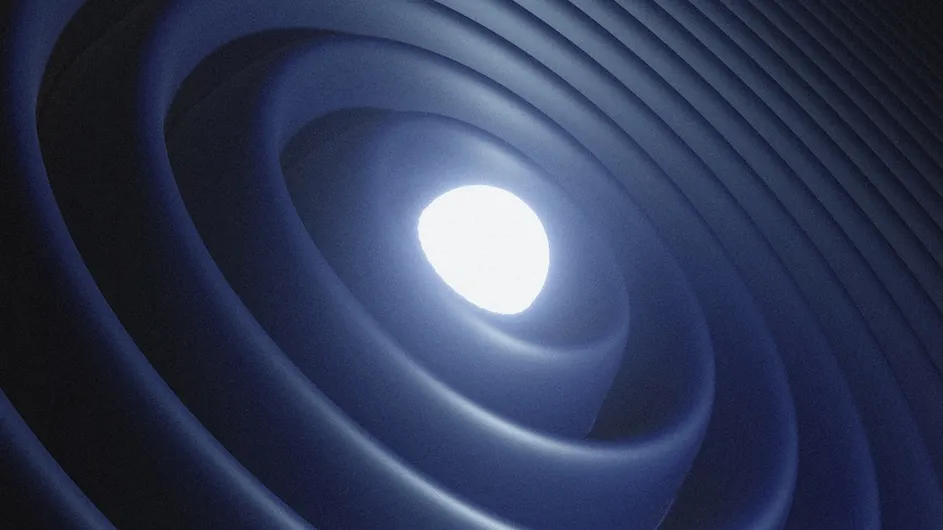
The large new catalog has also enabled researchers to refine measurements of the universe’s expansion rate, discover two unique types of black holes, determine multiple pathways by which black holes are created and provide further evidence for Einstein’s theory of general relativity. The catalog’s observations were made by the LIGO-Virgo-KAGRA collaboration, a group of more than 1,000 scientists dedicated to detecting and studying gravitational waves from black holes, neutron stars, and other sources.
Maximiliano Isi, a Columbia University assistant professor of astronomy, is involved with the international LIGO collaboration, and was a major contributor to the findings. He co-wrote the new catalog’s flagship astrophysics paper, and contributed a key analysis showing that black holes are split into two distinct groups: a majority that spin very slowly, and a minority that spin extremely fast. That finding has far-reaching implications for our theories about where these black holes come from (how they are formed). The question of whether black holes come directly from dying stars, or have been assembled step by step from the mergers of smaller black holes, is still hotly debated. The diversity in spins identified by Isi suggests that both mechanisms may be at play.
“With this catalog, we now have enough data that we can start to tease apart the properties of these black holes and to figure out where they came from,” said Isi, who is also an associate research scientist at the Flatiron Institute. “We’re also able to chart the expansion of the universe over its history, which is a super important unanswered question in cosmology right now.”
The new catalog, the fifth of its kind, contains 161 newly observed black hole mergers from April 2024 to January 2025. As a result of a series of upgrades to the LIGO detector and the 2024 relaunch of the Virgo detector which had been offline for four years, in Italy, the combined detectors have increased sensitivity, enabling them to capture as many as three to four gravitational wave signals per week.
That increase in detections is enabling astronomers to study black holes in ways never possible before, including probing their origins.
This news story was adapted from a press release from the Simons Foundation’s Flatiron Institute. More detail on the research is available on the Flatiron Institute’s website.