A Book Shows How Narrative Therapy Gives Meaning to Life
Older adults especially benefit from this therapeutic practice, say the authors.
Around the world, growing populations of older adults need social care. Aging is typically associated with steady physical and cognitive decline; the practice of narrative therapy, by contrast, focuses on the resilience of older adults by encouraging the construction of meaningful life stories. Practitioners engage participants to revisit personal journeys to uncover life lessons, finding core beliefs and values to help cope with new challenges. Ultimately, narrative therapy helps older adults recover meaning in life by inviting them to recollect and commemorate their life experiences.
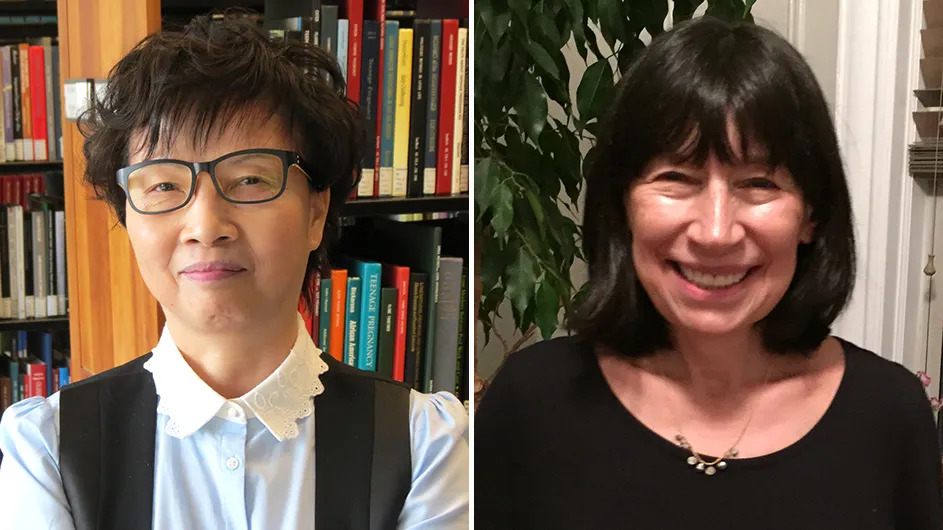
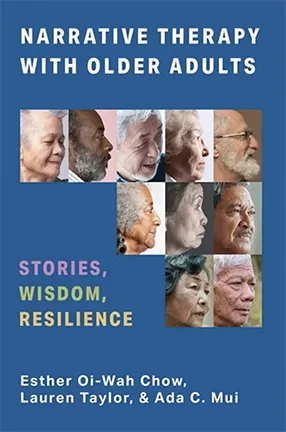
Narrative Therapy With Older Adults, by Lauren Taylor, a senior lecturer at Columbia School of Social Work (CSSW); Ada Chan Yuk-Sim Mui, a professor of social work at CSSW; and Esther Oi-Wah Chow, a social work professor at Hong Kong Shue Yan University, is an in-depth guide to narrative therapy for students and practitioners in health care, social work, gerontology, and counseling. By showing readers how to develop a culturally sensitive practice framework with older adults, this step-by-step manual presents a transformative narrative practice with older people in individual, family, group, and collective settings. Drawing on extensive clinical practice with older adults in Hong Kong and New York City, the authors explore narrative methods in divergent cultural contexts to advance a globally minded approach, and foreground alternative models of aging that celebrate lives worth living.
Lauren Taylor discusses the book with Columbia News—including how the pandemic affected both her and the plans for this book—along with what it’s like to be a co-writer, and what she’s working on and teaching now.
Why did you write this book?
I owe my participation in this project to my co-author, Ada Mui. Ada had met Esther Chow, our other co-author, at a conference in Hong Kong. Esther subsequently came to Columbia to work with Ada as a fellow, and brought with her a proposal for a book on narrative therapy in Hong Kong. The topic needed to be expanded for a wider audience, and Ada contacted me to see if I could help. Together, we conceived of the idea of narrative therapy in cultural contexts, East and West. Esther is primarily a researcher and I am a clinician, which created a nice balance in the material, with Ada as the bridge between us.
The pandemic impacted my experience, both in writing and in my clinical work. We received the book contract shortly before the pandemic began. On a personal note, I had written two chapters in the beginning of 2020, and then became severely ill with COVID in early March of 2020. I was unable to write for over a year, but finally sat down to write again in the summer of 2021. I wrote several pages, and thought to myself: “I can do this.” I went back to check a reference in one of the chapters I had written before the pandemic, only to discover that I had just written exactly the same thing as I had written before. I had to throw it out and start all over again, but despite this setback, I persevered.
Professionally, my work changed dramatically during the pandemic with the introduction of telehealth. Suddenly, I was seeing clients on a screen instead of in person. Some were clients I had seen in person before the pandemic, but there were new clients I had never met. I also began doing phone sessions, and in these sessions, I never saw the people with whom I developed therapeutic relationships. To my surprise, I found that phone sessions were just as effective as Zoom, for those who preferred them. Because of the profound impact of telehealth, I decided that it was important to add a chapter on this subject to the book. At present, working remotely has become routine. Although I also work in person, many of my older clients prefer telehealth, as it allows them to maintain consistency in treatment when they are not able to come in person. I have a number of older clients, including some in their nineties who, despite believing that they are not technologically savvy, have learned to use Zoom.
What exactly is narrative therapy, and why is it so crucial for older adults in need of care?
Narrative therapy is a respectful, client-centered form of psychotherapy that aims to separate the person from the problem, and help an individual rewrite negative life narratives to highlight strength and resilience, rather than failure and regret. Many older adults in need of care have become so intimately entangled with their problems that they lose sight of themselves as complete human beings whose narratives extend far beyond “the problem.” This is not to say that we should not address these problems; rather, in helping people uncover and appreciate their larger narratives, we assist in bringing deeper meaning to their lives.
Narrative therapy is an interactive and collaborative process, in which therapist and client work together to create a narrative tapestry that connects past and present. Life narratives contain many subplots, interwoven with the narratives of others, and with the cultural themes of the larger society. For older clients who may not have had therapy in the past, or for whom therapy carries a certain stigma, this approach may be effective in easing them into the process.
Can you give an example from the book of someone who benefited from narrative therapy?
In the book, I write about the many ways in which narrative can be used in therapy. I will share perhaps the most challenging case I have encountered. It is the story of a man whose Parkinson’s had robbed him of the ability to speak. He had been the general counsel for a major corporation, but now he was unable to communicate verbally, although his capacity to understand was still present. I have changed his name to protect confidentiality, so I will call him Allen.
As normal conversation with Allen was not possible, I had to think of creative ways to use narrative in our work together. Allen could not tell me his life story, but I could help him derive meaning from the life he had lived, and was still living. To that end, I asked Allen’s wife if she had some family photos I could use. For the next few months, I engaged Allen by asking about the stories behind the photos. Although Allen could not construct a complete sentence, he was able to relate enough through individual sounds and nods of his head to help me understand the stories behind the pictures. I asked him if he would like me to write down these stories, and he indicated he would. This became an important part of our time together. He relished the process, and especially enjoyed it when I read to him what I had written.
Towards the end of his life, Allen lost all ability to speak. Instead, I talked to him for the hour we spent together each week. He often sat in his wheelchair across from the west-facing windows of his dining room, and I noticed that he seemed fascinated by the setting of the sun, and by the reflection of the chandelier in the window over the dining room table. In my effort to keep him engaged in the therapy, I took pictures of the sky and the reflection as the sun began to set. With each phase of the sunset, I showed Allen the picture I had just taken. He was delighted, and indicated as best he could that I should take more photos.
Although very little conversation transpired in my narrative work with Allen, I felt a deep connection with him. When he died, I had the feeling that I had helped him construct a meaningful story, a “song without words.”
What was the process for producing this book with Ada and Esther?
Esther and I have never met in person, though I certainly hope we will some day! We initially communicated through WhatsApp, email, and, eventually, Google Docs. At first, it was difficult to coordinate, trying to figure out who would write what, and how we would combine our work into a cohesive text. Ada was most helpful in dividing up the chapters; in the end, Esther’s work as a researcher and mine as a clinician, with Ada as the link between us, came together in a complementary way. Our editors also helped facilitate the process.
What are you teaching this semester, and in the spring?
The courses I teach are not offered in the fall semester. I teach Social Work Practice with Women, and Resilient Aging in the spring semester, and Resilient Aging in summer school.
What are you working on now?
Over the years, I have collected many stories and quotes from my clients, as well as creative ideas from teaching. I have begun writing about my work, conceptualizing it as a kind of patchwork quilt, in which I plan to bring together the different pieces to create a narrative that I hope will be both thought-provoking and instructive.
In addition to my ongoing work in a geriatric mental health clinic, where I see clients both individually and in groups, and my work as an oral historian, I have begun to collaborate with an architectural preservationist whose work focuses on reparative narratives and historical sites. I’m looking forward to expanding my use of narrative into new areas, including the ways in which AI can assist older adults in telling and preserving their stories.