A Columbia University Economics Superstar: Edmund Phelps
Fellow Nobel laureate Joseph E. Stiglitz remembers his friend and colleague.
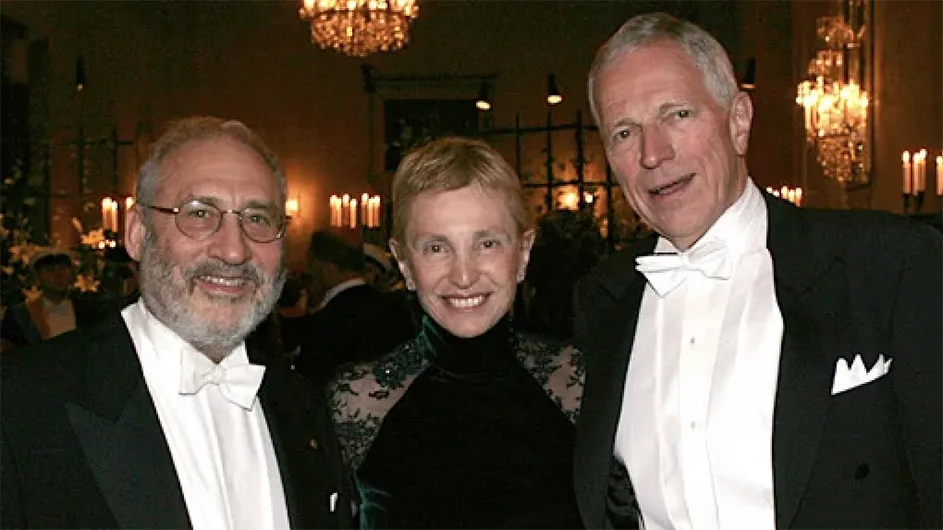
Edmund (Ned) Phelps came to Columbia 55 years ago as a full professor. At that time, he was already a star in the profession, with multiple pathbreaking articles to which he would add year after year over the succeeding decades. I would join the faculty some 30 years after he did; Ned was one of the main attractions drawing me to Columbia. We had been friends for decades. We had both attended Amherst College, and although he was 10 years ahead of me, we had bonded over our shared values and experience of learning from the same professors, including Arnold Collery, who served as dean of Columbia College from 1977 to 1982.
There was extensive overlap in Ned’s and my research agendas, on imperfections of information, on macroeconomics, on discrimination, on education and innovation, on the implications of social justice, and so much more. When Ned won the Nobel Prize in 2006, he and his wife, Viviana, generously invited me and my wife, Anya, to Sweden for what turned out to be unforgettable December days in Stockholm together.
Ned’s Nobel citation for “his analysis of intertemporal tradeoffs in macroeconomic policy” does not do justice to his scientific contributions. His lifelong project was understanding what made our capitalist system work—and how to make it function better. Here at Columbia, Ned established the Center for Capitalism and Society, and the center’s conferences were always a high point of the year, bringing together economic thinkers from around the world and generating spirited debate. The titles of some of the events give a flavor: “Progressivism, Socialism, Nationalism,” “The Age of the Individual: 500 years ago today,” and “The Economic Consequences of Mr. Trump.”
Ned recognized that there was so much more to capitalism than was captured in the simplistic market models that dominated economic thinking. The importance of his work was instantly recognized and followed by a slew of researchers further developing his insights. In some cases, it took decades for the depth of his ideas to go mainstream.
In his earlier years, Ned focused on introducing imperfect information, with its associated market frictions, and imperfect knowledge, with its consequent complications, into macroeconomics. In later years, he shifted to understanding the determinants of the economy’s dynamism.
His scientific contributions are too great to summarize briefly, but interested readers can look at the Nobel prize citation, a speech I gave at the American Economics Association in honor of his receiving the Nobel Memorial Prize in Economic Sciences, and the introduction to a festschrift in his honor that I co-edited with Phillippe Aghion (recipient of last year’s Nobel Prize in Economics), Roman Frydman, and Michael Woodford in 2003.
Ned’s commitment to social justice and a fairer society permeated his research. Even the titles of his papers reflect his ethics: a very influential 1961 paper titled “The Golden Rule of Accumulation: A Fable for Growthmen,” a 1972 paper titled “The Statistical Theory of Racism and Sexism,” and a 1973 paper “Taxation of Wage Income for Economic Justice.” The titles of his books show similar concerns: Mass Flourishing: How Grassroots Innovation Created Jobs, Challenge, and Change (2013) and Rewarding Work: How to Restore Participation and Self-Support to Free Enterprise (1997).
This commitment went beyond his writing. At Ned and Viviana’s urging and support, the Center for Capitalism and Society organized a conference in 2019 titled “Women in an Inclusive Economy,” bringing together leading women social scientists, including Lisa Cook, who was later appointed to the Federal Reserve, and Carmen Reinhart, who became chief economist of the World Bank.
Ned’s pathbreaking ideas naturally attracted students and a host of followers. His collaborators spanned the world—and not surprisingly—they were great scholars and, like Ned, lively personalities.
Ned was a dedicated teacher, and kept close relations with his former students. On one occasion I was the beneficiary: it was a meeting in Seoul of the Econometric Society, where we were both presenting papers. One of his former students had become head of a major Korean conglomerate, and invited us to an intimate, four-person dinner. The fourth person to join us was Ken Arrow, one of the two or three greatest economists of the 20th century (who received his Ph.D. from Columbia), who shared Ned’s love of life and music. I should have anticipated that the evening would have ended with karaoke, and though I like music, I have no musical talents. In a room with only four, there’s little place to hide. Thankfully, Ned rescued me, as we sang “O sole Mio” together.
But there was so much more to Ned than his scholarship. We were great friends, and spent much time together, not just in New York, but elsewhere, especially in Europe. His dinner parties began with a vibrant exchange of ideas among his many friends from around the world and ended with convivial singing around a piano. Ned was always warm and generous, and Viviana organized wonderful birthday celebrations, including a dinner one year at the Metropolitan Museum of Art. Some four decades ago, Ned and I separately tried to provide a clearer articulation of the relationship between the arts and the economy in a special session at the Spoleto music festival in Italy—giving us the chance to say that we had “performed” at that famous event.
Ned met Viviana at Columbia decades ago. Dynamic, lively, talented, and multilingual, Viviana was born in Argentina and was his wife for 52 years. They were inseparable. My lifelong friendship with Ned was just as much a lifelong friendship with Viviana.
Ned Phelps will be greatly missed. He touched so many people in his lifetime, including myself, through his intellect and his zest for living; and he lives on in his academic scholarship and in our memories of an abiding friendship.
Joseph E. Stiglitz is University Professor at Columbia University, where he teaches at the Business School, the Graduate School of Arts and Sciences, the Department of Economics, and the School of International and Public Affairs. He received the Nobel Memorial Prize in Economic Sciences in 2001.