Concision Is Key at the 10th Annual GSAS SynThesis Competition
The Graduate School of Arts and Sciences celebrates a decade of this fun, fast-paced master’s thesis contest.
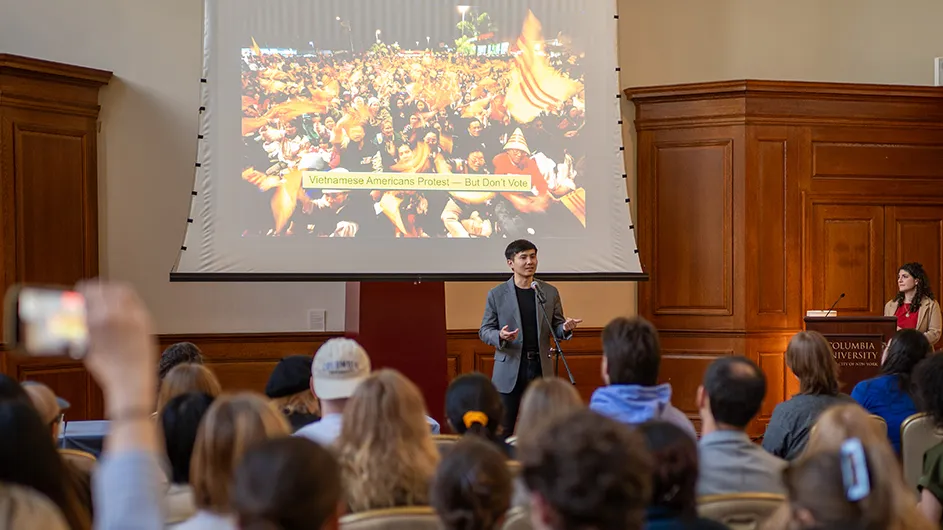
On April 29, 2026, within the wood-paneled walls of the Faculty Room in Low Library, more than a dozen master’s students will face off in a competition of words, ideas, and public performance. The event is the 10th Annual SynThesis Competition, in the Graduate School of Arts and Sciences (GSAS). The challenge to students is deceptively simple, but intellectually rigorous: Participants must present months of thesis research distilled into a three-minute talk, accompanied by a single slide, and delivered without notes. There will be a live audience and a panel of judges, who will select the winners of the day and award cash prizes.
The competition began in 2016 when GSAS Dean Carlos Alonso recognized the need for master’s students to practice communicating their research. “Describing your work as well as doing it effectively has become a necessary skill for graduate students,” said Alonso. “Communicating the results of one’s research is an integral part of the outcome of research. We created the SynThesis event to shine a light on our impressive MA scholars and their impressively varied thesis research.”
A GSAS Tradition
Since then, SynThesis has grown into a GSAS tradition, with its share of bumps and surprises along the way. The event was canceled in 2020 just as the pandemic hit; the next year, Rachel Bernard, GSAS Director of Graduate Career and Professional Development, worked with her team to adapt SynThesis to take place online, unfolding in Zoom squares. “We took a screenshot of all the participants and the judges smiling in their grid,” she said.
Upon returning to in-person presentations in 2022, the judges found themselves in a deadlock: There was a tie for first place. Bernard was at her laptop, recalculating scores and searching for a tie-breaker, when she spotted GSAS Vice Dean Andrea Solomon. “And so, I asked her, ‘Is it okay if we have a tie?’ We needed permission in that moment to award more first-place prize money.” Dean Solomon was happy to oblige, and that was the first SynThesis tie, but not the last.
The secret to this event’s longevity is the celebration of master’s scholarship. Leyre Santos (MA’25, European History, Politics, and Society), a 2024 SynThesis winner, said, “It’s super fun to watch! You see people in the library every day and have no idea what they’re researching, and the reality is that many people are working on fascinating topics.” Bernard agrees: “SynThesis is a quick and broad dose of what Columbia's all about—sciences, humanities, social sciences, the cutting edge in this generation of research. In 45 minutes, you can learn so much.”
A Breathtaking Array of Subjects
Over the past 10 years, enthusiasm for SynThesis has only grown. Dean Alonso said, “The fact that so many master’s students compete to make it to the final round indicates that SynThesis will be with us for a long time.” Indeed, this year’s iteration received more applications than ever, making it the most intense, high-level competition yet.
The ability to explain a complex idea in three minutes is not just a contest trick, but a career-defining superpower.
The 2026 participants will tackle a breathtaking array of subjects. Jamie Woych (Biotechnology) will discuss her investigation of the sensory switch in newts, which allows them to transition between water and land. Siddhartha Minhas (History and Literature) will explain the theme of xenophilia—the opposite of xenophobia–in Shakespeare’s Tempest. Sydney Homer (American Studies) plans to explore the race and gender politics of 1930s American tap dancing. And for anyone who has wondered why they choose a certain seat in a theater or an airplane, Gabriel Møller (Quantitative Methods in the Social Sciences) will enlighten you about the phenomenon in three minutes.
To mark this special anniversary, GSAS is also looking back at the competition’s impact on alumni. A panel of graduates, now working in fields ranging from environmental policy at New York City Audubon to international human rights law, will discuss how the concision of SynThesis shaped their work, and how the ability to explain a complex idea in three minutes is not just a contest trick, but a career-defining superpower.
On competition day, SynThesis is, above all, a rousing good time. Frédérique Baumgartner, director of the MA Program in Art History, is a four-time SynThesis judge who is looking forward to judging again this year. "It's one of my favorite events,” she said. “I love the energy in the room—the mix of excitement and tension, as at a music or theater performance." Like a concert made up of a wide variety of songs, the audience enjoys a fast-paced series of three-minute presentations, which add up to a fun and thought-provoking afternoon of entertainment. “You’ll learn more in the shortest time than you ever expected,” said Bernard. “It’s the one day of the year when quiet scholarship turns into a public event with lots of applause.”
Join us for the 10th Annual SynThesis Celebration: Wednesday, April 29, 4 pm, in the Low Memorial Library Faculty Room. Registration is required; click here for a seat. Reception to follow. Admission is free.
Jessica Vitkus is senior manager of communications operations for the Graduate School of Arts and Sciences.