A Course at Columbia Asks, "Is a Good Death Possible?"
Living, Dying, and the Meaning of Life blends ethics, medicine, religion, and philosophy to ask this and other big questions.
In Earl Hall Auditorium, a trim woman dressed in a navy blue pantsuit stands before a full class of students and quickly brings them to attention by saying, “Today we’re talking about death. I know it hits close to home for some of you, so I want to start by acknowledging that. As a physician and an ethicist, I give patients terrible diagnoses, which is very difficult, and I walk with them to the end of their lives.”
The woman is Lydia Dugdale, Dorothy L. and Daniel H. Silberberg Professor of Medicine at Columbia University Irving Medical Center, and director of its Center for Clinical Medical Ethics. The class is Living, Dying, and the Meaning of Life, which she co-teaches with Dean of Religious Life Ian Rottenberg and Philosophy Professor Katja Vogt.
“Let’s begin today with a question,” continues Dugdale. “What to you is a good death, and is it even possible?”
Hands pop up, and the first student says, “A peaceful death is good,” followed by another student who chimes in, “A good death means the end of suffering.” “It’s a question of time,” adds a young woman. “A prolonged dying process could be worse, but dying in a sudden accident could also be devastating.”
“I agree with your book (Dugdale’s The Lost Art of Dying: Reviving Forgotten Wisdom),” another student says. “Community is essential, along with acceptance of death.” “I want to push back,” says someone else. “I don’t believe in a good or bad death, because it’s out of our control. Death is the great neutralizer.”
The Meaning of Life
Dugdale and Rottenberg met during the early days of the pandemic in spring 2020. Her in-person book tour for The Lost Art of Dying was being shifted to an online format, just as Rottenberg’s office, the Center for Religious Life, part of University Life, was looking for relevant online material for Columbia’s student communities.
“Among many things Lydia and I shared was a belief that we needed to be doing more as a university to help our students think about death,” said Rottenberg. “We felt there was an unmet need for students to consider the fact of mortality, and its relationship to how we might choose to live.”
With their religious and applied ethical backgrounds, Rottenberg and Dugdale conceived of an interdisciplinary course in partnership with the Philosophy Department, which is how Vogt became involved. The three of them designed a curriculum built around questions of meaning, death, and happiness. The questions are central to human life, but often elusive: Should we prepare for death? If yes, how? Does an awareness of mortality shape the way we live? What constitutes a good human life? What does one need to be truly happy? Is life meaningful? Is it up to us to engage in pursuits that make our lives meaningful?
The course is open only to undergraduates, and makes connections between scholars from the fields of philosophy, medicine, and religion. There is a wide range of readings, from ancient texts to contemporary ethics, from the philosophy of religion to works of literature.
“Our mission with this class is for students to develop skills for literary and philosophical analysis, reading, reasoning, and written argumentation,” said Rottenberg. “We also invite them to reflect personally about the ways in which existential questions impact their own lives.”
The Ars Moriendi
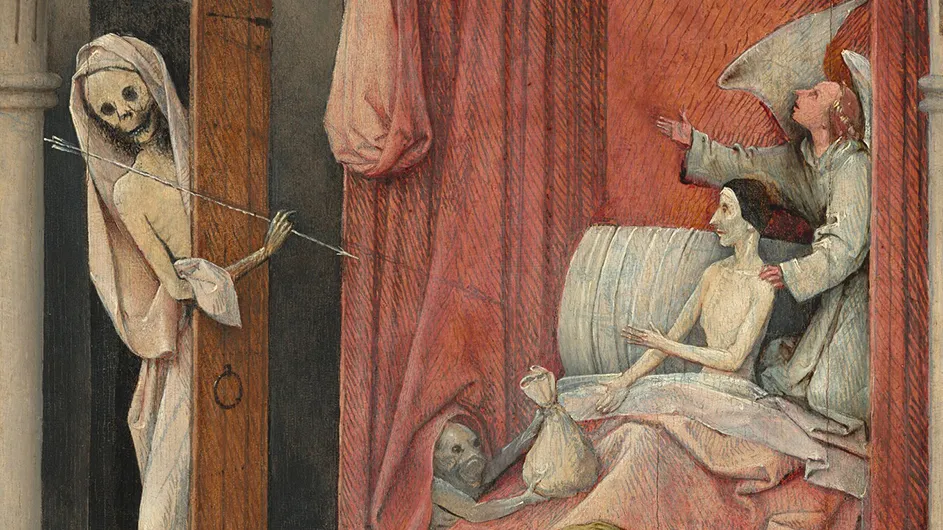
Back in Earl Hall, Death and the Miser, a late 15th-century painting by the Netherlandish artist Hieronymous Bosch, appears on the screens at the front of the room. The work portrays the last moments in the life of a miser, right before his fate is decided. A demon tempts the miser with a bag of gold; a kneeling angel encourages him to acknowledge a crucifix in the window. Representations of good and evil appear throughout the painting.
“In the late Middle Ages in Europe, people believed you died poorly if you died in a state of greed,” says Dugdale.
She goes on to explain that this type of deathbed scene derived from an early printed book, The Ars Moriendi, or The Art of Dying, which was very popular at the time. The books formed a widespread literary genre, which lasted for several centuries, and emphasized that to die well, one first had to live well, and described what practices best help people prepare for death.
“The Ars Moriendi is no longer popular, but the lessons it imparts and the questions it asks still remain,” says Dugdale. “How can you die well? And how can you live well to ensure that happens?
Grief Within the Broader Human Experience
In the summer before her sophomore year of college, Barnard student Chloe Hoyle’s father was diagnosed with stage four pancreatic cancer. Up to that point in her life, said Hoyle, she had encountered loss only from a distance, and lacked the philosophical tools to understand grief within the broader human experience. “I felt as though my pain was an isolated tragedy rather than part of a shared human condition.”
Living, Dying, and the Meaning of Life became a lifeline for Hoyle. “The class provided me with the language and framework to wrestle with the inevitability of death, the gift of life, and the necessity of finding meaning. The discussions and texts helped me rethink my values, and see that a life defined by external achievements alone risks becoming hollow if it lacks depth, purpose, and genuine human connection.”
Hoyle met two of her closest friends in the class. “In a university as large as Columbia, it’s rare to find a space where academic pursuit fosters such lasting emotional bonds.”
Hoyle is such a fan of the class that she volunteered to help out with this semester’s weekend retreat, a part of the course that takes place for a few hours on a Saturday in Earl Hall. “As a returning guest, I helped facilitate conversations. I met students who, like me last year, were grappling with personal experiences of loss, identity, and purpose. Seeing them find meaning in the same texts and discussions that had impacted me was incredibly rewarding. It reinforced the idea that philosophy is not just an academic discipline: It’s a way of making sense of the human experience and a tool for connection.”