Feeling Lost? Here’s One Resource Every Columbia Student Should Know
A Health Promotion Appointment is your helpful portal to finding health, care, and community on campus—and off.
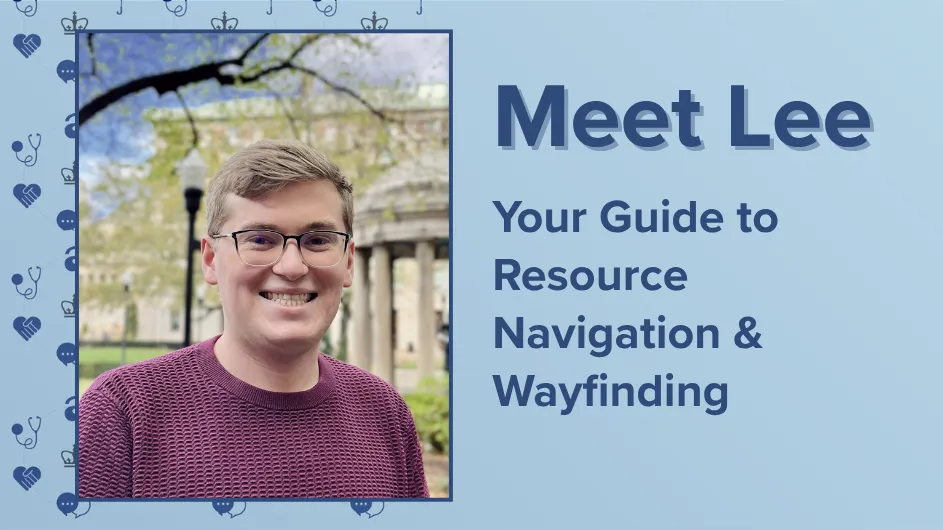
You just started at Columbia. Your inbox is overflowing. This health insurance terminology? Unreadable. You're not yet sure which campus service handles what or whether you even qualify. Heck, you keep getting turned around trying to make it from the Joe Coffee in Dodge Hall to Dodge Fitness Center. When someone says "Alice!" you might think they are talking about a person.
Number one thing? You're not alone. College life is inherently overwhelming, but one quick appointment could start to change that.
Meet Lee Daniel (MPH'22), Health Promotion Specialist for Resource Navigation & Wayfinding, who, through his work with Columbia Health's Alice! Health Promotion team, helps students make their way through the maze of university life. This might include accessing healthcare, understanding campus resources, navigating off-campus services, and figuring out ways to build community.
"There isn't a question that is too silly or small," Lee Daniel said. "None of us expect students to be experts in the U.S. healthcare system. In the same way we don't expect a first-time research assistant to be an expert in navigating the journal submission process.
"We are here to help support students as they navigate these processes on their own, many of them for the first time. Our job is to help you figure out what you need and how to get there."
As the University ramps up for a new academic year, Lee spoke with Columbia News about how his role came to be, what students can expect from a Health Promotion Appointment, and his tips for feeling grounded and connected at Columbia.
How did you find your way to Columbia and this work in health promotion/navigation?
I’m a Columbia alum. I graduated from the Mailman School of Public Health in 2022, right in the heart of the COVID-19 pandemic. I’d just finished undergrad in North Carolina, where we went home for spring break and never came back again. That moment made me rethink what public health could look like.
At Columbia, I learned that college health and well-being is a real field you can work in. That clicked for me. I had already done student support work in undergrad as an orientation leader back in North Carolina, and at Mailman, I saw how you could bridge public health with higher education.
I was going through the hybrid college experience as an individual, but then I learned about Columbia Health as an organization that was helping students navigate community and well-being support when folks were disconnected physically, and trying to figure out how to make it through the pandemic. When I graduated, I learned about this role at Alice! Health Promotion, and here we are a full three years later.
What exactly is a Health Promotion Appointment? What happens when a student signs up?
It’s a low-barrier, confidential resource designed to help students explore what support they need. We always start with the question: “What are you hoping to get out of our conversation today?"
From there, we talk through and explore what services exist on campus and beyond, whether that’s mental health care, primary care, disability services, or insurance navigation. We also talk about off-campus options, transferring care from back home, or connecting to local providers. It’s about mapping your support system—what you already have and what you may still need.
Sometimes when we talk about health, we fall into that kind of trap of "oh, it is just my physical or medical health," and that is a lot of what I do, connecting students to clinical resources they pay for through their health services fee. But I think it's also about leading with the fact that we are supporting students, so what does it mean to promote well-being and the human behind your role on campus?
How do I advocate for myself? How do I navigate a situation with faculty? How do I know if my stress level is impeding my academic or professional success? How do I support my friends who are struggling?
These appointments can include those pieces as well.
Who is eligible for these appointments?
We serve students from the Morningside, Manhattanville, and Lamont-Doherty campuses across Columbia’s schools. Last year, more than 330 students joined an appointment. That includes most graduate and undergraduate students, but not those from Barnard or CUIMC, they have their equivalent services, which you can find here for Barnard and here for CUIMC.
Even if folks don't have insurance, like part-time students, you're still able to meet with our department. Even if someone isn’t fully enrolled yet, like admitted students who’ve activated their UNI, we can meet to help them prepare and understand what support exists at Columbia.
From your work so far, what kinds of concerns or goals do students typically bring up?
In the early fall, it's often logistical: “How do I get connected?” "How do I find care?" “What is primary care?” “How do I use my insurance?” As the semester goes on, it shifts to “I’m not doing as well as I wanted to,” or “I’m struggling, what can I do?”
Toward the end of a semester, we see more complex situations: students navigating leaves of absence, insurance transitions, or life changes. The common thread is that they want to stay connected to their academic and personal communities, even when things feel overwhelming.
Columbia is a big place. Any tips for incoming students who feel lost or unsure how to get their bearings?
- First, don’t ignore your email, but also know it’s okay to feel overwhelmed by it. Find out which emails are relevant to your school’s student affairs or wellness offices and make a point to read those. A little upfront effort pays off in being able to navigate to the resources you need before you need them.
- Second, clarify your goals. What kind of community are you hoping to build? That can help guide what events or groups to join.
- Third, lean into peer-to-peer connections. Even if you’re introverted (like I am!), just saying “Hey” to the person sitting next to you in class can start something. We get so focused on getting to class, focusing on the professor, that we forget people are sitting on either side of us. That's an opportunity to lean in and explore.
There are also so many staff members who can support you in making those connections, even someone like your academic advisor, who could connect you to other students who are in a similar situation. I also help students find community or involvement with students in schools other than the students' own, all the time. In a small program, you may feel like the only student who identifies a certain way or has particular interests, but remember, Columbia has 17 schools and four affiliates that mutually cohabitate with one another. You can find community across the University.
What’s one thing you wish more students knew?
You don’t have to be in crisis to seek support. You also don’t need to know exactly what to ask. Our job is to help you explore options and take the next step, whatever that is.
Also, Columbia is two-thirds graduate students. There are lots of people navigating multiple roles within the institution—student, employee, researcher, maybe even parent—and no one expects you to be an expert in health care or University organization. That’s what we’re here for.
How can students schedule a Health Promotion Appointment?
Just go to the Columbia Health website, fill out our short intake form, and there will be a follow-up email with appointment times available to you. Appointments are virtual by default, but in-person is available too—no need to give a reason.
You can also email [email protected] or give us a call at (212) 854-5453 during business hours to get connected to our team as well.