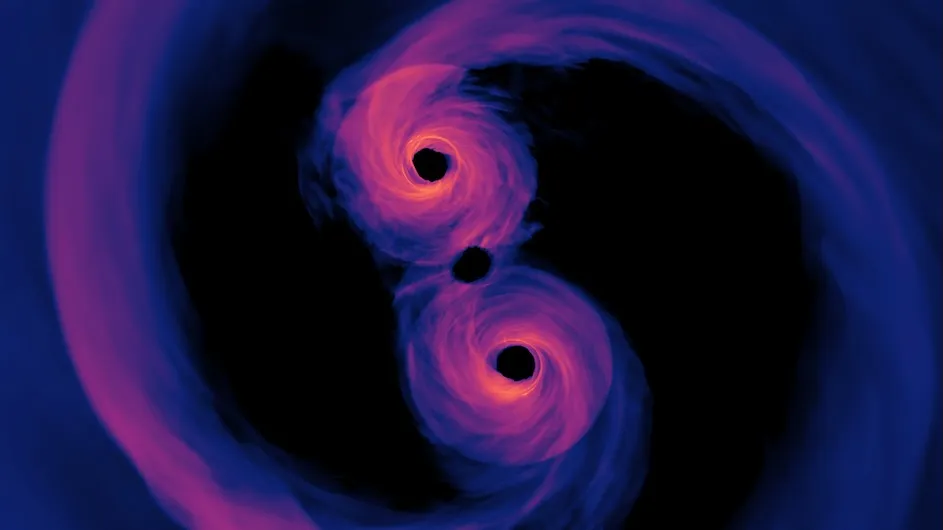
“There are signs that these black holes may have been rotating extremely fast in directions opposite to each other, leading them to precess as they came together like a pair of spinning tops,” Isi said. “This potentially created a very distorted new black hole in the process, that then wobbled as it settled down into a stable state.”
The detection was made by a collaboration of researchers from three experiments that measure ripples in the fabric of space-time created by events such as black hole mergers: LIGO, Virgo and KAGRA (LVK).
The data analysis was unusually challenging, and pushed the detectors to their limits in many ways, the scientists said. "We are still learning how to extract every ounce of power out of the LIGO instrument, and hopefully results like this will get the broader public excited about continuing to fund this extraordinary scientific machine so that we can keep sharing fascinating discoveries with the world for years to come," said Siegel.
Gravitational waves are a key component of Albert Einstein's theory of general relativity and can provide critical insights into extreme cosmic events like exploding stars or merging black holes.
“To me, this discovery highlights that gravitational wave astronomy is a discovery-driven field that is full of surprises, interesting puzzles and open questions,” Isi added. “We are at the frontier of the unknown.”
Isi has a joint appointment at Columbia and the Simons Foundation.
This news story was adapted from a press release by the Simons Foundation.