Meet the Sustainability Director Who Volunteers to Drive Columbia’s Commencement Shuttle
Daniel Allalemdjian has spent a decade helping Columbia move more sustainably. Every year when graduation season rolls around, that means getting behind the wheel, literally.
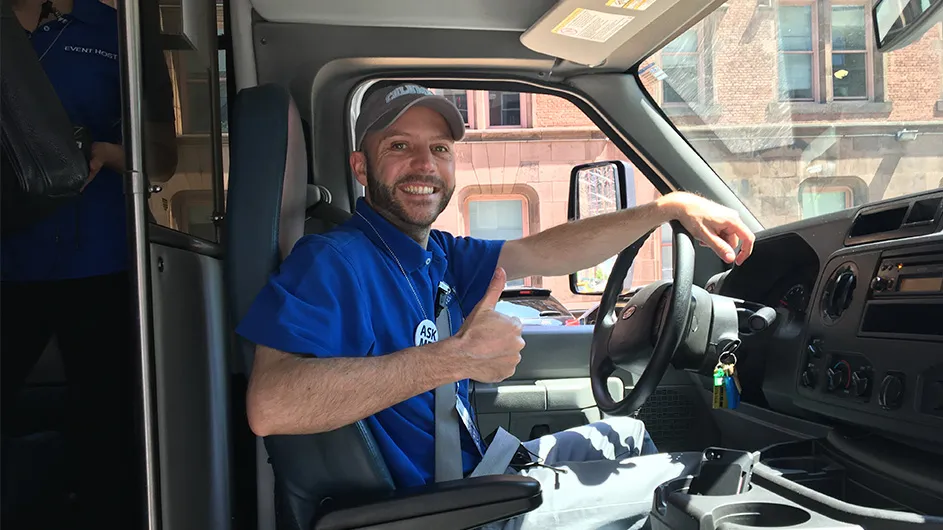
When Daniel Allalemdjian (SPS’25) came to Columbia University a little over 10 years ago, he arrived with a specific mandate: help the University reduce its car traffic footprint, starting with the growing Manhattanville campus. What he didn’t know was that the job would grow into something much larger. And that every spring, he’d volunteer to trade his desk for the driver’s seat of a Commencement shuttle bus.
As director of sustainability and transportation in Columbia’s Office of Sustainability, Allalemdjian oversees sustainable transportation initiatives, such as the electrification of the University’s vehicle fleet, commute travel initiatives, and, most recently, the Campus as a Living Lab initiative, which connects real sustainability challenges on campus with student-led projects.
He has also, for nearly every one of his 10 years at Columbia, volunteered at Commencement as an ADA-accessible shuttle driver, helping graduates and their families get to where they need to go.
“The true spirit of CUFO comes out at Commencement,” Allalemdjian said, referring to Columbia University Facilities and Operations, which is home to the largest contingent of Commencement volunteers year after year. “It’s one of the times of the year where we’re all out on our feet together, working in a true CUFO fashion of making everything work so that the students and their families have a high-end experience.”
It takes about 450 staff and faculty volunteers to help make Commencement run smoothly, and you are encouraged to join the fun (and it is one of the most joyful days of the Columbia academic year) for 2026, which will have not one, but two, Commencement ceremonies.
Columbia News recently sat down with Allalemdjian to hear about his around-the-world journey to Columbia—from rural Outback Australia to Morningside Heights—and what it means to help move people, in every sense of the word.
How did you find your way to Columbia?
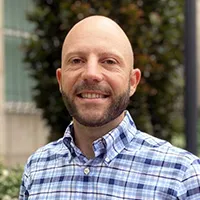
I was up in New Hampshire, applying for jobs all over the country. I’d left the Department of Transportation, done a year of travel, and was ready to get back to work. Of all places, I got a job in New York, and it was in my field of transportation.
Columbia was expanding into the Manhattanville campus and needed someone to implement programs that would reduce car traffic. Things like carpooling incentives, a park-and-ride shuttle network from New Jersey, and strategies to discourage driving because we weren’t building parking. That was me.
How did you originally get into urban planning work?
I grew up in rural Outback Australia, on a farm. After high school, my parents made clear I wasn’t staying home. My dad was born in the U.S., so I had dual citizenship, and coming here was easy.
I spent about a year and a half doing seasonal work across the country: teaching kids at an environmental camp in New Hampshire, harvesting wheat in Texas, driving shuttle buses at a ski mountain in Vail, Colorado.
That was probably where the transportation enthusiasm really took hold. I was always sort of driving a tractor or a shuttle bus. And personally, I always feel good when my body’s moving: if I get on a bus or a plane or in a car, the adventure starts there.
Where did the sustainability piece come from?
It was already part of how I grew up. On our farm, we were moving toward organic practices, reducing chemicals. I remember ordering dung beetles as a kid because I’d learned what they did for the soil. And then my aunt helped me get a job at an environmental camp when I came to the States, so it kept showing up.
When Columbia hired me, they placed my position in the Office of Sustainability, which made sense because reducing car traffic is also reducing greenhouse gas emissions. The two missions go hand in hand. And then, as my role has grown, I’ve taken on campus engagement as well. We have something called the Campus as Lab Initiative, where we match real sustainability challenges at the University with student-led projects. Last academic year, about 40 students were working with our office in some capacity. For an office of five people, that’s a significant force multiplier.
What do those student projects actually look like?
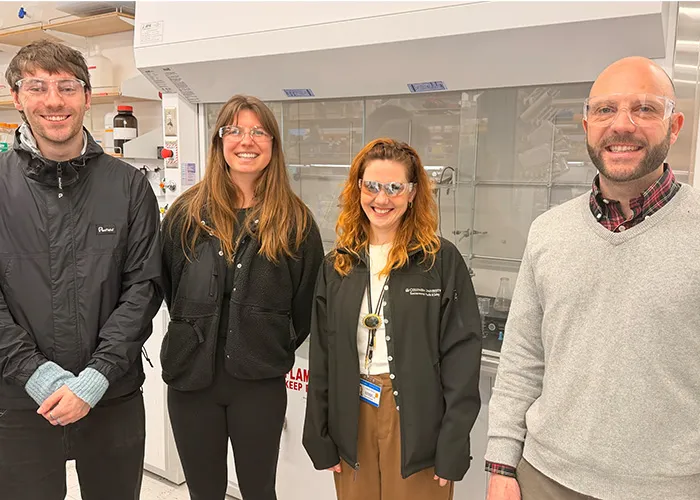
Procurement has been a big one recently: looking at what the University buys in bulk and finding ways to make it more sustainable while also saving money. Such as our custodial supply items. Disposable gloves, for example. We buy a lot of them for our cleaning staff. Working with our Central Procurement office, a student mapped out our top supply items, and they are helping us consolidate to certain brands that are both more sustainable and cheaper because of our buying power. Saving money and saving the planet.
Another student group spent a semester developing a campus engagement framework that we’re now rolling out across schools and departments. Part of that is waste centralization, removing individual desk-side bins to funnel people toward proper recycling at central collection points. We’re piloting it now and hoping to expand it across campus.
You also went back to school yourself—at Columbia.
I did. I took advantage of the tuition benefit and enrolled in the School of Professional Studies’ Sustainability Management program, finishing just last year. It was the most delightful thing. I never thought I’d have this kind of elevated job at a prestigious institution, and then to also get to be a student here was just an extra layer of privilege and accomplishment. I’m so thankful for it.
And it genuinely makes me better at my job. A big part of my role now is student engagement, so having experienced Columbia from the student side gives me a real perspective on what that means.
How did you end up driving the Commencement shuttle?
I’ll be frank: there’s a strong culture in CUFO around volunteering, and in my management line, the question was very much, “Why aren't you volunteering?”
But I got connected with Miguel Pagan, who runs Columbia Transportation, and he remembered that I used to drive shuttles in Vail. He said, “Dan, how about you drive the shuttle this Commencement? You’ve done this before.”
I said absolutely. A driving job at my office? Sign me up. And I’ve done it basically every year since. They’re like, “You’ve got the skills, you’re our guy.” Why change something that works?
“It’s a day where you’re out of your chair and on your feet, seeing what we’re all here for. ...You see the full machine working.”
What does the shuttle actually do during Commencement?
Most guests should arrive by public transit—it’s usually the fastest, most reliable way to get to campus. But for guests with disabilities who don’t want to walk all the way around campus to reach their entrance, the shuttle is essential.
When you come out of the 116th Street subway station, look for someone holding a paddle sign that says “shuttle,” and they’ll walk you to the stop. It’s about a five-minute ride, and the shuttles run every 10 to 15 minutes. We also have a wheelchair lift, so if you’re using a wheelchair, you can load up and bring your guests along with you.
What kept you coming back year after year?
It brings me right back to Vail: a full bus of people buzzing with excitement, everyone ready for something big. At Commencement, there’s that same energy. People are dressed up, and families have come in from all over the world. It’s like going to the races: everyone’s dressed to the nines.
My colleague Christina usually works the bus with me—she handles the guests, gets them seated, works the wheelchair lift, chats with families about who they’re there to see. My job is to focus on the road. There’s a nice recurring rhythm to it. Every year it’s a “hey, high five, we’re at it again” kind of thing.
It’s a day where you’re out of your chair and on your feet, seeing what we’re all here for. It brings together people who work at their desks with people who are on their feet every day, like the custodial team and the grounds crew. You see the full machine working.
What was it like to experience Commencement as a graduate last year?
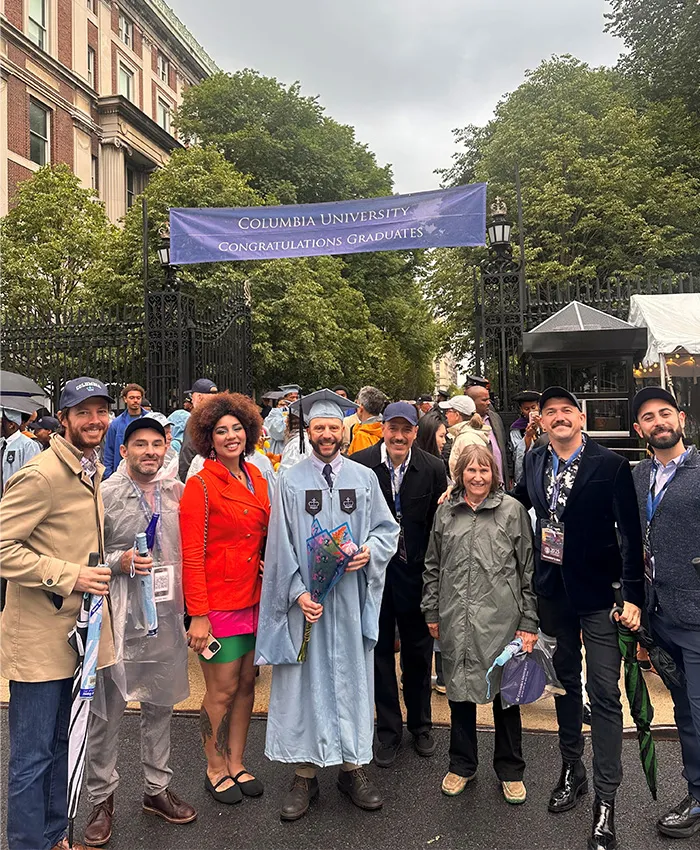
It was really special. To have worked here for a decade and then also gotten to sit with classmates as part of a tradition going back to 1754—that’s something. It was raining, but I stayed to the end. I was not going to leave early.
Afterward, my family and I went to Carmine’s on the Upper West Side for a big family-style Italian meal, and then we just wandered the city. The ferry to Brooklyn, some thrift shopping, and bar hopping. People on the street were congratulating us. That’s New York.
Any advice for grads and families this year?
Take transit to campus.
Have a specific meeting spot planned in advance: not something vague, something like a particular gate.
Plan a restaurant. Have the whole day mapped out, because as a grad, it’s your day and you should own the agenda. Don’t leave it to your guests to figure out, or you’ll end up with frustration instead of celebration.
Stay in your regalia as long as possible. And if it rains, your hat is cardboard, so bring a shower cap if that matters to you.