A Perfect Book for Graduates: How to Find Happiness
Katharina Volk’s new translation of Cicero explores this timeless question.

“Of course, we all want to be happy,” wrote the Roman statesman, orator, and philosopher Marcus Tullius Cicero. He and his fellow Greek and Roman philosophers agreed that the secret to happiness—or what they called the “good life”—is pursuing the “greatest good.” But they couldn’t agree on what the greatest good is. Cicero addressed this dilemma by composing a set of dialogues, On the Greatest Good and Evil (De finibus bonorum et malorum), in which he pitted advocates of different philosophical approaches to happiness against one another.
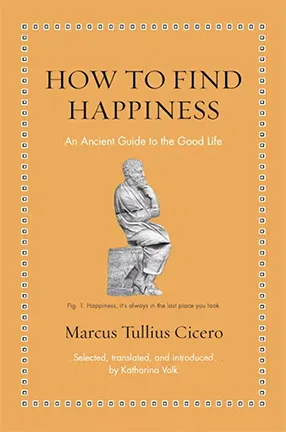
In How to Find Happiness: An Ancient Guide to the Good Life, Katharina Volk, chair of the Classics Department, offers a vivid new translation of selections from Cicero’s work, complete with an introduction and the original Latin text on facing pages. The result is a lively and engaging debate, which includes the Epicureans (who believe that the greatest good is pleasure) and the Stoics (according to whom it is moral virtue). Rather than choosing sides, Cicero (and Volk) consider the pros and cons of the different philosophies, ultimately leaving it to readers to make up their own minds.
Why did you write this book?
I have always wanted to write a book with a broad audience appeal, and I know from teaching ancient approaches to happiness—especially in my class, Virtue and Happiness: Philosophy in Classical Rome—that people, including young people, often find such philosophies quite attractive. At the same time, I feel that it is important, now perhaps more than ever, not to provide simple solutions to difficult problems. Cicero would agree: At the end of his dialogue, On the Greatest Good and Evil, no one philosophy is presented as correct, and readers have to decide for themselves.
Do you think Cicero’s presentation of different philosophical approaches to happiness is applicable today?
I think Cicero is applicable, and, in fact, contemporary versions of Epicureanism and Stoicism exist, though they are often very simplified and sometimes distorted in comparison with their ancient precursors. It’s important to understand that for the Epicureans, “pleasure” is not just momentary sensory stimulation, but a steady and rational state of freedom from physical pain and mental anxiety. For the Stoics, “moral virtue” means acting ethically, but also being able to cope with any setbacks in doing so. It is certainly the case that the Stoics are more altruistic than the Epicureans, but ultimately, both philosophies are about enabling the individual to achieve a happy, self-sufficient life.
Is being happy even possible? What would Cicero say about this if he were alive now?
Ancient philosophies, such as Stoicism and Epicureanism, are inherently optimistic: According to them, human nature is such as to enable us to find happiness, even if it is hard work. Cicero would have agreed. When he was writing his philosophical works, he was going through a difficult period in his own life, both politically (after a civil war, the Roman Republic had been replaced by Caesar’s dictatorship) and privately (his beloved daughter had died in childbirth). He credited philosophy with saving him, as it were, during these dark times.
Summer plans?
After a quick trip to Germany and Belgium, my husband, Emeritus Classics Professor Jim Zetzel, and I will spend the rest of the summer in our house in the Adirondacks, working on a joint commentary on another dialogue of Cicero. It’s a very Roman thing—going to the country to engage in philosophy.
Which three ancient scholars/philosophers would you invite to a dinner party, and why?
Obviously, I would have to invite Cicero. I think he would be thrilled to meet Plato and Aristotle, and so would I!