Researchers Announce Discovery of a Possible Pulsar in the Milky Way’s Center
Confirming a pulsar star would enable unprecedented tests of General Relativity. Such a discovery would revolutionize physics.
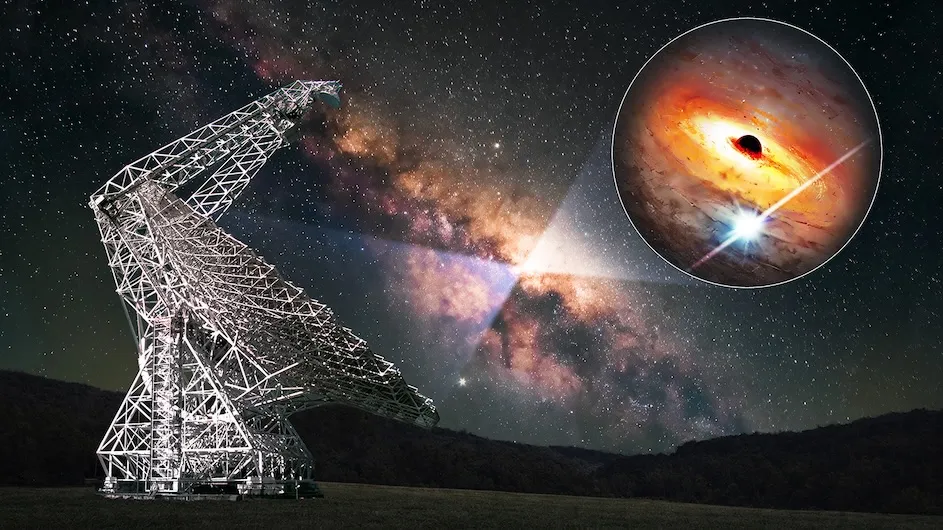
Researchers from Columbia University and Breakthrough Listen, a scientific research program aimed at finding evidence of civilizations beyond Earth, have published new results from the Breakthrough Listen Galactic Center Survey, one of the most sensitive radio searches ever conducted for pulsars in the dynamically complex central region of the Milky Way Galaxy. The study, led by recent Columbia PhD graduate Karen I. Perez, was published in The Astrophysical Journal.
The survey identified an intriguing 8.19-millisecond pulsar (MSP) candidate near the supermassive black hole Sagittarius A*, which is at our galaxy’s center.
Detecting, confirming, and carefully measuring the arrival of a pulsar in this region of the Milky Way would enable unprecedented tests of General Relativity, including precision measurements of the space-time around a supermassive black hole.
Pulsars are rapidly spinning, highly magnetized neutron stars that emit beams of radio waves that sweep across Earth like cosmic lighthouses.
In the absence of any external influences, the pulses from a pulsar arrive at telescopes with extraordinary regularity, so they can be thought of as very accurate clocks with highly predictable behavior. Millisecond pulsars in particular exhibit extremely stable clock-like behavior due to their very rapid rotation.
“Any external influence on a pulsar, such as the gravitational pull of a massive object, would introduce anomalies in this steady arrival of pulses, which can be measured and modeled,” said Slavko Bogdanov, a research scientist at the Columbia Astrophysics Laboratory who was a co-author on the study. “In addition, when the pulses travel near a very massive object, they may be deflected and experience time delays due to the warping of space-time, as predicted by Einstein's General Theory of Relativity.”
Since Sagittarius A*, the central black hole in our Galaxy, has a mass about 4 million times the mass of our Sun, it exerts a strong influence on its surroundings.
Given the potential implications of this discovery, analysis of extensive follow-up observations is underway.
To maximize community impact, Breakthrough Listen is releasing the observations publicly, allowing researchers worldwide to pursue independent analyses and complementary science cases.
“We’re looking forward to what follow-up observations might reveal about this pulsar candidate,” Perez said. If confirmed, it could help us better understand both our own Galaxy, and General Relativity as a whole.”