This Student Advocates for Brain-Injury Survivors
Claire Liu Zhu uses the arts and storytelling to empower and serve those living with neurological conditions.
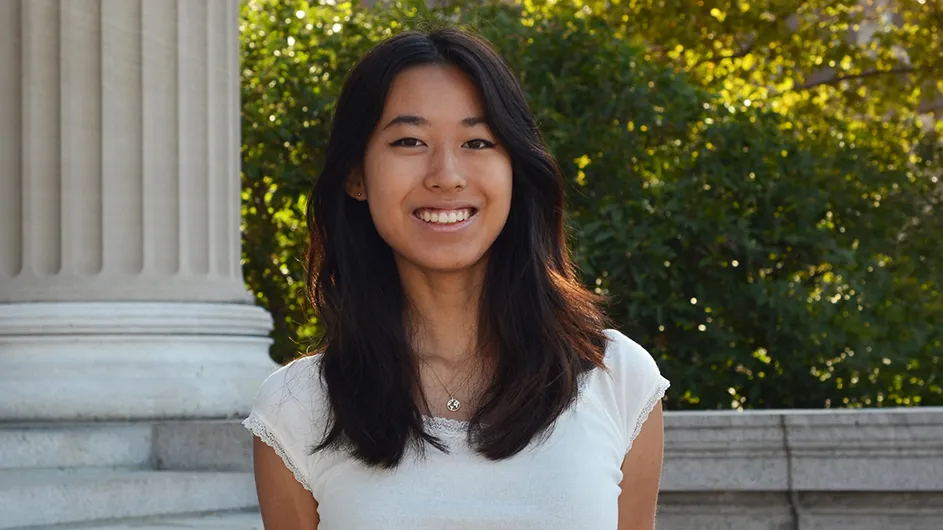
Columbia College junior Claire Liu Zhu has been able to relax a bit since the April 18 Brain Injury Art Exhibit, a collaboration between Columbia Synapse—a student group that she leads—and Voices of Brain Injury.
The exhibition brought together more than 80 works from artists in the brain-injury community, sharing perspectives that are often overlooked in clinical and public spaces. Through painting, photography, film, and poetry, the pieces in the one-day show held in Low Library challenged how people understand recovery, identity, and life after injury.
When will you graduate from Columbia College, and what is your major?
I will be graduating in 2027, and I am double-majoring in Neuroscience and Behavior and Medical Humanities. I am passionate about exploring the intersection of these two fields, and I hope to use the arts and storytelling to advocate for, empower, and serve individuals living with neurological conditions.
Has there been a special mentor/professor during your time at Columbia? Or a particular class that inspired you?
It is hard to choose just one, as my time here has been shaped by a multiplicity of classes that expanded my horizon and challenged my perspective in different ways. I loved my art humanities class with Martina Mims, a lecturer in art history, who assigned journal entries and museum visits around the city. I learned how to intentionally slow down and reflect on the deeper meaning of artworks, while responding to my classmate’s interpretations. In the midst of a busy schedule, to find myself at Ruth Asawa’s exhibition at the Museum of Modern Art (MoMA), analyzing how her work collapses and reanimates dimensionality, was a gift I will carry with me forever. At the end of the semester, we were asked to curate our own exhibit, drawing connections across everything from Greek and religious architecture to Basquiat and his inspiration from jazz.
I also loved the introduction to Narrative Medicine class I took with Professor Mary Sormanti, in which we explored themes of embodied experience, ethical witnessing, trauma, and the significance of telling and holding onto a story, through films and patient testimonies. I learned to listen differently by understanding the embedded context from which an individual emerges, and how their past, communities, and relationships shape the stories they tell in the present.
This semester, these threads synthesized in Introduction to Comparative Literature and Society, with Professor Rishi Goyal. The class blended philosophy, contemporary texts, and theory, as we explored each module, which focused on a specific word, such as “theory” or “symptom.” Inspired by the class’s keyword assignment, I decided to dive deeply into the word “synapse” as the guiding concept for the brain-injury art exhibit. Synapses invite us to reconsider the beauty of co-presence and the endless possibilities of connection, which exist not in spite of, but across whatever physical or ideological gaps exist between us.
How did you get involved in advocacy work, especially your focus on Columbia Synapse and the April art exhibition?
I initially joined Columbia Synapse during my freshman year with an interest in neuroscience, but without a true understanding of brain injury. At the time, the club was on somewhat of a rocky footing with about only 10 members, so I stepped in to co-facilitate our weekly support groups. Over time, as I developed close relationships with the group participants, I learned firsthand the frequently overlooked struggles and unmet needs of the brain injury community, from physical and cognitive challenges to grappling with the loss of their former identities. Even though I had never sustained a brain injury myself, I was deeply moved by the courage and vulnerability of living with what individuals call an invisible disability. I was especially moved by the way members would hold space for each other; in the face of immense frustration, the love and grace they extended to one another inspired us to foster an empowering group where success was redefined, celebrating even the small wins together.
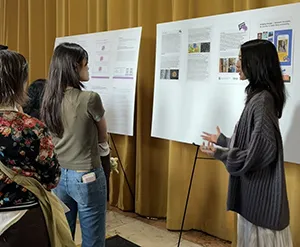
As I shifted into the presidency of Columbia Synapse, I sought to build an organization that enables survivors to share their stories, and a bridge for my peers to advocate for and fully attend to others’ lived experiences. The organization has grown to reach over 200 individuals with brain injuries and their caregivers with a diverse portfolio of initiatives. Our weekly peer support groups and peer buddy programming continue to combat social isolation by offering a space for survivors and caregivers to connect, exchange practical resources, and find mutual understanding.
The April 18, 2026 Brain Injury Art Exhibit grew organically out of this community. We initially conceptualized the idea over winter break after a participant expressed her passion for art. Seeing the enthusiastic response from the brain injury community during our initial call for submissions, we realized we had a responsibility to make it happen. The show was an ambitious endeavor to build from scratch, but we collaborated closely with Wallach Art Gallery personnel and School of the Arts MFA students to bring the vision to reality. We created object lists and coordinated large-scale physical work with the artists to finding creative ways to map out the board designs and floor plans for our exhibition space in Low Library. The final result was beyond anything we could have imagined. The exhibition brought together over 80 works—ranging from art, photography, and film to poetry and sculptures—from 20 artists in the brain injury community, many of whom were showing their work for the first time.
Through these pieces, the artists shared perspectives often overlooked in clinical and public spaces, challenging our understanding of recovery, identity, and life after injury. We attracted over 160 registrants, including faculty, students, and even my own art humanities classmates. Hearing the artists speak about how they made their recovery journeys visible, and seeing my peers so deeply touched by the work, was an incredibly moving experience. It was the ultimate privilege to provide a platform for these artists and their families.
How can clinical science be humanized through the arts?
When patients navigate an invisible disability like a brain injury, words often fall short of articulating their lived reality. Art becomes a universal language that can communicate across those differences. Art not only serves as a therapeutic process for survivors to express what words cannot: It also, in turn, transforms the observer. I was so encouraged to hear how students responded to the artists speaking about their creative process, and how details of the pieces resonated with their own experiences. Sometimes, I believe art is created through a mediated dialogue between artist and viewer, and the resulting interpretation. That idea was the basis of the name of the exhibit and our organization’s vision—synapse.
I believe that synapses, much like art, teach us that even when a perfect union is impossible, the active attempt to bridge the gap is where meaning is truly born. In fact, we decided to include an unmasking interactive craft station for making masks in our exhibit. Having witnessed the stories of transformation and resilience on display, we invited attendees to turn that gaze inward. For all of us, whether survivor or visitor, a brain injury elicits a shared question: Who am I? With supplies available at the table, we invited everyone to visualize their own identities and give form to the parts of themselves that words cannot yet reach. Art has this beautiful, disarming quality that allows us to open ourselves to one another, and we hoped the show could offer a liberative pause for introspection to embrace vulnerability and explore the nuanced layers of identity.
Beyond visual art, through another program, our synapse storybook initiative, we interviewed brain-injury survivors to capture their lived experiences in their own words, asking about their unique recovery journeys and the identities they hold beyond their diagnoses. We have since distributed over 500 free copies of these storybooks to healthcare centers and our partner brain-injury organizations. The most validating part of this work has been seeing its direct impact on medical professionals. After a recent presentation, one neurology resident shared how much they appreciated the incorporation of patient testimonials, noting that it made the clinical symptoms of a brain injury appear far more personal. Engaging with the arts helps medical professionals cultivate the observational skills needed to understand the complex contexts a person occupies. Clinical manifestations of illness often deviate from textbook definitions and expectations. The objective truths gathered in a given moment are only a temporal snapshot of the more nuanced, multifaceted dimensions of an individual. Humanizing clinical medicine is about remembering that behind every diagnosis is a human story, and the arts give us the tools and gateway we need to witness them.
How do you like studying in the city? What are your favorite urban pastimes?
I love finding pockets of calm amid the hustle of New York. While I frequent local cafes (I have a Google map list with 100 cafes bookmarked!), I also love escaping to Little Island and any of the piers during sunset. My favorite ways to explore the city are biking and running. I enjoy being surrounded by that energy, and specifically, by some incredibly supportive friends who inspired me to take on a challenge of my own. I set my sights on completing the Falling Leaves half-marathon last fall. It was a rewarding journey that started simply, gradually building from one-mile runs on the indoor track in Dodge Gym to logging miles across different neighborhoods. Running and biking enable me not just to see the city, but also to meet new runners and sample cafes at the end for a sweet treat!
Any specific recommendations for things to do beyond campus?
Exploring the city's jazz scene is an absolute must! There is an amazing spot in midtown called Tomi Jazz. It is an intimate Japanese jazz club with live music and food. I also recommend Broadway shows, specifically through standby or rush tickets. I’ve rushed The Great Gatsby.
We are so lucky to have MoMA and the Metropolitan Museum of Art, as well as countless smaller museums and galleries, scattered across the boroughs (the Frick is my favorite small museum).
What’s been the most special thing about studying at Columbia?
The intersection of the Core Curriculum, our location in New York City, and the incredible community. Being in the city is so inspiring, especially with its rich arts scene. Because I am constantly surrounded by people from all walks of life, the city gives me the freedom to figure out who I am, while also making me recognize how interconnected I am with the diverse communities around me. I have found that sense of community through the teamwork with Columbia Synapse. Building that organization alongside my peers has been one of the most grounding parts of my time here.
Academically, the Core creates these shared intellectual touchpoints with peers who span an array of backgrounds and majors. One unique opportunity I had was taking a class hosted by Theater of War, which showed how ancient texts can still speak directly to contemporary audiences. By working through a variety of texts together, the class created a safe space for dialogue about our campus community, navigating political contentions, and embracing individual vulnerability and growth. The class captured what makes being a student here so transformative: You can blend timeless human questions with the immediate reality of the world around you.
How have you found community at Columbia?
I have found the community here to be incredible. The hallmark of Columbia students is our shared culture of inquisition. There is this collective drive to question the status quo and push boundaries. I am constantly surrounded by peers who genuinely care about the “why” behind even simple observations or intuitive concepts. What makes finding community here so singular is that we have a traditional college feel, yet we are by no means isolated from the rest of the world. Because we are integrated into the city, real-world events can be studied in immediate proximity. The concepts we discuss in our seminars or tackle through our advocacy work never feel abstract because we watch those exact social dynamics and global events unfold right before our eyes every single day. That shared experience of navigating both a rigorous academic campus and the pulse of the city binds us together.
What are your plans post-graduation?
I aspire to become a physician, likely in neurology. I plan to continue the advocacy work I have started here, and integrate my passions across the humanities, medicine, and research. I strive to advance a community-driven approach in my career as a physician-leader, who is committed to fostering supportive environments and empowering others, both the communities I serve and my peers. Above all, I hope to be a lifelong learner, thanks to the appreciation and love of exploration I have developed during my time at Columbia.