What 1976 Reveals About 1776 (and 2026): The American Bicentennial at Columbia, Revisited
A new exhibition at the Rare Book & Manuscript Library looks back at how Columbia University marked the United States’ 200th birthday.
Head up to the sixth floor of Butler Library and you’ll find one of Columbia University’s incredible gems: The Rare Book & Manuscript Library (RBML), which is home to the University Archives. It’s a collection that stores, in equal measure, the triumphant and quietly remarkable moments of Columbia's long history.
As the United States marks its 250th anniversary, the archives hold a particularly interesting position in helping to define not just 1776, but also the moment Columbia last paused to reflect on the founding of the nation. An upcoming exhibition is about 1976, but it reflects much back to us about 1776 and, indeed, today.
“Spirit of 1976” opens in the RBML's display cases on June 1 and traces how Columbia marked the United States’ 200th birthday: on a shoestring budget, in a city in crisis, with institutional sincerity that characterizes the best of what archives preserve.
Records Manager Joanna Rios, who has spent a decade in Columbia’s archives, excavated the collection for months to build the exhibition. What she found reaches back to the Revolutionary War fought in what would become Morningside Heights, to King's College becoming Columbia College, and to the founding figures whose stories are now central to Columbia's own semiquincentennial story.
It all started with a single striking artifact.
The Flyer That Started It All
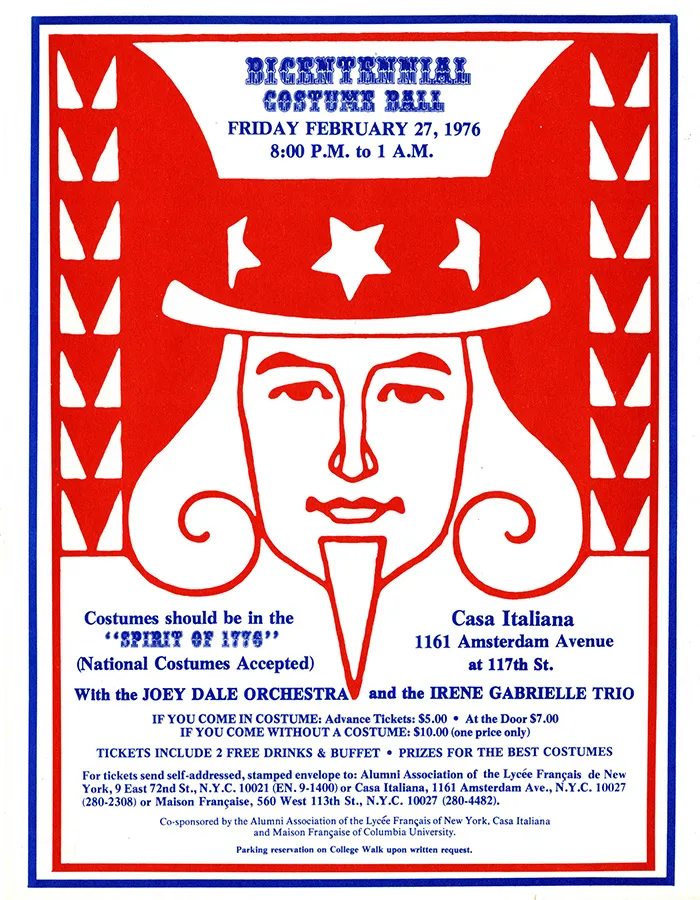
A few years ago, Rios was processing the papers of the Italian Academy when she came across a flyer for a costume ball. The graphic was a vivid red, white, and blue, unmistakably of its time.
“I thought the graphic for that poster was really phenomenal,” Rios said. “It stuck in my head how 1970s it looks.”
The discovery lodged itself in her mind, and when conversations began about what RBML might look into for the 250th anniversary, the connection was clear.
What she found in the University Archives was a rich picture of a university and a city during an extraordinarily difficult moment. In the mid-1970s, Columbia was carrying the weight of years of deficits that spiraled from the upheaval of 1968, with University President William McGill working to balance a budget deep in the red that wouldn’t reach a steady point until 1978.
“This University is not doing well, the city’s not doing well, but they’re gonna do something to mark the anniversary.”
New York City itself was in fiscal turmoil, the Bronx was burning, and the federal government had, infamously, refused to provide aid. The tabloid headline “Ford to City: Drop Dead” captures the moment precisely, said Rios.
Against that backdrop, to celebrate the founding of America felt … complicated.
Programming on a Shoestring
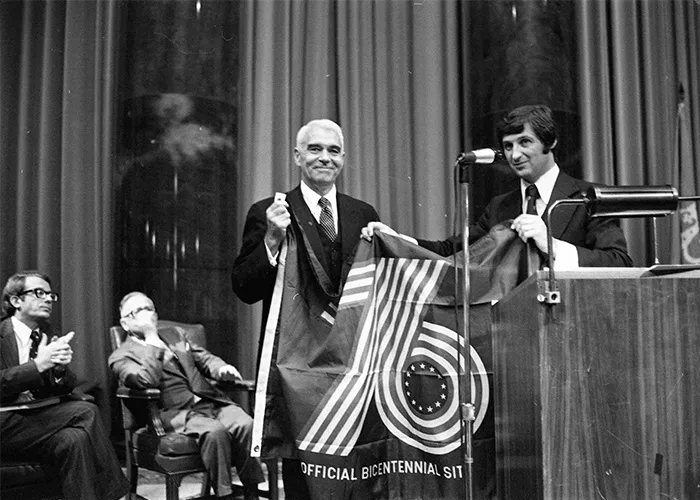
The celebrations Columbia hosted were “very Columbia,” Rios said: a lecture series, a major exhibition, the publication of the first volume of the John Jay Papers, a student arts festival featuring dance and film, and, in a detail that delights Rios, two nights of stand-up comedy by Robert Klein.
“Instead of this idea of, how can we do something big and splashy, it was, how can we do something homegrown and celebratory that is sort of us?” Rios said.
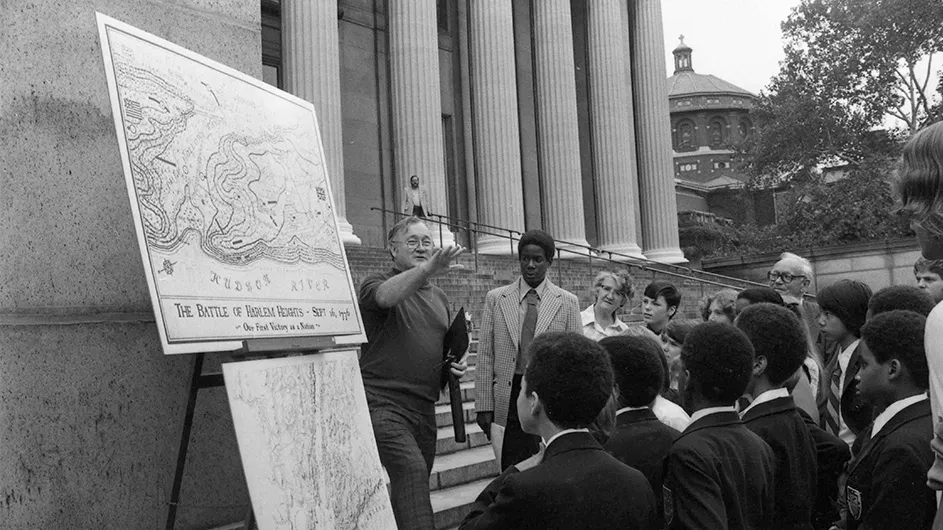
One photo in the collection captures the spirit of the whole enterprise. The late American History Professor James Shenton is pictured crouching down with Morningside Heights schoolchildren, pointing across the neighborhood to trace how troops moved during the Battle of Harlem Heights.
The children, smartly dressed in suits and ties, are looking at a map. The map was made by Lincoln Diamant (CC’43), a Columbia College alumnus who had traveled to the University of Michigan to study the papers of the British commander Henry Clinton and used that research to settle a long-running debate about exactly where the battle was fought. The answer? Right here, between Columbia and Barnard’s campuses.
The rest of the exhibition tells the same budgetary story.
“Everything is either handwritten or on a typewriter, because there is no budget for any of these things,” Rios said, pointing to a variety of examples from the archive. “Everything is sort of low budget, simple, plain, yet meaningful.”
Flyers were produced on personal letterhead. Programs were folded sheets of legal paper. The one beautiful piece of graphic design in the collection—a lush, professionally produced poster from the Maison Française and the Italian Academy—stands out precisely because it was an exception.
There’s also an incredible edition of Columbia College Today on display, which surveys students about a wide array of topics of the day, including how they felt about the future (44% confused, if you were wondering, with unemployment the top domestic area of concern).
Football, Ships, and a Debate
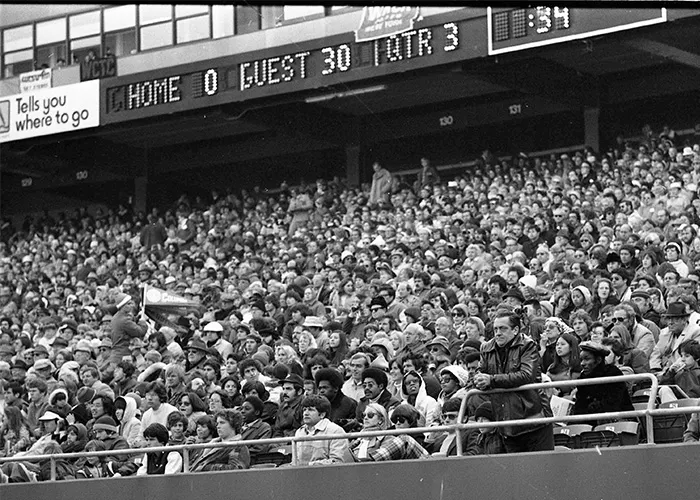
One of the highlights of 1976 was a football game that reads as a historical footnote in two ways. Columbia University (formerly King’s College) played Rutgers University (formerly Queen’s College), a meeting of two colonial-era institutions that was billed as the “Bicentennial Classic.” It was the second game ever held at the newly opened Meadowlands Sports Complex in New Jersey (which this summer is a World Cup venue for a different kind of football).
“If you read the write-ups of the game, they will tell you that everyone was really concerned: can people drive there? How’s the traffic going to be? Can they hold major events in this brand new arena?” Rios said, noting the concerns feel remarkably contemporary given current debates about the region’s transit infrastructure.
“We had over 42,000 people in attendance,” Rios said.
Columbia lost 47-0, but the program cover, illustrated by longtime Columbia Athletics cartoonist Charlie McGill of the Bergen County Record, is one of the gems on display in the exhibition.
That summer, tall ships sailed into New York Harbor for the grand Fourth of July celebration that, by many accounts, marked a turning point in the city’s morale. A similar event will take place this year, hosted by Sail 4th 250.
In the fall, Columbia hosted a screening of the first presidential debate between Jimmy Carter and Gerald Ford, organized by Philip Benson, Deputy to the President for Student Affairs, then the University's highest-ranking African American administrator.
Looking Back to King's College
The exhibition's deepest reach into the founding era comes through its treatment of Alice Bonnell, who served as the University’s Columbiana Curator (effectively a University Archivist before that title existed) and mounted a large exhibition in the Low Library Rotunda as the centerpiece of Columbia's 1976 programming.
Rios has reconstructed two of Bonnell's original display cases, honoring her predecessor's work while, in one instance, gently correcting it.
That correction involves one of the collection's more charming mythologies: the so-called Washington Telescope, long believed to be the instrument Columbia gave to George Washington during the Revolutionary War. Correspondence in the archives confirms that Washington did receive a telescope and thanked the University for it, but in the 1990s, researchers determined that the telescope Columbia now holds dates to 1784, acquired just after the college reopened as Columbia College, not during the King's College era.
Bonnell displayed the telescope as the genuine article; the new exhibition will set the record straight. “It's still pretty old,” Rios said. “But it's not the Washington one.”
Still, the letters are a tangible thread connecting King's College to General Washington, whose first battlefield victory, the Battle of Harlem Heights in September 1776, was won on what is now Columbia’s Morningside Heights campus.
The 1976 exhibition, like this one, was partly an exercise in Columbia reckoning with its own founding: the moment King's College became Columbia College, severing its ties to the British Empire and embracing a new national identity. That story sits at the heart of what Columbia News is now marking with its semiquincentennial landing page.
A Slice of Life, Not a Lesson
For all that the exhibition illuminates about 1776, Rios is careful to keep it firmly rooted in 1976 itself: “I'm focused on just a slice of life,” she said.
The parallels between 1776, 1976, and 2026 don’t need drawing out explicitly. A University that was already 222 years old in 1976, that had educated Alexander Hamilton and John Jay and Robert Livingston, where the Battle of Harlem Heights unfolded on its own future campus, and that still found itself scrambling to produce meaningful programming on no budget during a citywide fiscal crisis, is doing something remarkable simply by showing up to the anniversary.
“It was a difficult time, a different time,” Rios said. “But they stepped up and had this celebration. Budget, but still homegrown. And the things they did, they were very Columbia.”
Fifty years on, those efforts have made their way into the exhibition. The flag, the football program, the typewritten flyers, the poster—all of it sits on the sixth floor of Butler Library, waiting to be rediscovered.
The exhibition opens in the RBML display cases on Butler Library's sixth floor in time for Reunion Weekend (May 29) and runs through August 2026. The RBML is open Monday through Friday, 10 a.m. to 4 p.m. CUID holders may visit without an appointment; members of the public should register at the Library Information Office with a government-issued photo ID.
For more on Columbia's broader Semiquincentennial programming, visit America at 250: United States Semiquincentennial and Columbia.