What Is Antisemitism? Asks a New Book
Professor Mark Mazower guides readers through a history that seeks to illuminate rather than to blame.

For centuries, Christendom had a long-standing suspicion of its Jewish population. When the 20th century began, the vast majority of the world’s Jews still lived in Europe. For them, there was no confusion about where the threat of antisemitic politics lay, a threat that culminated with Nazi Germany and the Holocaust.
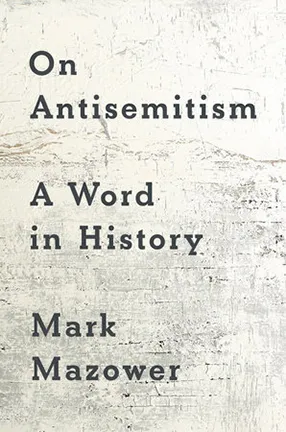
In On Antisemitism: A Word in History, Mark Mazower, Ira D. Wallach Professor of History, covers the period from the term’s invention in the late 19th century to the present, and argues that the landscape is now very different. More than four-fifths of the world’s Jews live in two countries, Israel and the United States. Before the Second World War, Jews were a minority apart, and drawn by opposition to Fascism into an alliance with other oppressed peoples. Now there is a Jewish nation-state and Israel’s treatment of the Palestinians has become a critical issue around the world.
Mazower shows how this geopolitical shift transformed the term, guiding the reader through a history that seeks to illuminate rather than to blame, demonstrating how the rise of a pessimistic, post-Holocaust sensibility, along with growing international criticism of Israel, produced a gradual conflation of the interests of Jews and the Jewish state. Half a century ago, few people believed that antisemitism had anything to do with hostility to Israel; today, mainstream Jewish voices often equate the two. The word remains the same, but its meaning has changed.
Mazower discusses the book with Columbia News, along with what books he’s read lately and those he’ll read next, what he’s teaching this year, and who his ideal dinner guests would be.
How did this book come about?
During the campus protests over Gaza, I, like many others, was struck by the confusion surrounding the term antisemitism. Although I have studied and taught modern European history for years, I did not understand the conflation of an ethnic prejudice with the issue of Israel-Palestine. This seemed to be a fairly new and problematic development, and I decided to explore what had been happening over the past few decades that might help explain it.
What do you see as being the way forward, in terms of fighting antisemitism?
In Alice Through the Looking Glass, Humpty Dumpty tells Alice you can make words mean what you want and then ram that meaning down other people’s throats. In a similar spirit, one of the predominant approaches to fighting antisemitism today is to litigate speech on the basis of the so-called International Holocaust Remembrance Alliance (IHRA) definition.
Unfortunately, this definition is poorly worded and ineffective in actually fighting prejudice. In fact, it discredits that fight because it leads to legitimate debate over the plight of the Palestinians being silenced and even criminalized, and it curtails discussion where it should be sacrosanct—in the classroom.
The reality is that there can be no serious effort to combat antisemitism until we see it as part of a larger struggle against racial prejudices of all kinds. We live in a world of prejudices, among them antisemitism. The fight against it is admirable and necessary. But not in a way that leads to moral and intellectual idiocy. Getting lawyers and their definitions out of pedagogy would be a start.
What books have you read lately that you recommend, and why?
I have been reading old volumes in the Penguin Famous Trials series––models of the storyteller's art that are now sadly out of print. Criminals also overlap with wordsmiths in Sarah Ogilvie's The Dictionary People, which recounts the lives of some of the volunteers from all over the world (and all walks of life) who crowd-sourced the first edition of the Oxford English Dictionary. Lexicographers are great guides to the strange and often surreal behavior of words, and some of our problems talking about antisemitism would be eased if we thought more about words in general.
What’s next on your reading list?
I have just begun Hunting the Falcon by John Guy and Julia Fox, which is about the relationship between Henry VIII and Anne Boleyn. Next up are Nasser Abu Srour’s The Tale of a Wall—the author’s memoir of the decades he has spent in an Israeli prison—and The Passenger by Ulrich Alexander Boschwitz, which tells the story of Germany’s descent into violence and the hero’s effort to escape it: Boschwitz himself did get out of the Third Reich, only to die at sea during the war before he was 30.
What are you teaching this semester, and in the spring?
I am teaching a seminar on the philosophy of history, which asks what historical knowledge is knowledge of—the past, obviously, but then, what is the past and what is its relationship to our changing present? Not easy questions to answer. After that, I will probably teach a seminar, which looks at how historians have approached the challenge of writing about individual human experience. Both courses bring that special pleasure that teaching wonderful students provides.
What are you working on now?
My current book project began with a glimpse of a dilapidated house in a Greek film from the 1970s. I became haunted by this house and decided to try to find out where and whose it was. The quest has led me into the secrets of a once powerful and wealthy family and the vanished world of the European upper-middle class. At the same time, it has turned into a kind of meditation on the strange business of being a historian.
Which three historians/scholars, dead or alive, would you invite to a dinner party, and why?
R.G. Collingwood because he achieved the miraculous feat of becoming a first-rate philosopher of history despite being British. The poet and classicist A.E. Housman so we could discuss poetry and landscape and how they intersect. (Also, I would love to encounter a real Victorian). And the 12th-century historian and princess, Anna Comnena, because no serious dinner party is complete without an attempted usurper to the Byzantine imperial throne among the guests. Anna’s subsequent confinement to a monastery––the Byzantine version of a sabbatical––gave her the time to write her great work on her father’s reign, so she is a glowing example of filial piety as well.