What Every Element of Columbia’s Academic Regalia Actually Means and the History Behind It
From a medieval cleric’s cloak to a signature Columbia Blue gown, the caps, hoods, and robes worn for Commencement carry centuries of history.
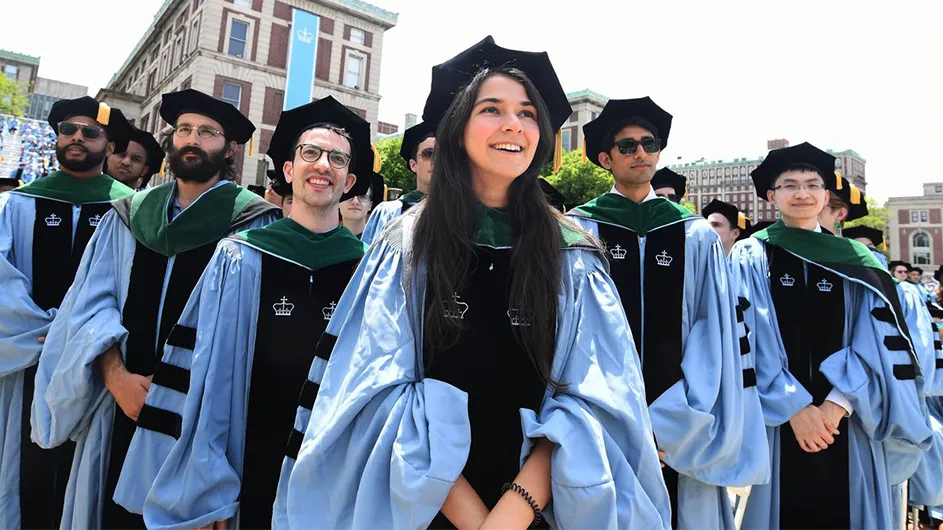
When Columbia University graduates line up each May for Commencement, they wear history. Gowns, hoods, mortarboards, and tams (and even more recent additions like stoles and cords!) are a direct connection to the garments worn by scholars and religious clerics in early centuries, the world over.
Back then, long, closed robes were thought to be worn mainly for warmth in frigid buildings, but over the centuries, universities began to adopt specific, official styles of regalia that had nothing to do with the quality of HVAC on campus.
As Mary Kemper Gunn documented in Guide to Academic Protocol (Columbia University Press, 1969), the transition from clerical dress to the ritual of academic costuming was gradual and shaped by tradition and institutional ambition to be set apart. The book is also a great crash course on the perfect tilt of a mortarboard for formal academic proceedings and exactly how one should invite various officers of the University to tea.
If that sounds like it warrants a learned society and a peer-reviewed journal, you are correct. The Burgon Society, founded in 2000 and registered as a charity in England and Wales, exists entirely for the study of academic dress: its design, history, and practice around the world. Its journal, Transactions of the Burgon Society, publishes original scholarship on everything from the evolution of the Oxford hood to the regalia customs of universities in sub-Saharan Africa. Its articles draw some 18,000 downloads per year.
Yes, this is real. Yes, it is eccentric in the best way. And, lucky for us, within Transactions Vol. 9’s pages lies an article titled “King’s Crowns: The History of Academic Dress at King’s College and Columbia University.” The paper involved an interview with a university president, a thorough review of Columbia Trustees’ meeting minutes, and visits to the University Archives.
Its author, Stephen Wolgast (JRN’92), is himself a Columbia graduate and now the Knight Chair in Audience and Community Engagement for News at the University of Kansas. Aside from being an award-winning journalist, he has edited Transactions since 2009 and, along the way, became a scholar of academic dress. Side note: In a follow-up paper, Wolgast pored through the digitized archives of the Columbia Spectator to uncover students’ own feelings on Columbia’s regalia going back to the 1870s.
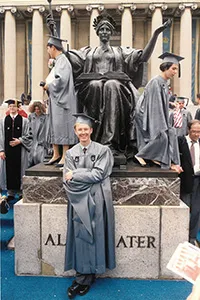
He first became interested in academic dress while in college, taking photos of a graduation ceremony when he saw a dean in elaborate regalia, which made him wonder, “What’s this all about?”
“I’d always been interested in maps, any kind of map,” Wolgast said. “And when you learn about a map, you have to look in the corner, at the legend: what do the symbols mean? I guess it’s this interest in trying to figure out what symbols and representations mean, whether it’s a two-dimensional graphic or something bigger.”
Even during his nine years at The New York Times, a tenure during which his team received a Pulitzer Prize for Public Service, this interest never left him. On slow days in May, Wolgast would wander over to the wire photo machine to look at the graduation season pictures coming in from campuses around the country, just to see how different each ceremony might look.
He couldn’t let the opportunity pass to visit Columbia’s University Archive to figure out how exactly the robes he wore to his own Columbia Commencement came to be, turning a longtime curiosity into something more formal. And, my, was there history there.
After finding The Burgon Society through a Wikipedia rabbit hole one day, he finally had a place to put that research.
A Quick History in Black
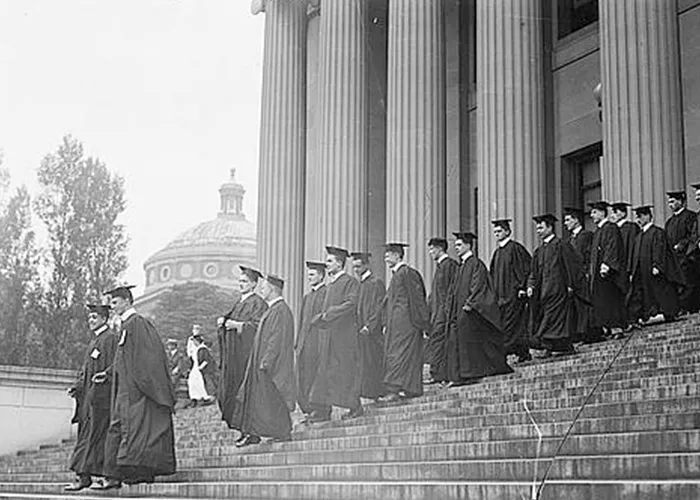
Columbia opened its doors in 1754 as King’s College, and many of its academic customs mirrored those of England. That meant black gowns for academic costume. Columbia’s second president, Myles Cooper, took it even further, making gowns mandatory on campus every single day, even off campus.
According to Wolgast’s research, this was not entirely about decorum: gambling dens and brothels of colonial Lower Manhattan were clustered right around the original location of King’s College, and a gowned student heading somewhere he shouldn’t be would be easier to spot!
The American Revolution ended that tradition. Daily gown-wearing stopped in 1776, along with much else associated with the British Empire. King’s College was closed to be used as a war hospital by both Patriot and Loyalist forces (Cooper, a loyalist through and through, fled to England). When it reopened in 1784, it was under a new name, Columbia College, and nothing codified what exactly students or graduates should wear. In 1785, a New York statute was published that said students would not be required to wear robes.
Yet students clamored for regalia to be brought back, petitioning Columbia’s Trustees several times for permission to wear gowns again in order “to be distinguished in their dress from the rest of their fellow citizens,” according to Wolgast’s research. In August 1788, the Trustees relented, writing: “That for the present, such of the students as choose to wear gowns, be, and they are hereby, permitted to wear them; and that the board of president and professors ascertain the distinctions between the different classes until the corporation make further regulations on the subject.”
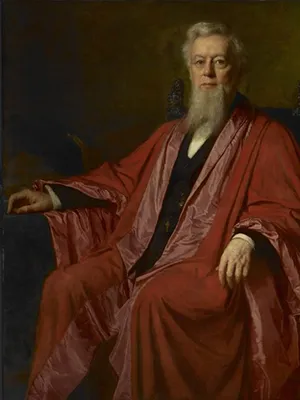
Academic dress had officially returned, but it wasn’t until 1887 that Columbia codified its own rules, including designating a scarlet gown for ceremonies. It was only the second Ivy League university, after Penn, to introduce a colorful gown. But it would be a century before Columbia completely deviated from the black robes for all degree levels.
By the 1880s, the majority of students and faculty had stopped wearing robes for day-to-day academic work, reserving them for special academic activities.
Here’s How to ‘Read the Regalia’
Headed to Columbia University Commencement and trying to figure out what it all means? We’ve got you covered. Here’s a handy table that will help you put together the story of an academic career and achievements.
Image Carousel with 5 slides
A carousel is a rotating set of images. Use the previous and next buttons to change the displayed slide
-
Slide 1: A 2015 Engineering Graduate’s yellow/gold shoulder cord (aguilette) designates a Senior Class Marshals, outstanding students of the senior class in good academic standing who have a record of contributing to their class, their school, and their community. These undergraduates are also wearing the standard square mortarboard, black tassel, and Columbia Blue robes. Photo by Chris Taggart
-
Slide 2: A great example of the oblong sleeve indicative of master’s degree, seen here on School of the Arts graduates in 2022. Photo by Diane Bondareff.
-
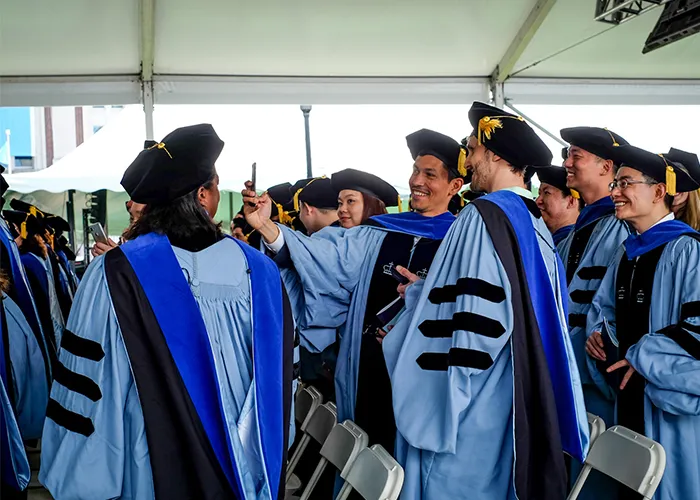
Slide 3: Doctoral graduates from the Graduate School of Arts and Sciences show off the doctoral robe, tam, and stole with a blue velvet trim, indicating academic discipline, and light blue and white lining, indicating degree-granting university (in this case, Columbia!). Photo courtesy Columbia University Graduate School of Arts and Sciences.
-
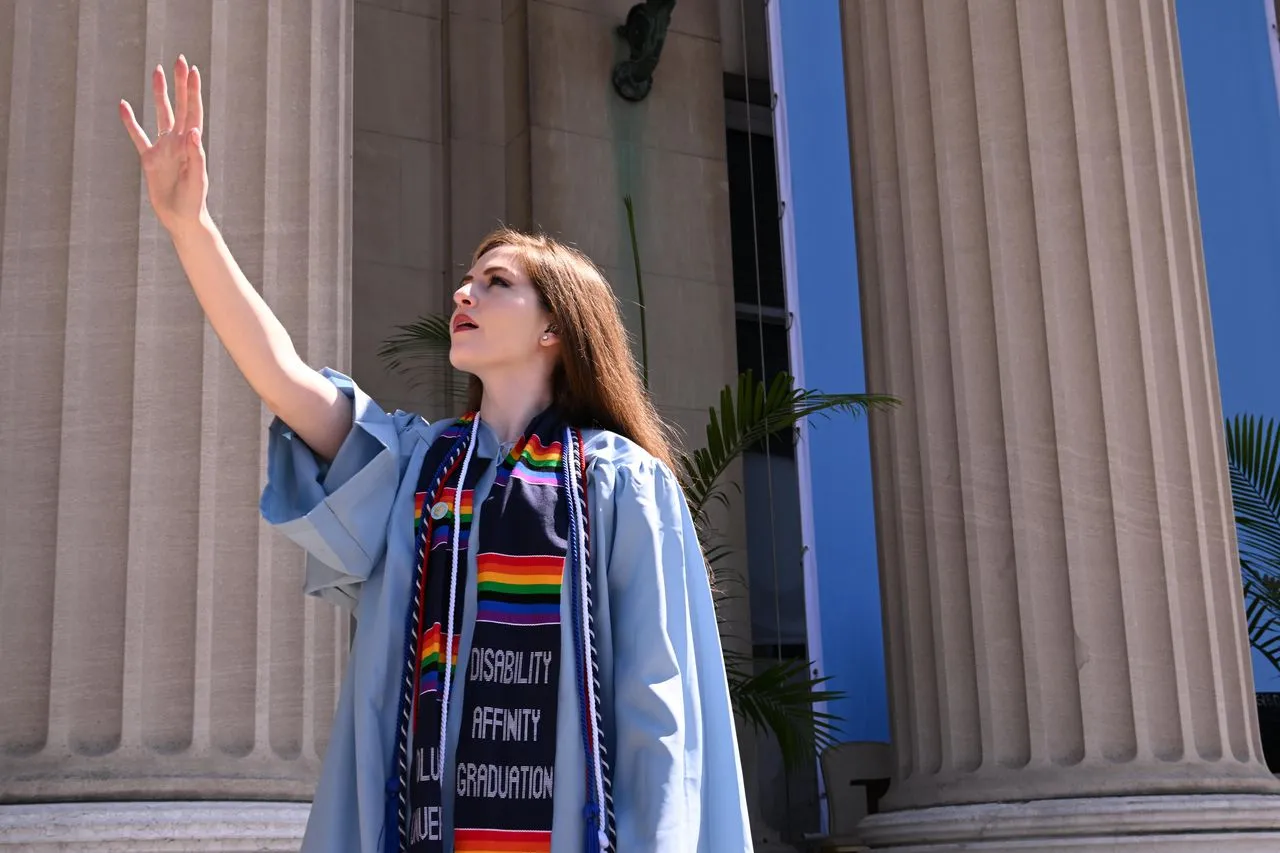
Slide 4: An example of a student-group stole and several kinds of honors/service cords. Photo by Eileen Barroso.
-
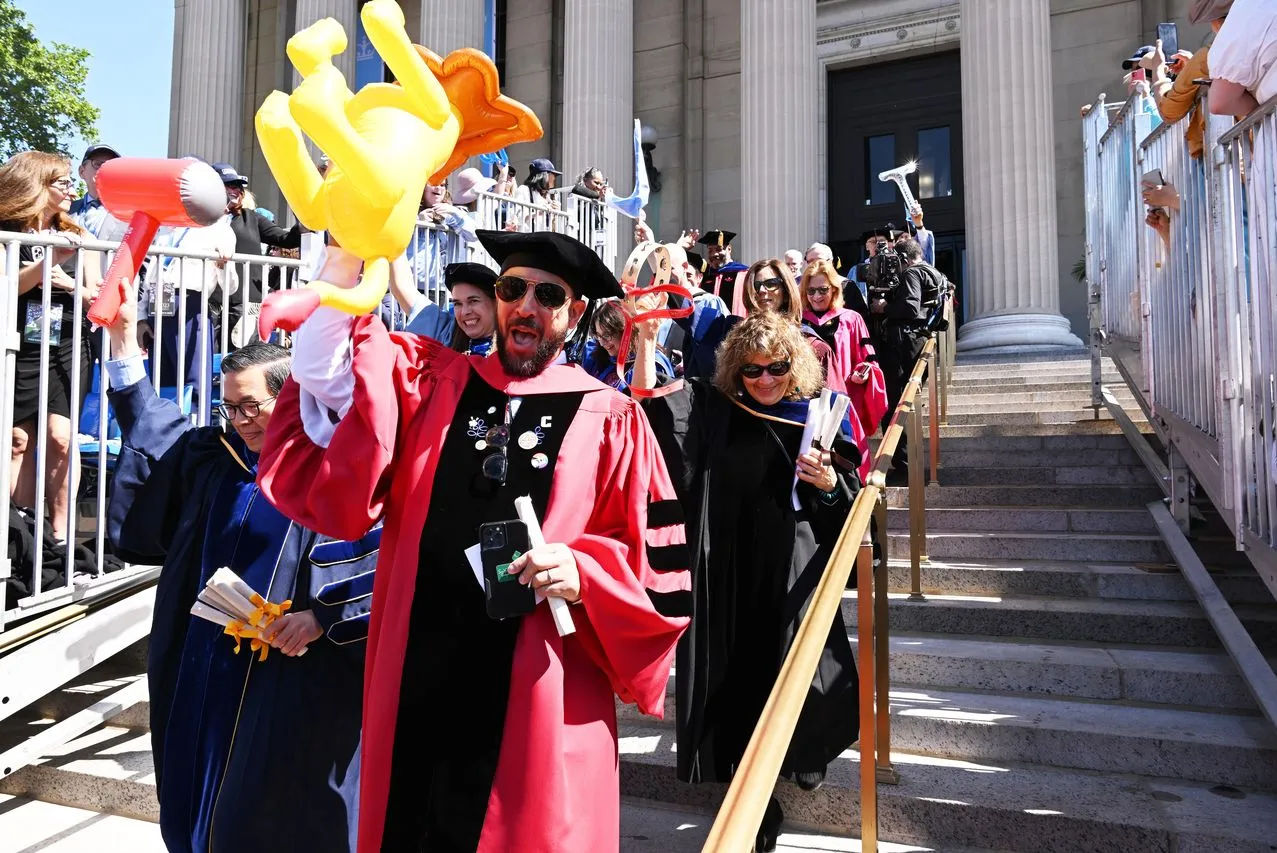
Slide 5: Columbia faculty and administrators process into the 2023 Commencement ceremony, showing a wide array of robes and doctoral hoods, indicative of their own alma maters. Photo by Eileen Barroso.


A National Code Written at Columbia
Columbia’s role in shaping American academic dress is largely unsung. In the 1890s, after codifying its own academic costume rules, Columbia President Seth Low convened an American Intercollegiate Commission to standardize the wild variety of caps and gowns that were by then in use across the country.
“The idea was so that you could tell at a glance where a man went to college, or what he studied,” Wolgast said. “You knew what degree he had by his gown, his field of study by the hood, and where he went to college by the lining—Columbia’s is blue with the white chevron.”
In March of 1895, the document was agreed to and prescribed gown types for each degree level, established hood lengths/lining colors to identify university and discipline, and (important to note here!) established black as the universal gown color, according to Wolgast’s research.
In October of that year, Columbia adopted the commission’s academic costume rules. When the new Morningside Heights campus was dedicated in 1896, students, faculty, and trustees were requested to wear this academic dress. In 1898, the trustees gave the faculty the right to wear academic dress at Commencement, and within several years, most universities in the United States had agreed to the group’s proposal as well.
There were notable exceptions, however, including Harvard University, which in 1902 added an embroidered double crow’s foot to the front panels of its gowns. Into the 1900s, more universities began to deviate from the norms set out in the code. Including, ironically, Columbia.
A Columbia Blue Exception, Evolving Traditions

For decades after 1895, Columbia graduates wore black, like almost everyone else. But something just didn’t seem to fit, and there were several attempts to change the color of academic attire for Columbians.
President Nicholas Murray Butler, who led the University for over four decades starting in 1902, was the first documented Columbia administrator to advocate for something more distinctive, proposing crowns on the gowns as early as the 1920s after noticing Harvard’s embroidered crow’s feet. However, Butler’s proposal went nowhere, as did attempts in the 1940s and 1950s.
According to Wolgast’s research, things changed at Columbia’s 1961 Commencement when President Grayson Kirk was taken by the crimson doctoral gown worn by the dean of Columbia College (a Harvard graduate) and began to advocate for Columbia to improve and individualize its regalia once more.
In 1963, Provost Jacques Barzun, the noted historian and author of The American University (1968), took up the challenge and decided he would redesign Columbia’s regalia from scratch, by hand. His objection to black? As anyone who has ever sat in one during a two-hour-long graduation ceremony knows: black gowns bake in the outdoor sun. A celebratory Commencement moment felt like a sweaty ordeal.
Barzun’s creation was a slate-grey gown (which appears as a cool-blue tone in direct sunlight) with Columbia crowns embroidered onto black fabric that’s stitched into the gown below the yoke, a nod to the University’s royal origins. The robes themselves had subtle changes over the years, mostly adhering to the Intercollegiate Code of Academic Costume’s guides on sleeve and hood styles.
In the 1980s, Columbia changed the robe manufacturer it used, shifting the color of the robes to “Columbia Grey,” which had even more blue in it, according to Wolgast. Over the years, changes in fabric and robe manufacturing subtly shifted in a more blue direction. In 2004, the University marked its 250th anniversary by changing the gowns to an even lighter shade of blue. By 2010, the current shade of the gown was officially settled on as “Columbia Blue.”
It should be noted, however, that by the end of the 1960s, several other universities across the country and all Ivy League universities had followed suit and chosen their own colors for their official academic costume. The great unraveling of codified American academic dress had begun.

One exception to the Columbia Blue robes you might see at Commencement? The costume worn by the University’s mace bearer. The mace, crafted of Sheffield plate and crowned with acanthus leaves, represents Columbia's authority to confer degrees. In 1966, the mace bearer was given distinctive robes to wear at Commencement because he had no academic dress of his own. For reasons lost to history, the gown is red wool with white facings and sleeve linings. You might also notice University Trustees and the University President wearing a flat, light-blue hood in place of the normal doctoral cowl-shaped hood.
To add to the pageantry, in recent years, students from each school have taken to carrying inflatable representations of their school’s mascot or symbol at Commencement (a tambourine for School of the Arts; a lion for Columbia College; an owl for Columbia General Studies; an international flag for the School of International and Public Affairs, and the like). A joyful (and unofficial!) modern addition to a very old ritual.
All in all, that sea of light Columbia Blue robes on Commencement Day is a rare distinction, one of the most recognizable visual markers of a Columbia degree.
As a journalism professor who now wears his Columbia gown every year at his university’s commencement proceedings, Wolgast said it’s nice to wear something that stands out from the sea of (mostly) black.
“To me, it represents my journalism education from an excellent journalism school, one that stands up for First Amendment rights and free expression in a way a lot of other programs might not be able to.
“The gown is a representation that you have now joined this long line of scholars. People have been studying and trying to learn more formally for centuries. It’s a symbol that you have joined that line, to broaden the understanding that we as individuals, and as a society, have of who we are, where we came from, and where we can go.”