What Would Cats Chase If Not For This?
In 1951, Columbia’s Charles Townes came up with the idea for the device that led to the laser. It earned him a Nobel Prize.
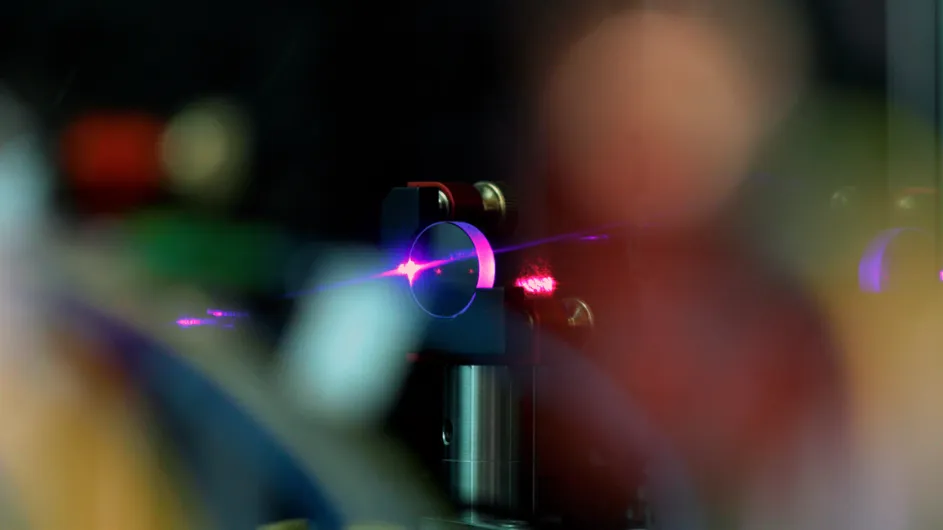
We use lasers almost everywhere in our daily lives—from hand-held pointers, laser printers, and barcode scanners to LIDAR, LASIK, and fiber optic telecommunications networks.
But did you know that the laser traces its origins to Columbia physicist Charles Townes, and his somewhat lesser-known invention, the maser? Though not as ubiquitous as lasers, masers play an important role in astrophysics and atomic clocks, and they paved the way for the lasers we use today.
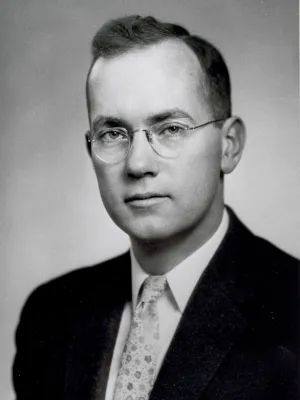
The acronym “maser” stands for “Microwave Amplification by Stimulated Emission of Radiation.” (the “l” in laser stands for “light”). Townes conceived the theoretical idea of the maser while sitting on a park bench in Washington, D.C., in 1951, three years after joining Columbia. During World War II, he had worked at Bell Telephone Laboratories on radar technologies, before turning his attention to microwaves. Townes wanted to develop an extremely stable, steady beam of microwave energy. That steady energy could, in theory, unlock our ability to study atoms and molecules and advance research in areas including astro and nuclear physics, telecommunications, and power transmission.
In 1954, in Pupin Hall, Townes’ idea became a reality when he and his lab members built the first maser device, a cabinet-sized box filled with glass tubes, metal rods, and ammonia gas.
In 1958, Townes co-authored a theoretical paper proposing that the maser technique could be extended to amplify light. However, Theodore Maiman at Hughes Research Laboratories in California beat him to building a working device. In 1960, Maiman debuted the world’s first laser, which used a ruby to amplify red light.
Microwaves and light rays are just different regions of the electromagnetic spectrum. You can think of the electromagnetic spectrum as an oscillating line: at one end, there are low-frequency, long-wavelength radio and microwaves; at the other, high-frequency, short-wavelength X-ray and gamma rays. The part of the electromagnetic spectrum that we can see, visible light, falls roughly in the middle. The energy of the entire electromagnetic spectrum is represented by quantum particles called photons.
Photons normally bounce around the ambient environment and are emitted freely from devices like light bulbs, flashlights, and microwave ovens. But photons also abide by the rules of quantum mechanics and can become coherent; that is, individual photons can combine into a larger whole that shares the same quantum state.
In a simple laser, energy is added to a reflective tube, which “excites” electrons from a material that is inside the tube. Eventually, the electrons release that extra energy via a photon. These photons bounce back and forth until they take on one shared, coherent wavelength. They are then released from the tube as a concentrated beam of light with a particular color. Townes’ maser operated on a similar principle, with ammonium used as the medium to amplify microwaves; since then, other gases, like hydrogen, have been used in masers.
Townes shared the 1964 Nobel Prize in Physics for inventing the maser with Russian scientists Alexander Prokhorov and Nikolay Basov—the father of Dmitri Basov, who is currently the Higgins Professor of Physics and Physics Department Chair at Columbia. In the years that followed, lasers kept getting smaller and finding new applications that even Townes didn’t expect.
“I knew that masers and lasers would be important and I could see some applications for them, but I couldn’t possibly foresee all the applications, many of the things in fields that I wasn’t familiar with,” Townes recalled in an interview about his Nobel Prize. An early example from outside the physics lab came from the medical field, when surgeons adopted lasers to reattach retinas. “I’m so pleased when people tell me their eyes have been cured that way,” he said, 14 years before he passed away in 2015.
Lasers are now ubiquitous in medicine, industry, and our homes. Our cats, especially, thank Charles Townes for his innovation.
Want to learn more about Columbia University’s contributions to society? Visit Explore Columbia’s Impact.