Natural Areas May Acquire Too Little Nitrogen to Repair Climate
A study found that we have overestimated how much nitrogen enters natural ecosystems from the air. It has climate implications.
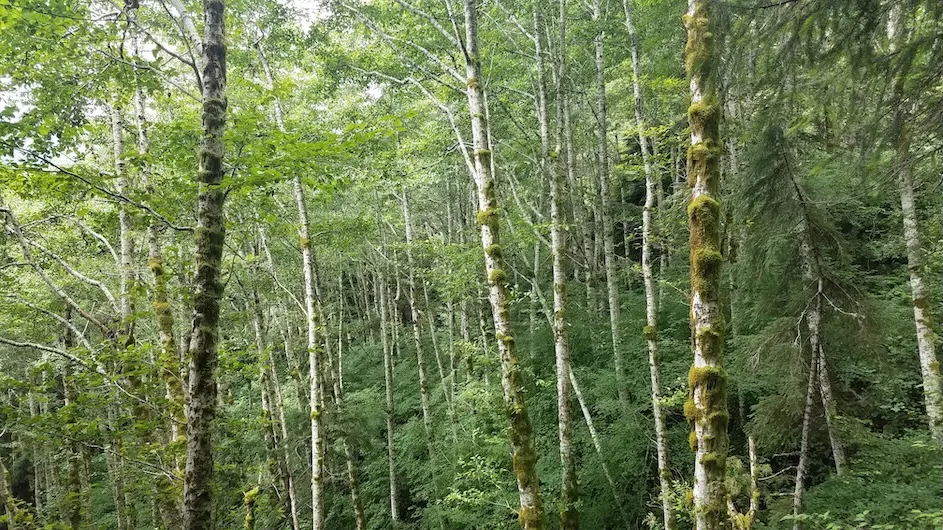
A new study indicates that forests, prairies, and other natural areas around the globe acquire less of the vital chemical element nitrogen than previously estimated.
The findings have climate implications as plants need nitrogen to remove carbon dioxide from the atmosphere.
Nitrogen makes up more than three-quarters of the Earth’s atmosphere (most of the rest is oxygen) and is essential to a range of life systems. The form of nitrogen in the atmosphere, nitrogen gas, is useless to life unless it is converted to a different form through a natural process called biological nitrogen fixation. Biological nitrogen fixation is conducted by specialized bacteria, some of which live in symbiosis with specialized plants. In agricultural settings, humans induce more nitrogen fixation by planting legumes like soybeans and alfalfa that host nitrogen-fixing bacteria.
The study published today in Nature finds that previous estimates of nitrogen fixation had been skewed by sampling bias: Field measurements of nitrogen fixation in natural areas had been taken in places where nitrogen-fixing organisms were 17 times more abundant than they are in natural habitats.
The study also shows a rise in agricultural nitrogen fixation that may be contributing to the degradation of land, air, and water quality.
The paper was inspired by research undertaken by Anika Staccone while she was a doctoral candidate at Columbia. Staccone’s dissertation research measured the abundance of the trees in which nitrogen fixation occurs, and used the abundance measurements to create an unbiased estimate of nitrogen fixation in trees in the United States. Convinced that Staccone’s approach could be scaled up, her dissertation advisor, Duncan Menge, a professor in Columbia’s Department of Ecology, Evolution and Environmental Biology, worked with colleagues to secure grant funding from the U.S. Geological Survey’s Powell Center. That grant funding supported the research that undergirds this new paper, which was led by Carla Reis Ely, a postdoctoral scholar in the Oregon State University College of Forestry.
“We’re so pleased that we were able to use Anika’s approach to provide this global estimate,” Menge said.
“In natural ecosystems, nitrogen fixation improves soil fertility and supports plant growth, thereby increasing carbon storage,” said Reis Ely, who led an international team of 24 scientists on the study, which included Staccone, Menge, and two other former Columbia PhD students, Benton Taylor and Sian Kou-Giesbrecht. “However, our new estimate of natural nitrogen fixation, based on improved scientific understanding, suggests less new nitrogen enters natural ecosystems.”
One implication of this finding is that these ecosystems may take up less carbon dioxide than scientists had thought previously. That means natural ecosystems could have a lower capacity to store carbon and mitigate climate change.
Meanwhile, the rise in agricultural nitrogen fixation is both a positive and a negative. Nitrogen fixation is essential for producing food for a growing global population and is generally more environmentally sustainable than synthetic nitrogen fertilizers, but food waste in the production and consumption chain is a big contributor to nitrogen pollution. Excess nitrogen in agriculture can cause harmful algal blooms downstream and air pollution downwind. In addition, surplus nitrogen can become nitrous oxide, a potent greenhouse gas, and high nitrogen levels can favor fast-growing invasive plants that squeeze out native species and reduce biodiversity.
“The findings have important if sobering implications for our climate and how to mitigate the worst effects of climate change,” said Menge.
This story was adapted from a press release by Oregon State University College of Forestry.