A Book Explores the Jewish Unconscious Before Freud
Clémence Boulouque shows how this theory was built on older Jewish ideas, which offered the possibility of emancipation to Jews as well as others.

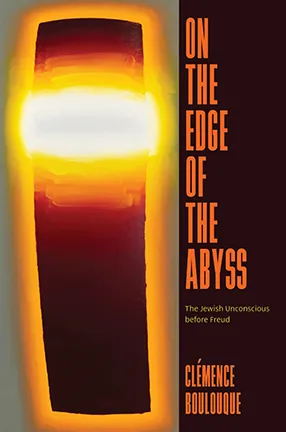
When Sigmund Freud published his theory of the unconscious, in 1899, he popularized an idea that had fascinated generations of Jewish philosophers before him. In On the Edge of the Abyss: The Jewish Unconscious Before Freud, Clémence Boulouque, Carl and Bernice Witten Associate Professor of Jewish and Israel Studies, Department of Religion, charts the development of the pre-Freudian unconscious from subcultural inquiry to dominant discourse during the 19th century. Although Freud’s scientific notion differed from Friedrich Schelling’s mythical description of the abyss from which creation springs, its resonance with older ideas was celebrated as an opportunity to express specifically Jewish contributions to modernity. Indeed, Boulouque shows that the pre-Freudian unconscious emerged from conversations in Jewish mysticism about otherness and coexistence. In the hopeful years before World War I, she argues, such reflections offered the possibility of emancipation not only to Jews, but to all.
Boulouque shares her thoughts on the book with Columbia News, as well as other books preoccupying her now, her current project, and what she’s teaching this year.
What was the impetus for this book?
One of my research interests is in the interaction between religion and psychology, and the attempts to reconcile religion and science—or modernity—more generally.
Can you give some examples from the book of what preceded the Freudian theory of the unconscious, how it was built on older Jewish ideas, and how this offered the possibility of emancipation to Jews as well as others?
The unconscious seems to have ushered in the 20th century. It arguably appeared in 1900, with Freud’s The Interpretation of Dreams. Yet the noun, “the unconscious,” was used for the first time by Schelling, in 1800, exactly a century before. The unconscious, first described by Schelling as an abyss from which creation springs forth, was in fact inspired by kabbalistic motifs. As a result, generations of Jewish thinkers made a case for the unconscious as a Jewish discovery, leveraging this to stake a claim for Judaism as both part of, and a source of, progress in science and culture. They recognized this specific philosophical and scientific construct, the unconscious, as a usable and reclaimable tool on which to build their defense of Judaism in periods of emancipation as well as of growing anti-Semitism.
The book reflects on the way science was appropriated by religious or ethnic groups once such scientific notions had entered a mainstream conversation. I investigate how these attitudes could be fruitfully put to work for understanding the self-fashioning of minorities and their interaction with the majority culture, in the 19th century and beyond.
What books have you read lately that you would recommend, and why?
Jan Morris, Trieste and the Meaning of Nowhere: A beautiful and meditative essay on the Italian port city—once a symbol of cosmopolitanism, home to James Joyce and Italo Svevo, and now a place steeped in literary nostalgia.
Claire Messud, This Strange Eventful History: A masterful saga that spans Algeria-France and the United States from 1940 to the 2010s.
Various works on Abd el Kader: The Sufi leader who resisted the French invasion of Algeria, Abd el Kader commanded a heroic and principled struggle before his eventual defeat. He later became an international figure of moral authority, known for his advocacy of dialogue and interreligious coexistence.
What’s next on your reading list?
Giorgio Bassani, The Novel of Ferrara: Bassani is best known for the poignant The Garden of the Finzi-Continis, but he is more than just its author—he is the chronicler, almost the scribe, of the wonderful city of Ferrara.
Eugene Rogan, The Damascus Events: The 1860 Massacre and the Making of the Modern Middle East.
What are you working on now?
I’m exploring concepts and modalities of reconciliation and forgiveness in the aftermath of mass violence, both within religious traditions and in Greek tragedy.
What are you teaching this semester?
I am only teaching one course because I am serving as director of graduate studies in the Religion Department and have course release. As always, I am excited to be teaching Literature Humanities. I look forward to spending a year with freshmen, reading these works that never stop teaching us.
Clémence Boulouque will discuss “The Jewish Unconscious before and after Freud,” with Professor Naomi Seidman, of the University of Toronto, at 6 pm on Wednesday, November 19, 2025, for the Institute of Israel and Jewish Studies’ Yosef Yerushalmi Annual Memorial Lecture.