Columbia Global Reports Saw the World Coming
Ten years ago, this publishing imprint, which is part of Columbia Journalism School, bet on emerging crises. Its books now read like early warnings.
More than a decade ago, as Nicholas Lemann wrapped up his 10-year stint as dean of Columbia Journalism School, the global narrative seemed to be moving in a single, reassuring direction. Globalization and liberal internationalism were the reigning faith, and there was hope that defeating terrorism would reaffirm a stable, American-led order—if not the so-called “end of history,” then something close to it. Economic recovery from the 2008 financial crisis was held up as evidence that growth had returned for good. Big Tech was treated as a national miracle. The Obama years had fostered a belief that institutions could bend toward justice, and that the future would bring the steady, technocratic march of progress.
But inside Pulitzer Hall on the Columbia Morningside campus, Lemann sensed something else: a tremor beneath the surface. Populism rising at the margins. Trust in institutions thinning. Inequality calcifying into anger. Work becoming more precarious. Silicon Valley more destabilizing. Democratic guardrails bending. Nativist, authoritarian forces stirring. Newsrooms were shuttering foreign bureaus, reorganizing around the 2016 election horse race, “pivoting” to video and podcasts, and chasing quick-hit stories that rose and fell with the day’s metrics.
“The stories that mattered most,” Lemann said, “were the big-picture, long-term ones most outlets weren’t looking at yet.”
That instinct became Columbia Global Reports (GCR). When then-Columbia President Lee C. Bollinger approached Lemann seeking a way to bring global issues to a wider public, they co-founded a publishing imprint based on a simple premise: commissioning, editing, and publishing short, deeply reported books on emerging global trends—stories not yet recognized as the forces shaping the world.
Ten years later, CGR’s early subjects look less like curiosities and more like warnings. Atossa Abrahamian’s The Cosmopolites (2015) exposed human rights inequality by looking at the lucrative global trade of citizenship rights. Haley Sweetland Edwards’s Shadow Courts (2016) examined the trade tribunals that fueled anti-globalization anger. John Judis’s The Populist Explosion (2016) charted the political revolt that would soon sweep the U.S., Europe, and beyond. Tim Wu’s The Curse of Bigness (2018) ushered in today’s antitrust battles with Big Tech.
“As a writer, Columbia Global Reports made it possible for me to explore important, complicated stories,” said Adam Kirsch, the author of two CGR books (The Global Novel, 2017, and The Revolt Against Humanity, 2023) and a forthcoming one (We Want to Believe). “As a reader, it has brought me insights about the world that I couldn’t have found anywhere else. In the landscape of American journalism, there’s nothing else like it.”
Looking Back to Understand Today
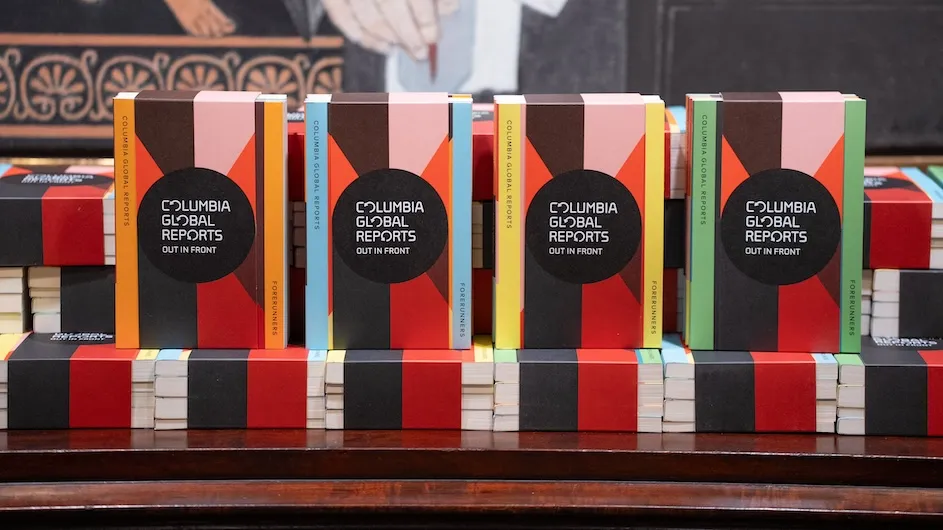
To mark its tenth anniversary, the imprint is making another counterintuitive move: looking a hundred years into the past. Its Forerunners series revives works published more than a century ago, during an earlier era of rupture and realignment that mirrors our own. That period confronted labor exploitation of women and the rapid reshaping of work (Elizabeth L. Banks’s Campaigns of Curiosity, 1894), the human cost of imperial conflict (Richard Harding Davis’s Cuba in War Time, 1897), resistance to the fight for racial equality (Kelly Miller’s Race Adjustment, 1908), and the need for a stronger and more expert federal government that would counter big business’s domination of American life (Walter Lippmann’s Drift and Mastery, 1914). The four Forerunners titles were released in October 2025 and marked the kickoff to a year of anniversary activities, which include a revamped website and special events in New York, Boston, and Washington, D.C.
“When we were thinking about why CGR exists, why we’re still around after ten years, we decided to look back and identify some works from a hundred years ago that sought to fulfill that same mission—books we would have published had we been around,” CGR publisher Jaime Leifer said. “They show that the problems we think of as uniquely modern—polarization, inequality, distrust—are part of a much longer story.”
Staying Small, Thinking Big
As CGR enters its second decade, it plans to remain deliberately small: six books a year, meticulously edited, fact-checked, and supported with reporting travel. That level of attention has become increasingly rare in publishing. The team will also keep seeking out new writers who are covering underreported stories and give them the support that can help establish a career. For some of CGR’s earliest authors, such as Abrahamian and Krithika Varagur, author of The Call (2020), their CGR books gave them their first taste of major book projects and national recognition.
The goal, Lemann said, is not only to identify emerging issues before the news cycle catches up, but to offer the historical, analytical, and narrative depth needed to understand them.
“If our first ten years were about catching early signals,” Lemann said, “our next ten are about finding ways through the polarization and conflict—before it’s too late.”