Ever Heard of an MRI?
Columbia physicist Isidor Isaac Rabi discovered nuclear magnetic resonance in the 1930s. Today, it lets doctors look inside patients.
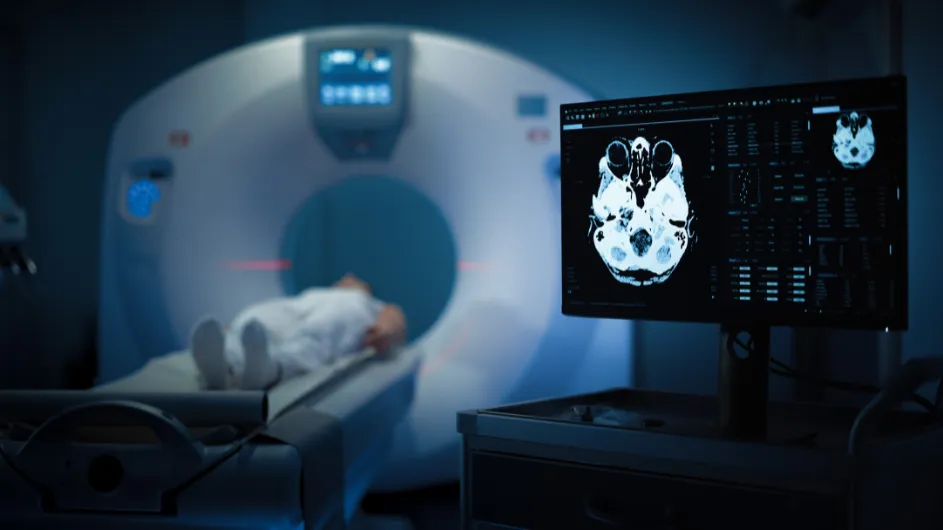
Did you know that if you’ve ever found yourself lying quietly inside a gently humming magnetic resonance imaging (MRI) machine, you’ve experienced quantum mechanics firsthand? And that these medical machines trace their roots to Columbia and physicist Isidor Isaac Rabi?
Rabi, who received his PhD from Columbia in 1927, was the sole winner of the 1944 Nobel Prize in Physics for “his resonance method for recording the magnetic properties of atomic nuclei.” In the coming decades, Rabi’s method and the observations it enabled would be transformed into the MRI machines we know today.
The first human MRI scan was performed in 1977, and MRIs, which use magnets and radio waves to create detailed images of the inside of the human body without a scalpel, catheter, or (in most cases) contrast agent in sight, are now routinely used in medical diagnostics around the world.
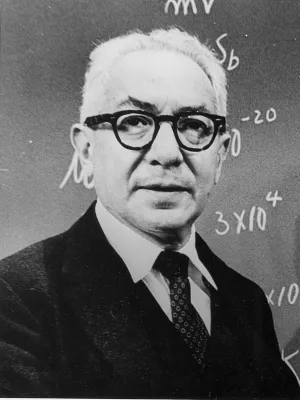
Rabi did not have medical aspirations in mind when, in the 1930s, as a young professor at Columbia, he began exploring the magnetic properties of crystals. He had recently returned from Europe, where he had spent two years learning about the emerging theory of quantum mechanics. In Room 803 of Pupin Hall, Rabi developed a new molecular beam method that let him probe the center of an atom, its nucleus.
The protons inside a nucleus have a quantum property called spin, which is usually random. Rabi’s method uses a strong magnetic field to force the protons to spin in the same direction, followed by a quick burst of radio waves, which throws them back out of alignment. As the protons line back up with the magnetic field, they emit a detectable amount of energy that is characteristic of the particular atom or molecule being probed.
To Rabi, this was a means to study magnetic properties at subatomic scales. To subsequent researchers, engineers, and doctors, it became a non-invasive way to map the body. Different tissues release varying amounts of energy and at different rates. Today’s MRI machines translate these energy differences into detailed images.
Rabi first published his method in 1938. He then left Columbia for a time during World War II to help direct the Radiation Laboratory at the Massachusetts Institute of Technology; the “Rad Lab,” as it came to be known, was instrumental in the development of radar and the atomic bomb (which has its own roots at Columbia). In 1945, he returned as chair of the Columbia physics department, which he transformed into one of the world’s leading physics departments. In 1964, he became the first faculty member to be designated a Columbia University Professor. He retired as University Professor Emeritus in 1967, but remained an active figure on campus.
Shortly before he passed away in 1988, Rabi found himself inside an MRI. “I saw myself in that machine. I never thought my work would come to this,” he recalled. In addition to MRI machines, Rabi’s magnetic resonance method would also prove key to the development of other Nobel-winning technologies, including ultraprecise atomic clocks, as well as masers and lasers (the former was invented by Charles Townes during his time at Columbia).
A titan of modern physics, Rabi is often credited as an early champion of “Big Science.” Following his time corralling researchers and resources for the Rad Lab and wartime research efforts, he helped establish the Brookhaven National Laboratory in Long Island in 1946 and the CERN facility in Geneva in 1952. Dedicated to peace and the power of science to help humanity, much of Rabi’s impact came from studying the world at some of its smallest scales.
Something to think about the next time you go in for a routine scan.
Want to learn more about Columbia University’s contributions to society? Visit Explore Columbia’s Impact.