14 Books Written by Faculty Members That Make Terrific Holiday Gifts
Fiction, nonfiction, memoir, history, essays, language, art history, architecture, climate—we’ve got you covered with this diverse list of books.
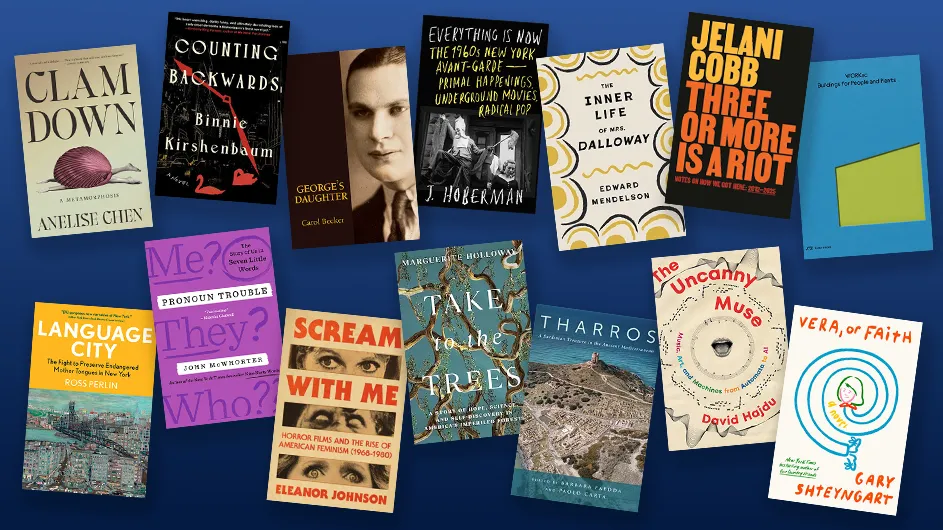
From Gary Shteyngart’s novel Vera, or Faith, a portrait of the loving but troubled Bradford-Shmulkin family, a modern blend of Russian, Jewish, Korean, and New England WASP, which is falling apart, thanks to the pressures of life in an unstable America; to John McWhorter’s Pronoun Trouble, a guide to the history and usage of those pesky yet necessary short words; Scream With Me, Eleanor Johnson’s take on how classic horror films demonstrate larger cultural attitudes about women’s rights, bodily autonomy, and more; and Clam Down, Anelise Chen’s hybrid memoir written in novelistic prose in which, after the dissolution of her marriage, a writer is transformed into a clam via a typo, when her mother keeps texting her to “clam down,” Columbia faculty have published a wide range of books in 2025. Here is a sampling, all of them great gift ideas for this holiday season.
Buildings for People and Plants by WORKac
By Amale Andraos and Dan Wood
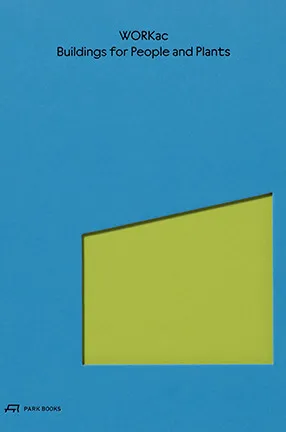
Buildings for People and Plants by WORKac is an exploration of 10 recent projects by the New York-based design firm WORKac, navigating through the interconnected realms of architecture, environment, community-centric design, and social sustainability. In the book, WORKac co-founders Amale Andraos, dean emerita and professor at the Graduate School of Architecture, Planning, and Preservation (GSAPP), and Dan Wood (GSAPP’92), who has taught at GSAPP, take readers on a tour of such projects as the Rhode Island School of Design’s Student Success Center and the Miami Museum Garage. The book includes an introductory essay by Andraos and Wood, and a visual presentation that showcases how WORKac’s architectural projects engage with their specific cultural and environmental contexts to support both people and plants. Also featured is a conversation with the two architects, conducted by the Orange County Museum of Art’s director Heidi Zuckerman, an essay by architecture critic Nicolai Ouroussoff, and an appendix with detailed information on the projects presented in the volume.
Read a Columbia News interview with Professors Andraos and Wood about the book.
George’s Daughter
By Carol Becker
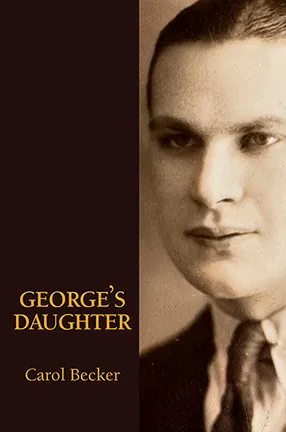
Dean Emerita of the School of the Arts Carol Becker has written a new book, George’s Daughter, which is both memoir and essay. Becker, still a professor at SoA, tells the tale of her beloved, but domineering and racist father in post-World War II Brooklyn. The family lived in Crown Heights, which, at the time, was where survivors from concentration camps settled and built new lives. In the following years, racial and religious discrimination again came to the fore, and Becker found herself increasingly at odds with her out-of-touch father. When he disapproved of her new romantic partner, a rupture threatened to ruin the family forever.
Read a Columbia News interview with Professor Becker about the book.
Clam Down
By Anelise Chen
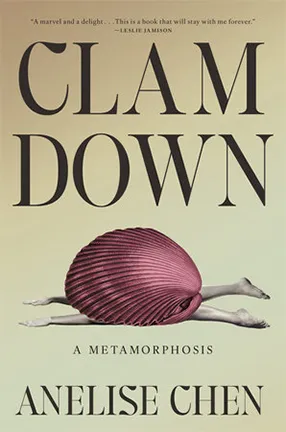
We’ve all heard the story about waking up as a cockroach—but what if a crisis turned you into a clam? After the dissolution of her marriage, a writer is transformed into a clam via a typo, after her mother keeps texting her to “clam down.” This is the premise of School of the Arts Associate Writing Professor Anelise Chen’s hybrid memoir, Clam Down. The funny, if unhelpful, command forces her to ask what it means to “clam down”—to retreat, hide, close up, and stay silent. Idiomatically, we are said to “clam up” when we can’t speak, and to “come out of our shell” when we reemerge, transformed. In order to understand her path, the clam digs into examples of others who have embraced lives of reclusiveness and extremity. Finally, she confronts her own clam genealogy to interview her father, who disappeared for a decade to write a mysterious accounting software called Shell Computing. By excavating his past to better understand his decisions, she learns not only how to forgive him, but also how to move on from her own wounds of abandonment and insecurity. Using a genre-defying structure, and written in novelistic prose that draws from art, literature, and natural history, Chen unfolds a story of interspecies connectedness, in which humans learn lessons of adaptation and survival from their mollusk kin. While it makes sense in certain situations to retreat behind fortified walls, the choice to do so also exacts a price.
Read a Columbia News interview with Professor Chen about the book.
Three or More Is a Riot: Notes on How We Got Here
By Jelani Cobb
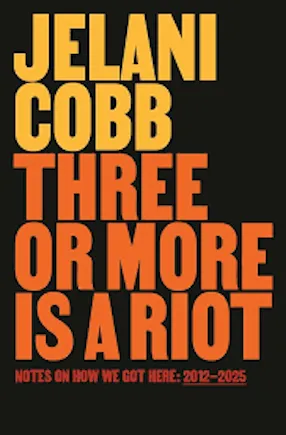
From the moment that Trayvon Martin’s murder initiated the Black Lives Matter movement in 2014, America has been convulsed by new social movements—around guns, gender violence, sexual harassment, race, policing, and so on—as well as an equally powerful backlash that abetted the rise of the MAGA movement. In Three or More Is a Riot: Notes on How We Got Here, Jelani Cobb, Dean of Columbia Journalism School and Henry R. Luce Professor of Journalism, provides a powerful collection of dispatches, mostly published in The New Yorker, which guide readers through this chaotic era. Cobb’s work as a reporter takes readers to the front lines of sometimes violent conflict, and he uses his gifts as a critic and historian to crack open the meaning of it all. Through a mix of narrative journalism, criticism, and penetrating profiles, Cobb’s writing captures the crises, characters, movements, and art of an era. Cobb has added new material to this collection—retrospective pieces that bring these stories up-to-date and tie them together, shaping these dispatches into a cohesive narrative of one of the most consequential periods of recent American history.
Read a Columbia News interview with Professor Cobb about the book.
Tharros: A Sardinian Treasure in the Ancient Mediterranean
By Barbara Faedda
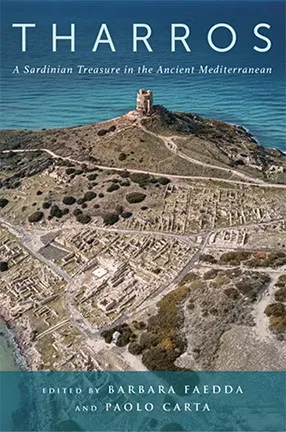
For nearly a thousand years, the city of Tharros in western Sardinia was central to trade routes and cultural exchange, a hub connecting North Africa, the Balearic Islands, and the Eastern Mediterranean. This strategic port’s earliest ruins, dating from the seventh century BCE, were likely constructed by Punic settlers from North Africa. The Carthaginians built temples and tombs; the Romans, who arrived in the third century BCE, erected their own infrastructure, such as public baths and aqueducts. Tharros was eventually abandoned around 1000 CE. The site was plundered over the centuries, and treasures from its tombs were widely trafficked. Tharros: A Sardinian Treasure in the Ancient Mediterranean, co-edited by Barbara Faedda, executive director of the Italian Academy and adjunct professor in the Italian Department, and Paolo Carta, a professor at the University of Trento, is the first English-language book to explore this rich archaeological site. Scholars of Sardinian and Mediterranean archaeology examine the history of excavations and the many significant discoveries that have been made at the site. Essays consider the religious beliefs, burial practices, material culture, and daily life of the inhabitants of ancient Tharros. Also showcased are the city’s architecture and artifacts—buildings and roads from the Bronze Age, the Punic era, ancient Roman times, and Christian centuries, along with treasured and everyday objects.
Read a Columbia News interview with Professor Faedda about the book.
The Uncanny Muse
By David Hajdu
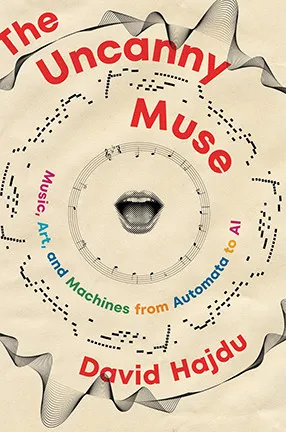
In The Uncanny Muse, Journalism Professor David Hajdu examines the history of automation in the arts from the Baroque period to the age of AI. He delves into one of the most controversial aspects of AI: artificial creativity. The adoption of technology and machinery has long transformed the world, but as the potential for artificial intelligence expands, Hajdu explores new, increasingly urgent questions about technology’s role in culture. From a life-size, mechanical doll that made headlines in Victorian London, to the doll’s modern, AI-pop star counterpart, Hajdu traces the varied ways in which inventors and artists have sought to emulate mental processes and mechanize creative production. For decades, machines and artists have engaged in expressing the human condition—along with the condition of living with machines—through player pianos, broadcasting technology, electric organs, digital movie effects, synthesizers, and motion capture. By communicating and informing human knowledge, machines have exerted considerable influence on the history of art.
Read a Columbia News interview with Professor Hajdu about the book.
Everything Is Now
By James Hoberman
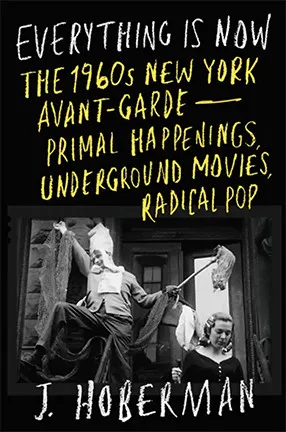
Like Paris in the 1920s, New York in the 1960s was a center of artistic innovation. As James Hoberman, adjunct professor of film and media studies at School of the Arts, shows in his book, Everything Is Now, boundaries were transgressed and new forms created. Drawing on interviews, memoirs, and the alternative press, he chronicles this collective history as it played out in coffeehouses, bars, lofts, storefront theaters, and streets. Hoberman covers such artists as Amiri Baraka, Bob Dylan, Allen Ginsberg, Yayoi Kusama, Yoko Ono, Nam June Paik, Carolee Schneeman, Jack Smith, Andy Warhol, and more. Some were associated with specific movements—avant rock, destruction art, fluxus, free jazz, guerrilla theater, happenings, mimeographed zines, pop art, protest folk, ridiculous theater, stand-up poetry, underground comix, underground movies. Others worked on their own.
Read a Columbia News interview with Professor Hoberman about the book.
Take to the Trees
By Marguerite Holloway
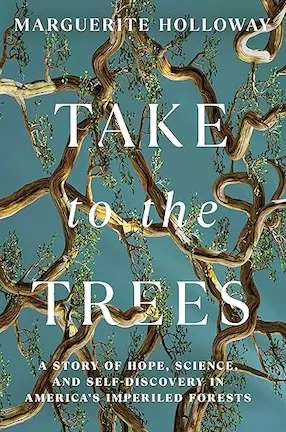
In 2017, Marguerite Holloway—a professor of science journalism at Columbia Journalism School who has written extensively about climate change and the environment—discovered an illustrated journal that her late mother had kept about many of the trees she had encountered and their natural history. That discovery set the gears turning for Holloway’s new book, Take to the Trees. In addition to exploring Holloway’s relationship with her mother and her experience with grief, the book includes extensive reporting on the latest climate change research, and showcases a range of people who are fighting to protect forests, including the arborists and tree climbers Bear LeVangie and Melissa LeVangie Ingersoll, who run the Women’s Tree Climbing Workshop, which Holloway became involved with.
Read a Columbia News interview with Professor Holloway about the book.
Scream With Me
By Eleanor Johnson
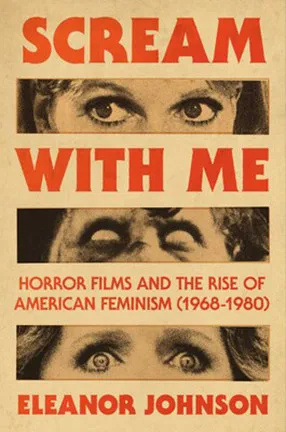
Scream With Me by Eleanor Johnson, a professor of English and comparative literature, sheds light on how classic horror films demonstrate larger cultural attitudes about women’s rights, bodily autonomy, and more. In May 2022, as the Supreme Court reversed Roe v. Wade, Johnson’s students were examining the 1968 film Rosemary’s Baby. She had a sudden epiphany: Horror cinema engages directly with the politics of women’s rights. Johnson reveals how classic films like Rosemary’s Baby, The Exorcist, and The Shining expose and critique issues of reproductive control, domestic violence, and patriarchal oppression. Scream With Me weaves these iconic films into the fabric of American feminism, showing that true horror often lies not in the supernatural, but in the familiar confines of the home, exposing the deep fears and realities of women’s lives. While the book is a celebration of seminal horror movies, Scream With Me also offers timely recognition of how this genre shapes and reflects cultural dialogues about gender and power.
Read a Columbia News with Professor Johnson about the book.
Counting Backwards
By Binnie Kirshenbaum
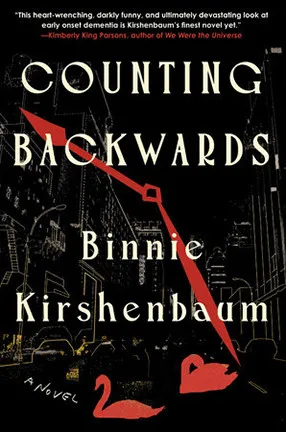
In Counting Backwards, School of the Arts Writing Professor Binnie Kirshenbaum tells the story of a middle-aged couple’s struggle with the husband’s descent into early onset Lewy body dementia. From their living room window, Leo begins hallucinating: He sees a man on stilts, an acting troupe, a pair of swans paddling on the Manhattan streets below. Then he’s unable to perform simple tasks, and experiences other erratic disturbances, none of which his doctors can explain. Leo, 53, a research scientist, and Addie, a collage artist, have a loving and happy marriage. They’d planned on many more years of work and travel, dinner with friends, quiet evenings at home with the cat. But as Leo’s periods of lucidity become rarer, those dreams fall away, and Addie finds herself less able to cope with an increasingly unbearable present. Eventually, Leo is diagnosed with early onset dementia in the form of Lewy body disease. Life expectancy ranges from 3 to 20 years. An uncharacteristic act of violence makes it clear that he cannot live at home. He moves first to an assisted living facility, and then to a small apartment with a caretaker, where, over time, he slips into full cognitive decline. Addie’s agony, anger, and guilt result in self-imposed isolation, which mirrors Leo’s diminished life. For years, all she can do is watch him die—too soon, and yet not soon enough.
Read a Columbia News interview with Professor Kirshenbaum about the book.
Pronoun Trouble
By John McWhorter
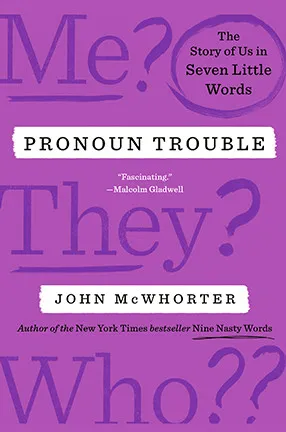
The nature of language is to shift and evolve. But every so often, a new usage creates a whole lot of consternation. These days, pronouns are throwing curveballs, and it matters, because pronoun habits die hard. Professor John McWhorter, who teaches linguistics, American studies, and music history, looks at these issues in Pronoun Trouble. If you need a refresher from eighth-grade English: Pronouns are short, used endlessly, and serve to point and direct, to orient us as to what is meant about who. Him, not her. Me, not you. Pronouns get a heavy workout, and as such, they become part of our hardwiring. To mess with our pronouns is to mess with us. Many of today’s hot-button pronoun controversies, however, are nonsense, as McWhorter makes clear in his book. The singular they has been with us since the 1400s, and appears in Shakespeare’s works. In fact, many of the supposedly iron-clad rules of grammar are up for debate (Jane and me went to the movies is perfectly logical!). With trivia, twists, and the quirks of early and contemporary English, McWhorter guides readers on a journey describing how pronouns emerged and have changed over time.
Read a Columbia News interview with Professor McWhorter about the book.
The Inner Life of Mrs. Dalloway
By Edward Mendelson
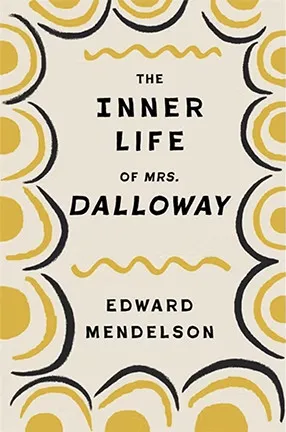
Mrs. Dalloway by Virginia Woolf is a novel about almost everything. The story of a single day in London after World War I, the book travels backward and forward in time and consciousness, venturing beyond the ordinary world into epic, mythic, and mystical modes. The novel is celebrated as much for its interwoven webs of meaning as for its moral and psychological vision. In The Inner Life of Mrs. Dalloway, Edward Mendelson, Lionel Trilling Professor in the Humanities, explores the novel’s deepest questions, focusing on the core themes of medicine, empire, and love. He traces how Woolf thought and wrote, considering the complexities and resonances of her works. Mendelson casts Mrs. Dalloway as an extended protest against authorities that wield power over others and a defense of the equality of inner lives. He also examines the place of the book in literary history, going back to Homer, Dante, and Shakespeare, as well as its influence on later writers from Erich Auerbach to Zadie Smith.
Read a Columbia News interview with Professor Mendelson about the book.
Language City
By Ross Perlin
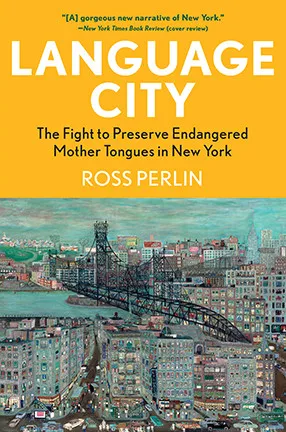
Half of all 7,000-plus human languages may disappear over the next century, and—because many have never been recorded—when they’re gone, it will be forever. Ross Perlin, a lecturer in Columbia’s Department of Slavic Languages and co-director of the Endangered Language Alliance, is racing against time to map little-known languages across New York. In his new book, Language City, Perlin follows six speakers of endangered languages deep into their communities, from the streets of Brooklyn and Queens to villages on the other side of the world, to learn how they are maintaining and reviving their languages against overwhelming odds. He explores the languages themselves, from rare sounds to sentence-long words to bits of grammar that encode entirely different worldviews. Seke is spoken by 700 people from five ancestral villages in Nepal, and a hundred others living in a single Brooklyn apartment building. N’ko is a radical new West African writing system now going global in Harlem and the Bronx. After centuries of colonization and displacement, Lenape, the city’s original indigenous language and the source of the name Manhattan, “the place where we get bows,” has just one native speaker, along with a small band of revivalists. Also profiled in the book are speakers of the indigenous Mexican language Nahuatl, the Central Asian minority language Wakhi, and Yiddish, braided alongside Perlin’s own complicated family legacy. On the 100th anniversary of a notorious anti-immigration law that closed America’s doors for decades, and the 400th anniversary of New York’s colonial founding, Perlin raises the alarm about growing political threats and the onslaught of languages like English and Spanish.
Read a Columbia News interview with Ross Perlin about the book.
Vera, or Faith
By Gary Shteyngart
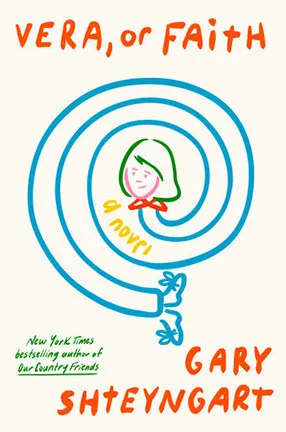
The cast of characters in Vera, or Faith, by Gary Shteyngart, professor of writing at School of the Arts, includes the Bradford-Shmulkin family, which is falling apart. A modern blend of Russian, Jewish, Korean, and New England WASP, they love one another deeply, but the pressures of life in an unstable America are fraying their bonds. There’s Daddy, a struggling, cash-thirsty editor whose Russian heritage gives him new currency in the world of 21st-century geopolitics; his wife, Anne Mom, a progressive, underfunded Boston blue blood who’s barely holding the household together; their son, Dylan, whose blond hair and Mayflower lineage provide him pride of place in the current American political order; and, above all, young Vera, half-Jewish, half-Korean, and a true original. Observant, sensitive, and always writing down new vocabulary words, Vera wants only three things in life—to make a friend at school; Daddy and Anne Mom to stay together; and to meet her birth mother, Mom Mom, who will at last tell Vera the secret of who she really is, and how to ensure love’s survival.
Read a Columbia News interview with Professor Shteyngart about the book.