Behind the Scenes: Columbia Students Create a Podcast Centering Afro-Latina Stories
How students in an advanced Columbia Spanish course create a public-facing podcast exploring Afro-Latina identity in the United States.
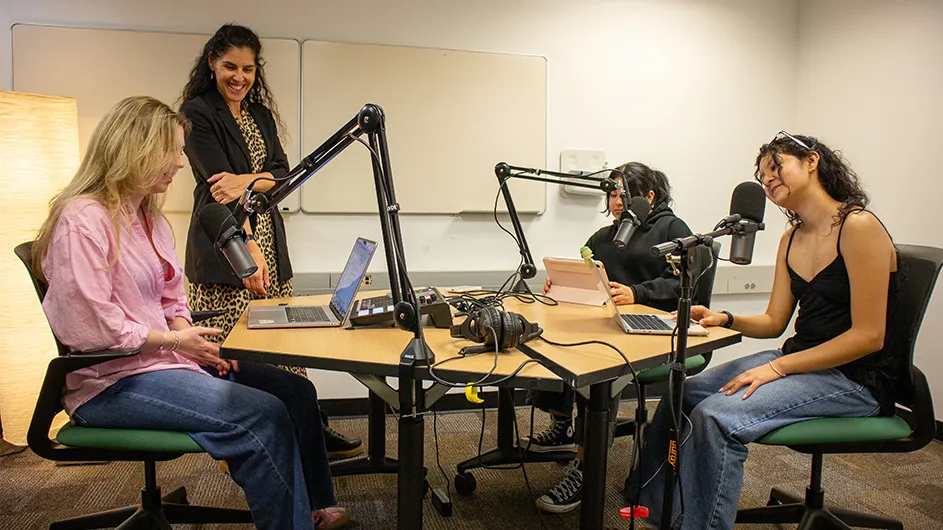
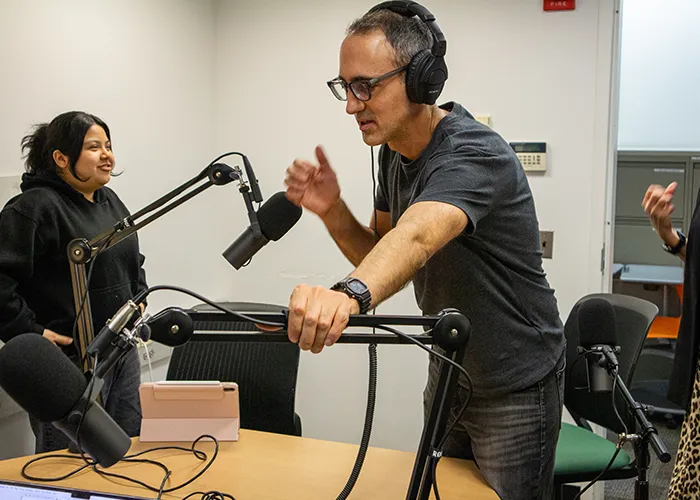
In the basement of the International Affairs Building on Columbia University’s Morningside Heights campus, down a hall through the Language Resource Center, three students lean toward their microphones, scripts open on laptops in front of them, and they begin to chat animatedly in Spanish.
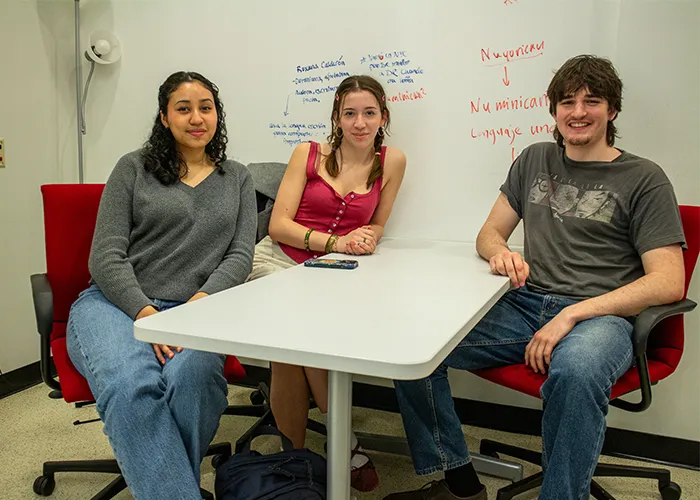
Next door, more small groups huddle around whiteboards, jotting down ideas in brightly colored markers (“Nuyoricans?” “revelación,” “tema central”) while striking through scripts and offering feedback.
This may sound like a podcast production studio, but it's actually a classroom. In an advanced Spanish course focused on Afro-Latina experiences in the United States, where issues of visibility, colorism, and access continue to shape whose stories are heard, students spend the semester producing their own podcast episodes.
Their work isn't only for a grade; it's part of a growing podcast series created by students that has real listenership: “Afrolatinas en Estados Unidos.”
Since one of the first Spanish-language podcasts was released in 2004, podcasting has become one of the fastest-growing forms of Spanish-language media, with audiences across the United States and the globe.
“Whatever my students did in class had to be out,” said Leyre Alejaldre Biel, Lecturer in Spanish in the Department of Latin American and Iberian Cultures, who created the course in 2023. “I was tired of students thinking, ‘I’m doing this in the language class, and the only person who is really listening is the professor.’”
Instead, the class operates more like a media production team. Each semester, students form editorial groups, choose topics, write scripts, and record episodes exploring issues related to Afro-Latina identity, culture, and history. To date, more than 30 episodes are available on Spotify, and the podcast just started releasing episodes for its fourth season.
Turning the Classroom Into a Studio
The road to creating the course and the podcast grew out of Alejaldre Biel's unconventional path to Columbia University, which spans high school classrooms, continents, and the study of language itself.
Originally from Spain and trained in linguistics and language pedagogy, Alejaldre Biel has spent much of her career teaching Spanish in different contexts. Teaching at a public high school in the South Bronx in the early 2000s was a seminal experience that led to higher education and roles teaching in and leading Spanish departments at universities in Barbados, The Gambia, and Thailand.
Those experiences, combined with her research in applied linguistics and language education, shaped her belief that language learning should connect to real-world conversations about culture and identity.
In 2017, when a faculty position opened up in Columbia's Department of Latin and Iberian Cultures, “it was a dream," Alejaldre Biel said.
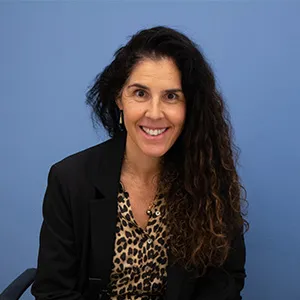
“One thing that New York has that I love is that it is like living in so many different places in one place, to be in contact with such a diversity of human beings,” Alejaldre Biel said. “It is what I miss most about living abroad. To be a good educator, a good professor or lecturer, you need to really understand your students. When you travel and live in different places for a long time, you learn different things from different parts of the world and integrate them. Then you apply them.”
That perspective eventually led her to a new experiment: turning her classroom into a podcast studio. While Alejaldre Biel teaches introductory and PhD-level Spanish courses at Columbia, "UN3300: Afrolatinas en Estados Unidos" is a more advanced undergraduate course, designed for heritage speakers and second language learners.
“I looked at the courses we were offering and none of them positioned women in the center,” she said. “I saw that there was a gap with the Afro-Latino, Afro-Latinx community.”
The podcast became a way for students to explore those topics while also developing their language skills in a new, more conversational context.
“Even as a native speaker, it is good to be reminded I don't know everything about the language,” said Catherine Enriquez (CC'29), whose team is producing a game show-style episode about Brooklyn-based storyteller Nydia Simone/@blactina. “It also feels really important to learn more and amplify the stories of the Afro-Latina community here in New York City.”
How the Podcast Is Made
In the first seasons of the podcast, the setup was simple: “I bought a microphone and recorded in class,” Alejaldre Biel said. “We created a studio in the classroom.”
Students gathered around the mic to record their conversations, while the rest of the class listened in and offered feedback.
Now the project is evolving. With support from the Language Resource Center (LRC), home to another popular Columbia podcast, “Said & Done," the class is beginning to record with professional equipment, giving students a glimpse of what producing a podcast in the real world looks like.
Christopher Kaiser, Associate Director of the LRC, said the studio where students record was transformed from a space for recording language tests and distance learning. He sees podcasts as a growing tool for language learning, so the transformation made a lot of sense.
Image Carousel with 4 slides
A carousel is a rotating set of images. Use the previous and next buttons to change the displayed slide
-
Slide 1: Ruby Perez (CC'27) records a segment of "Afrolatinas en Estados Unidos" about Nydia Simone. Photo by Kelly Moffitt-Hawasly.
-
Slide 2: Grace Holbrook (BC'29), Ruby Perez (CC'27), and Catherine Enriquez (CC'29) return to the brainstorm board after recording their podcast episode on Nydia Simone. Photo by Kelly Moffitt-Hawasly.
-
Slide 3: Christopher Kaiser, Associate Director of the Language Resource Center, sets up the recording studio for the Afrolatinas en Estados Unidos podcast. Photo by Kelly Moffitt-Hawasly.
-
Slide 4: Professor Alejaldre Biel offers advice on pronunciation during the podcast recording. Photo by Kelly Moffitt-Hawasly.
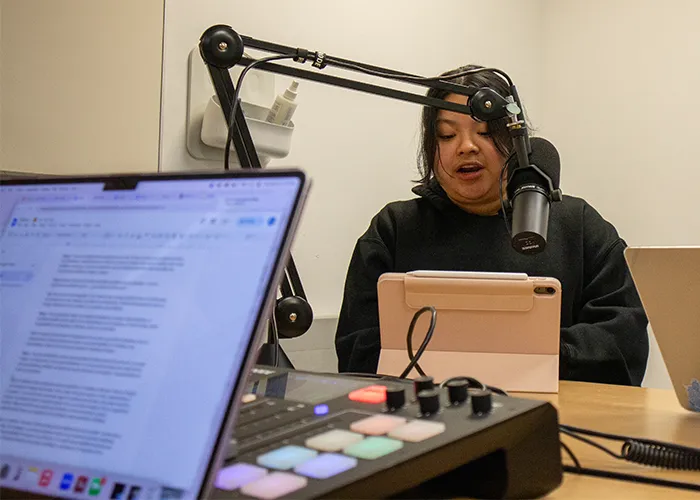
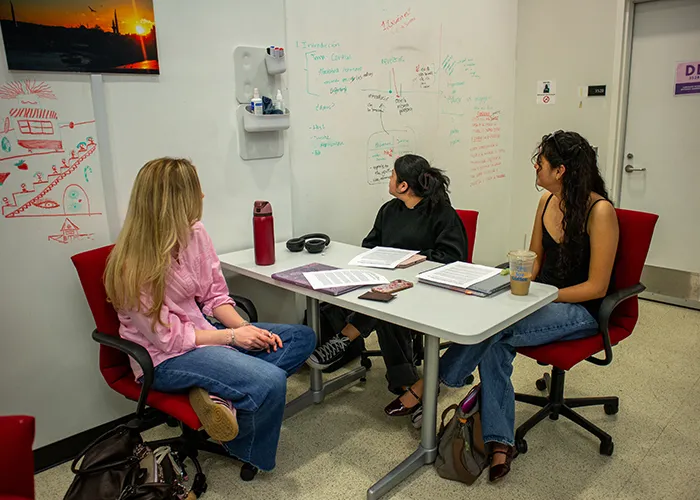
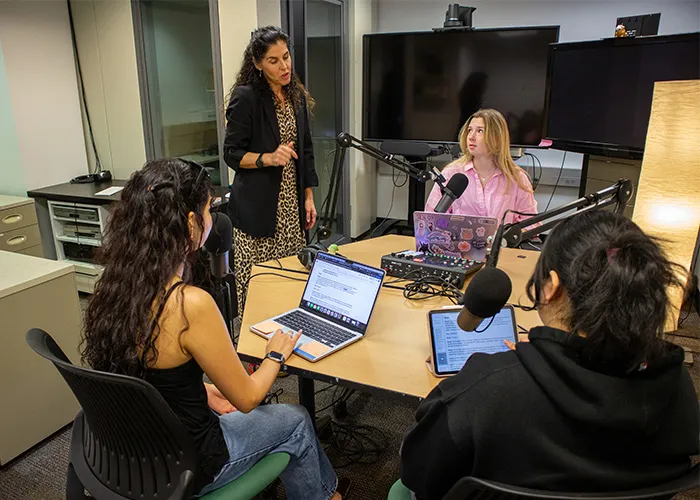
Early in the semester, students brainstorm potential episode ideas and form editorial teams. This spring, for example, four teams emerged who would work on each episode. Each team then researches its topic, writes a script, and records the discussion. After the recording, the rest of the class weighs in. The feedback helps students refine their episodes before they are finalized.
For many students, hearing their own voices in Spanish on a published podcast is both exciting and a little intimidating.
Andrew Murgitroyd (GS'27), whose team recorded an episode on writer and poet Roxana Calderón, is a Sciences Po/Columbia dual BA student studying human rights. The functional nature of the language they are learning and using is something he sees as being incredibly useful in his future work, even if he did not realize he'd be recording a podcast when he signed up for the course.
“It was a jump scare at first,” Murgitroyd said. “But I'm really happy with it. We brought the banter and tried to make it educational and informative.”
Jasmine Velasco (CC'26), a senior studying cognitive science who hails from The Bronx and identifies as Afro-Latina herself, is also working on the upcoming Calderón episode and has found the podcast a way to explore her Dominican-Mexican heritage as she prepares to pursue a career in radiation therapy.
Natasha Kolombo (CC'29), who hopes to go into immigration law, and Rinaz Jamal (CC'29), a pre-med student, are working on an episode about Afro-Mexican activist Alejandra Tentle. Their advice on podcast production?
“Make sure you consider the transitions,” Kolombo said. “Say your partner's name, tweak the script as you go so it sounds more conversational.”
After the episodes are recorded, Alejaldre Biel edits and scores them before they are released on Spotify, and then promoted through the @afrolatinasinspanish Instagram account.
Podcast Topics That Matter
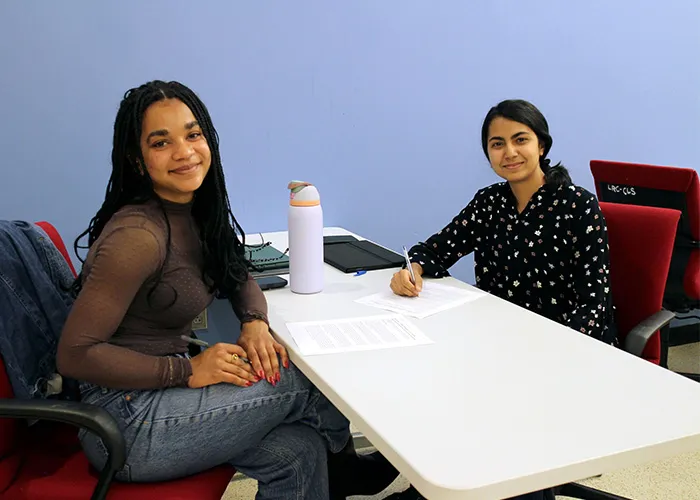
The episodes tackle a wide range of topics connected to Afro-Latina identity in the United States. Students explore questions of representation, beauty standards, activism, and culture, often discovering connections between language and identity along the way.
For Alejaldre Biel, those conversations also come with responsibility. Afro-Latina voices have often been underrepresented in both media and academia, something she asks students to consider as they develop their episodes.
“I tell them, ‘Students, people are listening to us. They are listening to you.’”
“When you teach with a perspective of the colonizer, you erase many stories that are very important for that culture, for the construction of the language, for the construction of the identity,” she said.
Part of the goal of the podcast, she added, is to push against that erasure: “I think that students being able to talk about these Afro-Latinas figures, organizations, and achievements is a great way to give visibility to all," Alejaldre Biel said.
She also encourages students to engage thoughtfully with the communities they’re representing, and to consider whose voices are centered in the stories they tell. Guest speakers to the class, such as Tentle, share their personal experiences and perspectives, which help inform the podcast production.
Beyond the Classroom
The podcast is growing. Alejaldre Biel is developing a digital platform where episodes will be paired with listening exercises and discussion materials for Spanish learners.
“We’re going to host all the episodes with listening comprehension activities,” Alejaldre Biel said. “Traditional ones to practice listening, and then more advanced discussions about culture and identity.”
Students also visit Columbia’s Rare Book and Manuscript Library as part of the course, exploring archival materials related to Afro-Latina history that sometimes inspire new podcast topics. The work of Josefina Báez, an innovative Afro-Latina artist known first for her groundbreaking work Dominicanish, is archived at Columbia in the Latino Arts and Activisms Collections.
Here's one episode that explores that collection specifically:
But the most important element of the project is simple: students know that someone beyond their classroom is listening. What they're talking about could help a Spanish language learner, while also reflecting stories of Afrolatinidad that more people should know.
“I tell them, ‘Students, people are listening to us,’” Alejaldre Biel said. “They are listening to you.’”