Columbia Celebrates Its Next President, Jennifer L. Mnookin
In an afternoon of thanks and inspiration, the future of the University looks bright.
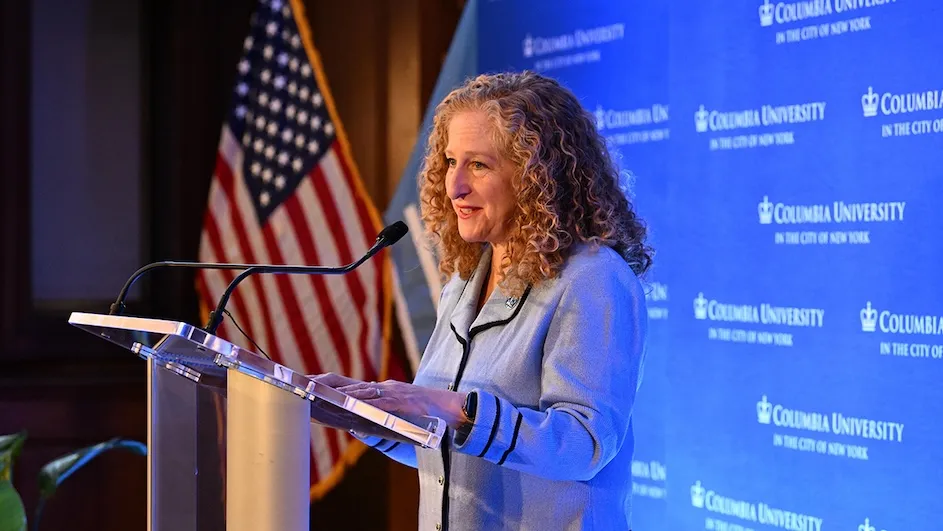
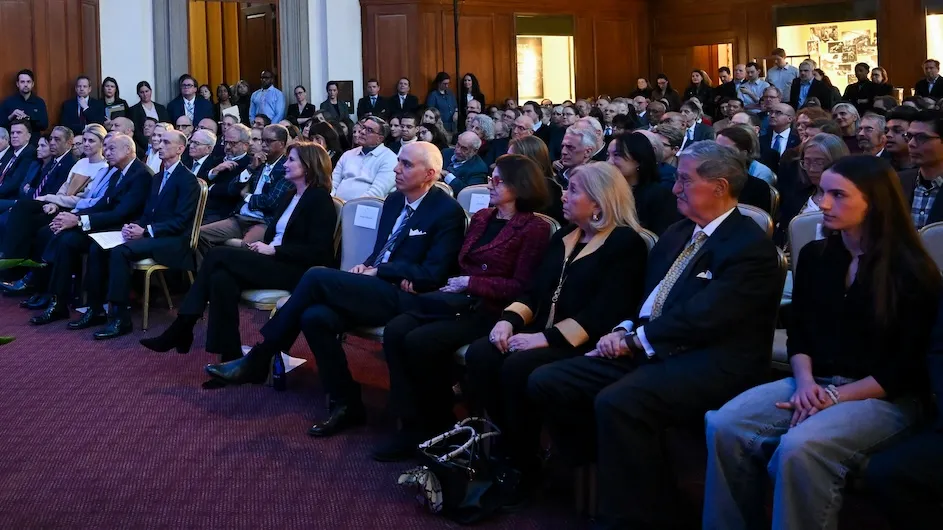
On Wednesday afternoon, Low Library was aflutter, as deans and senior administrators, faculty, student leaders and press, public officials, alumni, and staff braved the 12-degree weather to catch a glimpse of Columbia’s next president. The mood at the standing-room-only event in Faculty Room was serious and celebratory.
As David Greenwald, co-chair with Jeh Johnson of the Board of Trustees, approached the glass podium at the front of the room, a calm descended on the audience as if to say, “we’re ready for the next chapter. Onward.”
Greenwald thanked those in the audience. “Today,” he said, “is a moment for great celebration. We are gathered here to mark an important milestone in our University’s history, and I am thrilled that you will soon hear from President-Designate Jennifer Mnookin.”
He spoke of her “exceptional record as a scholar and a leader” and “her integrity and her ability to lead complex organizations with clarity and purpose.” He highlighted Mnookin’s “deep commitment to listening, engagement, and building trust.”
Greenwald went on to thank the search committee and its co-chairs, Jonathan Lavine and Andrew Barth. Then, in introducing the next speaker, he said: “I also want to recognize and thank Acting President Claire Shipman.” The audience reacted in a powerful and sustained applause.
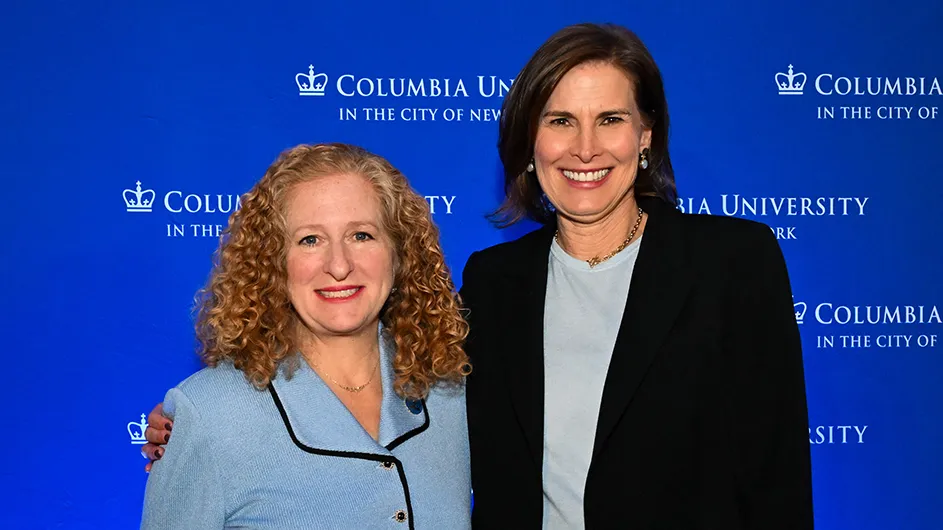
Shipman took the stage. “I am grateful to everybody in our community for the force of love that you and we all feel for this institution and the determination we all have to protect and support and better it.” She thanked Katrina Armstrong, CEO of Columbia University Irving Medical Center, for serving as interim president at such “a critical, impossible time,” and spoke about the “role universities play as essential pillars of our democracy, as bellwethers” and said that “this is something Jennifer Mnookin knows in her bones. Academic life is in her DNA.”
She described Mnookin as a “woman of great strength, wisdom, with clarity of purpose and enormous warmth, energy, and endless optimism … an optimism that I share, and I look forward to collaborating closely and seamlessly through our transition.”
Johnson was the next speaker and introduced the president-designate. “Columbia has been through a lot over the last three years,” he said. “The Columbia community has been divided over some of the most divisive issues of our times, in this nation, and in the world today. At this moment, we need to turn the page,” and “Jennifer Mnookin will bring us together.”
Mnookin graciously thanked the speakers for their generous words, and then turned to the wider audience: “The snow, the cold, Columbia, you know how to make a Wisconsinite feel right at home.”
In what was a lively and thoughtful speech, Mnookin spoke about the values that shaped her and the support and guidance she receives from her husband, Joshua Foa Dienstag; her parents, Robert and Dale Mnookin; and her mother-in-law, Eleanor Foa Dienstag; all of whom were seated in the front row. She mentioned that her adult children “couldn’t be here today,” and said that they posted her announcement on their Instagram Stories, “which never happens.” She also spoke about her 15-and-a-half-year-old rescue dog, Plato.
She described Columbia as a place where “people of different backgrounds and disciplines come together intentionally to engage in discussion, debate, and the challenging of ideas,” which she said is “essential to the search for truth and for the creation of new ideas, new inventions, new treatments and cures for diseases, new works of art.”
It’s “not always easy to be in a place so broad and complicated, in a city that is itself so broad and complicated,” but “the work of a great university like Columbia is not to retreat from that complexity, but rather to meet it with discipline, with humility, with an appreciation for pluralism, and with an equally deep dedication to discovery, research, and truth seeking, that includes an unwavering commitment to academic freedom and open inquiry and also to the habits that make that possible.”
Mnookin closed her speech with a personal story about donating a kidney to her father several years ago and how that transplant was successful because of what universities make possible.
“Small hinges can open big doors,” she said. “The research paper that might look narrow at the time that later becomes foundational; the experiment that might fail a handful of times before it succeeds; the elective taken on a whim that leads a student to a lifelong intellectual passion; the conversation with a colleague that turns out to spur a significant new research project. These hinges swing open the doors of grand possibility. That is why we are here: to assemble the hinges, small, medium, and large that will open big doors, some of them in the immediate future, and sometimes at a more distant time for people and generations that we might never even meet.”
This is the work of Columbia University. And “I intend to love, cherish, and defend it. And I cannot wait to get started.”
The crowd applauded and gave Mnookin a standing ovation, and then moved to the rotunda where they mingled with one another and ended the evening with a toast to the future.