How Columbians Are Combating Increasing Food Insecurity in New York—and How You Can Help
A growing network of Columbians is working together to mitigate the effects of rising hunger in the city. Here’s how you can get involved.
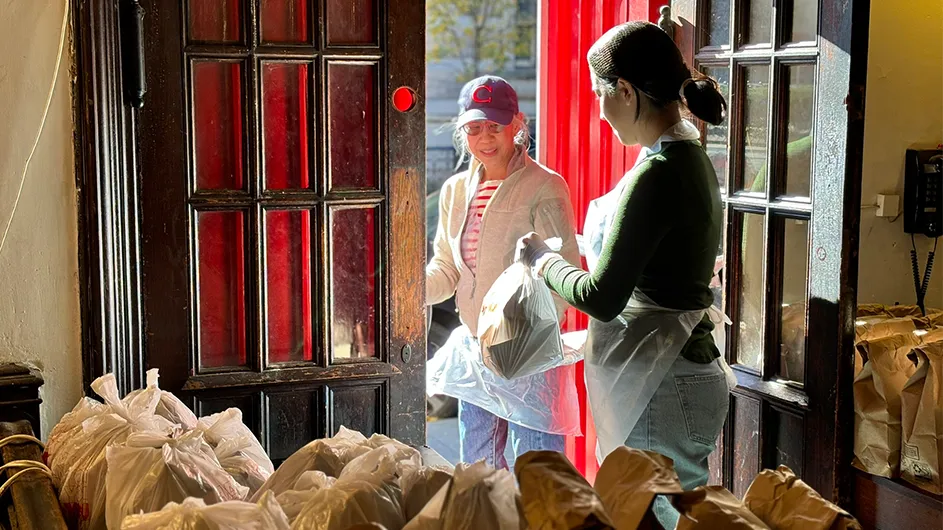
In pantries, kitchens, community spaces, and even classrooms across Upper Manhattan, Columbians are coming together around a shared goal: to make sure no neighbor, or student, goes hungry.
The need is great. Nearly 1.5 million New Yorkers, and as many as 1 in 4 children, are experiencing food insecurity. Visits to food pantries have reached record highs as the cost of living surges and state and federal assistance programs face large cuts.
In an annual food hardship report released Nov. 18, Robin Hood and the Columbia's Center of Poverty and Social Policy found that 36 percent of New Yorkers and more than 42 percent of families with children reported needing more money to meet their household food needs in recent years, a substantial increase over pre-pandemic period when rates stood at 29 percent and 34 percent, respectively.
There’s also the disarray faced by 1.8 million Supplemental Nutrition Assistance Program (SNAP) participants in New York, who have seen drastic changes to the program and general tumult in disbursement related to the recent government shutdown.
Kira Garfinkel, senior development manager of West Side Campaign Against Hunger, a pioneer in reshaping how New Yorkers access emergency food, says the issues we’re seeing go back to the 2008 recession, but what’s different now is who is facing food insecurity: namely, 15 percent of pantry users in New York City are fully employed, compared with 5 percent just a few years ago.
“Hunger isn’t always visible,” Garfinkel said. “You are not going to be able to identify it by looking at someone. It’s not just people who are unhoused or unemployed—it’s families, students, and working adults. Nationally, about 20 to 25 percent of college students experience food insecurity. Even at schools like Columbia, students on financial aid or international students can struggle to afford meals.
“When we talk about hunger, we’re talking about people you might pass on campus, in the library, or on your walk home.”
Columbia students, staff, and faculty are stepping up to meet the challenge and respond to the need.
From Community Impact’s community-facing Ford Hall Food Pantry and Columbia Community Service’s grantees fighting hunger in Morningside Heights and Harlem to CUIMC’s Food FARMacia program in Washington Heights and the Center for Student Success and Intervention’s Food Pantry at Columbia, the University’s network of programs is addressing food insecurity from every angle: connecting volunteers, researchers, and community partners to build a stronger, more nourished city.
Community Impact’s Ford Hall Food Pantry: Serving 30,000+ New Yorkers Yearly
Ricardo Bustamante started working with Community Impact (CI) at Columbia University 11 years ago as a work-study student, teaching ESOL courses while studying at the School of General Studies. After graduation, he worked for a spell at a charter school in New York before returning to CI to run its emergency food programs in 2018, including the Ford Hall Food Pantry at 616 West 114th Street and the Community Lunch program at Broadway Presbyterian Church, 601 West 114th Street.
Bustamante grew up in Venezuela, but has spent the last 25 years of his life in New York, where he has seen first-hand the challenges faced by immigrants and native New Yorkers alike as they navigate a rising cost of living.
“The Ford Hall Food Pantry distributes free food to the low-income community around Columbia’s campus, serving people from Morningside Heights, Manhattanville, Washington Heights, East and West Harlem, the South Bronx,” Bustamante said. “Now, we’re seeing people come to the pantry all the way from Flushing and Jamaica, Queens, Brooklyn, and even Westchester.”
When Bustamante started in 2018, the food pantry alone served 8,000 people in one year. Today, the pantry serves 3,500 people per month, totaling over 33,000 people per year. A 315 percent increase in seven years.
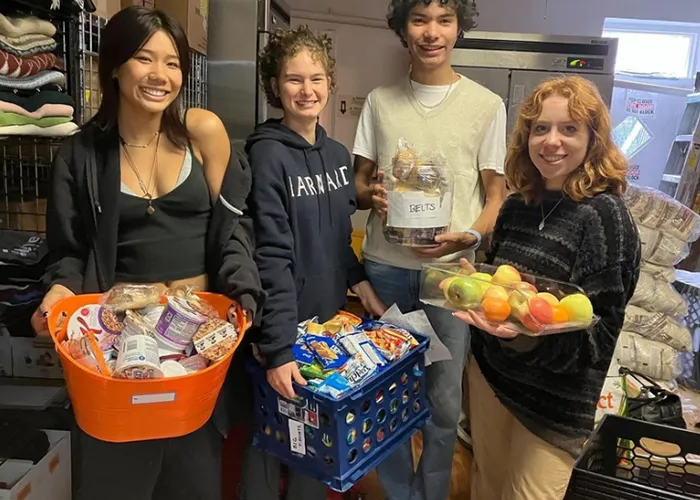
The pantry, staffed by Columbia students and community volunteers, distributes food on Monday, Wednesday, and Thursday from 11 a.m. to 2 p.m. and carries shelf-stable items like rice, pasta, beans, canned vegetables, as well as a solid amount of fresh vegetables and fruit in a grab-and-go bag style. Soon, with a grant from the West Harlem Development Corporation and PepsiCo Foundation, the pantry will begin to provide more protein—eggs, milk, meat, and cheese.
The Community Lunch program operates in partnership with Broadway Community Inc. out of Broadway Presbyterian Church at 601 West 114th Street, and student volunteers prep food on Thursdays and cook and serve food to community members looking for a hot meal on Fridays. This program serves 10,000 New Yorkers every year.
“The lunch program has also increased from 90 people per shift to around 200,” Bustamante said. “We offer 70 meals to go and 100 to 130 meals indoors. It is a complete meal with five courses.”
On top of coordinating the day-to-day of running these programs and five other student clubs related to food and health, Bustamante has had to turn his attention to an ever-more-uncertain landscape of state and federal funding for food relief. Recently, the pantry lost a $25,000 grant when funding was completely clawed back through cuts at the Federal Emergency Management Agency.
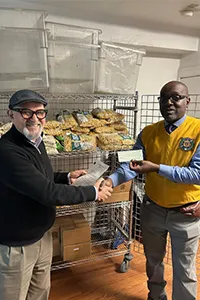
“Demand keeps increasing,” Bustamante said. “We keep seeing between 10 to 15 new families per week. Our normal client before would be a grandmother picking up for her daughter, so serving two families. But now, we’re seeing working families coming too. Not just the elderly or retired, but people who work in the area."
There are a few ways that Columbians can get involved with Community Impact’s efforts. First and foremost, they can donate to help keep the pantry stocked and food on the table. Students can also volunteer with the programs. And, for all Columbians, between now and Dec. 19, you can bring shelf-stable items to the Ford Hall Food Pantry every Friday in an effort dubbed “Fill the Pantry Fridays.”
“There is an immediate satisfaction when a client says ‘Thank you, God Bless you,’ and you receive that good energy in the moment,” Bustamante said. “That is a great motivator, but in the bigger scheme of things, even though we aren’t going to solve the hunger situation in the city, we are absolutely mitigating the effects of food insecurity. We are moving our little grain of salt to make the world a little bit better.”
The Food Pantry at Columbia: Serving 11,000 Students Annually
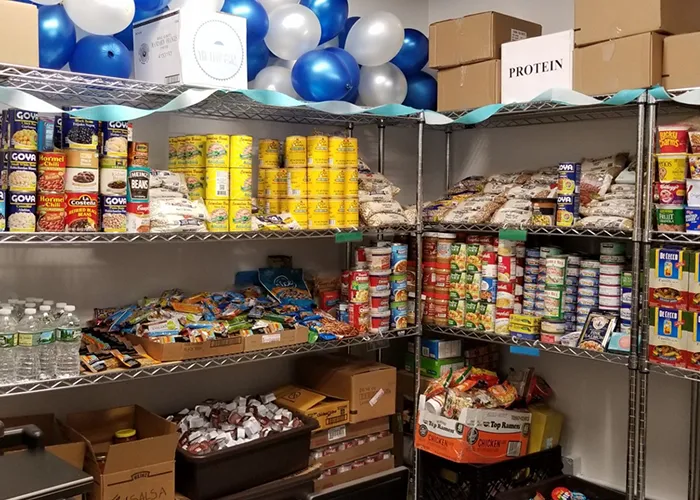
While many of Columbia’s food access and relief efforts extend into neighborhoods surrounding the University, support for students begins right on campus. The Food Pantry at Columbia, now more than a decade old and supported directly by the Center for Student Success and Intervention, was born from student advocacy, growing into an essential resource for thousands of Columbia students each year.
“The Food Pantry began as a student-run initiative providing free, no barrier, and dignified access to resources in a private space for all Columbia students, regardless of income level or financial aid status,” said Mabel Silva, student support specialist at Columbia and the staff member who oversees the Pantry in partnership with its student board. “Today, the Pantry continues to uphold its founding mission: ensuring that every student has access to the food and essential products they need to thrive, without shame or stigma.”
The need is real and growing. National surveys show that 1 in 5 college students experience food insecurity nationwide, and the latest Hope Center report found that 41 percent of students surveyed across 16 states faced food insecurity in the last year. Rising cost-of-living in New York only intensifies the situation.
“We’re seeing not only higher usage but also more diverse needs across Columbia’s campuses,” Silva said. “The focus has shifted from providing emergency assistance to ensuring consistent, equitable access to nutritious food as part of overall wellbeing and student success.”
What started in 2014 as a small pilot space founded by students in the First-Generation, Low-Income Partnership (FLIP) and the General Studies Student Council has evolved into an operation with multiple locations and a permanent home in Lerner Hall on the Morningside Heights campus and at Columbia University Irving Medical Center in Washington Heights.
In the 2024–25 academic year alone, the Pantry served approximately 11,000 students.
Both locations are open weekly, serving Columbia students from all 21 schools, colleges, and affiliates. There are no eligibility requirements beyond being currently enrolled.
It’s not just food on the shelves. Through partnerships with organizations like Corbin Hill (for fresh produce) and Femly (for menstrual products), the Pantry provides nutritious ingredients and essential personal care items that students may not otherwise be able to afford.
For Silva, whose background is in mental health and case management, the work is as much about nutrition as it is about belonging.
What keeps me hopeful is the incredible sense of community around the Pantry.
“True wellness starts with meeting basic needs in support of students' academic success,” said Silva. “Students can’t focus on academics or long-term goals if they’re worried about where their next meal is coming from. What drew me to this role is that the Pantry not only provides essential food assistance, but also creates a welcoming space that promotes dignity, access, and community.”
Silva emphasizes that supporting the Pantry is something every Columbian can take part in. The Pantry is currently running a Cansgiving Drive through Dec. 19, which encourages drop-offs of canned goods and essentials. Columbians can also volunteer at one of the distribution sites and give funds to the program.
Possibly most important, though, is spreading awareness to reduce stigma and make sure students know the Pantry is a welcoming space.
To access the food pantry, currently enrolled students can visit the pantry website and click the “order“ tab to schedule an appointment. Slots open at 2 a.m. the day before each shift.
This semester, the Lerner Hall pantry is open Mondays from 11:30 a.m. to 2 p.m. and Wednesdays from 10 a.m. to 1 p.m.. The 50 Haven pantry is open Wednesdays from 1 p.m. to 4 p.m. and Thursdays from 6 p.m. to 9 p.m. The hours are made in consultation with schools and colleges to accommodate academic schedules.
To register an account and schedule your visit, please use this link. For any questions, feel free to contact the Food Pantry via email at [email protected].
“The most impactful moments are when we see students leave the Pantry feeling relieved and supported,“ Silva said. “Seeing their stress ease, even briefly, reminds us why this work matters. What keeps me hopeful is the incredible sense of community around the Pantry.”
Columbia Community Service: Providing Nearly $350,000 in Grants to Uptown Nonprofits Fighting Hunger Since 2019
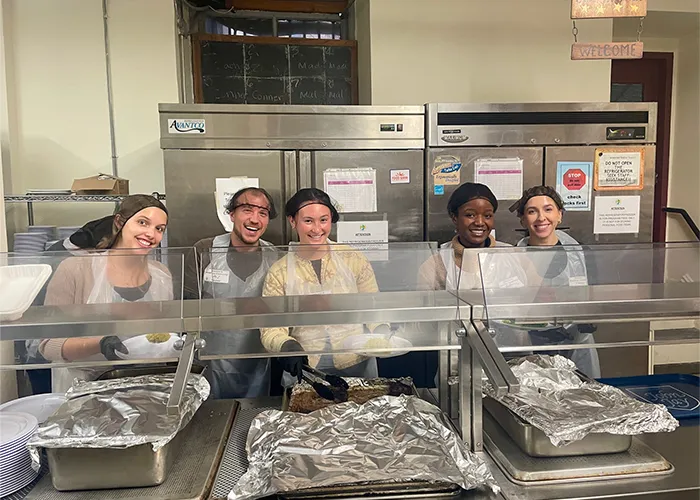
What started in 1942 as a World War II-era relief effort has blossomed into one of Columbia’s longest-lasting philanthropic and community engagement initiatives: Columbia Community Service (CCS). Through generous donations from faculty, staff, and retirees of Columbia, Barnard, and Teachers College, CCS supports more than 50 Uptown nonprofits that fight hunger, provide social services, support the arts, and offer educational enrichment to youth in Harlem and Morningside Heights.
Since 2019, CCS has provided $345,325 in grants to five Uptown organizations on the front lines of fighting food insecurity: Broadway Community Inc., Cathedral Community Cares, Church of the Ascension Food Pantry, NY Common Pantry, and West Side Campaign Against Hunger. All five of these organizations are seeing an increase in need for their services unlike any in recent memory.
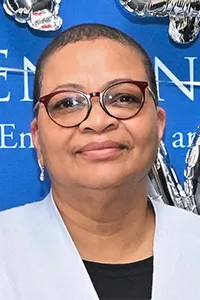
“The CCS Food Relief Campaign is a bigger focus than before,” said Joan Griffith-Lee, director of Columbia Community Service. “The CCS food pantries are working against costs and requests for help that are increasing daily. As employees, we must rise to the occasion and contribute as much as we can so that we can provide grants that meet the current need."
In addition to monetary support, CCS has also catalyzed hundreds of Columbia faculty and staff to volunteer through shifts at food pantries and soup kitchens.
In recent weeks, just steps from Columbia’s Morningside Heights campus, lines have stretched down the block at the Cathedral Community Cares (CCC) soup kitchen and food pantry.
“We’re seeing more families again and, surprisingly, more military families,” said Thomas Perry, director of CCC. “People who’ve just been laid off or are struggling to get by. You can feel that change. Budgets are being cut, and we’re just trying to keep up and help people live day to day.”
Support from Columbia Community Service has been more and more integral in recent years.
“I think flexibility is the biggest gift,” said Priscilla Bayley, of the cathedral’s development team. “Many funders have narrow interests, but CCS allows us to respond to real needs. When several of our refrigerators and freezers broke down (one was 20 years old!), CCS funds meant we could act immediately. As soon as the cessation of SNAP benefits was announced, the Cathedral team got together and conceived a campaign to purchase grocery cards to be distributed to those impacted. We chose to offer store cards in addition to food to provide our clients with the same dignity, flexibility, and ease of use that the SNAP cards did.”
NYP/CUIMC’s Food FARMacia Program: 2.5 Million Pounds of Groceries Distributed Since 2023
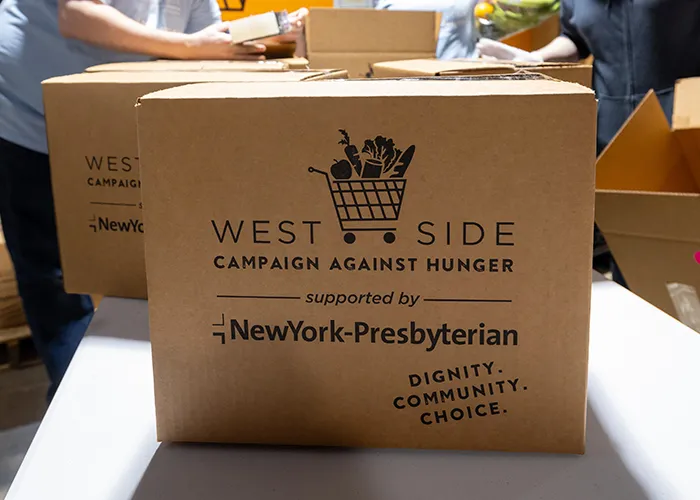
In Washington Heights, at Columbia University Irving Medical Center and NewYork-Presbyterian, the link between food access and health outcomes is impossible to ignore. That’s where Food FARMacia enters the picture.
The program, which began in 2019 through a close partnership with WSCAH, approaches food insecurity not as a separate social issue, but as a core driver of health.
“Food FARMacia is a home-delivery program that provides 40 pounds of nutritious food twice a month for up to six months for patients experiencing food insecurity,” said Dodi Meyer, medical director of community health at NewYork-Presbyterian and professor of pediatrics and Vice Chair of Community Health at CUIMC, who works alongside Program Director Carey Jernigan (MPH'19). “As part of this program, patients are also connected to social services.”
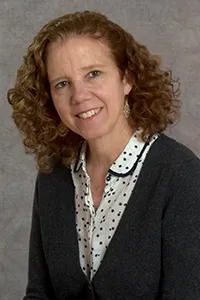
Designed for patients who are pregnant or postpartum and screened as food insecure at NewYork-Presbyterian’s primary care practices, the program operates at the intersection of medical care, community support, and academic research.
“As a primary care pediatrician, I see firsthand how social determinants of health are major drivers of wellbeing, and how addressing them is key,” Meyer said. “We know that food insecurity leads to multiple health problems such as obesity, diabetes, cardiovascular disease, depression, worsening school behavior, and decreased academic performance. It also leads to avoidable hospital utilization.”
The COVID-19 pandemic was a huge turning point for the home delivery program, when it needed to scale dramatically to deliver more than 3.5 million pounds of food to 12,300-plus households across New York City and Westchester County between 2020 and 2022.
After the crisis stabilized, Food FARMacia brought its focus back to NewYork-Presbyterian patients. Since 2023, it has distributed 2.5 million pounds of groceries to 5,000 households that represent 17,000 individuals.
For Meyer, the connection to the University is both professional and personal.
“We embed training and research within these programs using service learning and community-engaged research, studying the impact of the program on health,” Meyer said.
Columbia researchers have published multiple studies on Food FARMacia’s effects—from infant growth and household food security to participant satisfaction.
Looking ahead, Meyer hopes to broaden eligibility beyond pregnant and postpartum patients.
We are expecting hunger to increase in the next few months, and we need an all-hands-on-deck approach.
“We are expecting hunger to increase in the next few months, and we need an all-hands-on-deck approach,” Meyer said. “We’re constantly seeking grants to expand to children aged 0–5 and seniors 65 and older: the groups with the highest need beyond our current population.”
Her invitation to Columbians is clear:
“There are many opportunities to contribute not only to Food FARMacia but to food insecurity efforts overall,” Meyer said. “Faculty who want to be involved in community-engaged research and training opportunities are always welcome. Food pantries across the city are in need of volunteers, and many are receiving food donations. Specifically, Columbians can volunteer at WSCAH. You can sign up through NYCares.”