What Happens When You See a Monster in Your Phone?
Professor Jeremy Dauber takes on middle-grade readers in his second book for children.
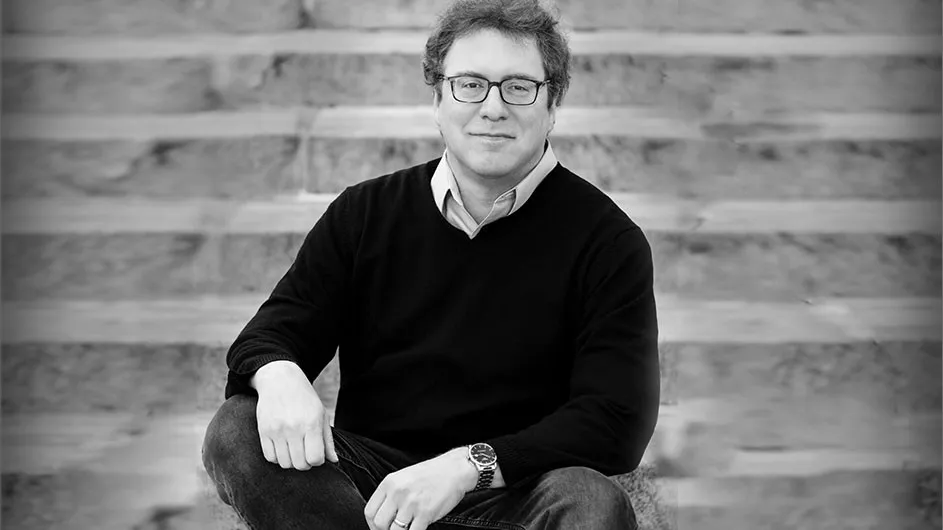
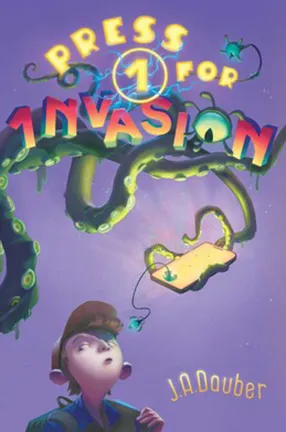
Ten-year-old Matt wants a phone, but his parents won’t let him have one. When he finds a phone lying on the sidewalk, he, of course, picks it up and claims it for himself. But when Matt uses his new phone to take pictures, they show the crossing guard in front of his school as a monster.
In Press 1 for Invasion, Jeremy Dauber, Atran Professor of Yiddish Language, Literature, and Culture, spins a fast-moving tale in which Matt soon learns that: a) his lunch lady is an alien; b) an invasion of Earth is due to take place within the next few days; and c) the lunch lady is having cold feet (well, tentacles) about the whole thing and wants his help. So Matt and his friend Marcela join forces with her to save the planet. As the danger mounts, Matt and Marcela must ask themselves what they’re willing to risk to save their friends, family, and the world.
Dauber, who writes primarily for adults, has already dabbled in the world of children’s literature with an award-winning, young-adult novel, Mayhem and Madness: Chronicles of a Teenaged Supervillain. But Press 1 for Invasion is his middle-grade debut, which is geared toward a younger audience.
Dauber discusses his new book with Columbia News, as well as what he’s working on and teaching this year, how writing for adults compares with writing for kids—and how his own children feel about his books.
Why did you write this book?
There are so many possible answers to this question, which means it’s a good one, but I’ll go with the one that feels the strongest: I had this image, one day, of a kid looking through a phone at his school crossing guard, and seeing—but only through the phone—a goggle-eyed alien monster in a crossing-guard uniform. I wrote the book to figure out the story behind that image.
Why the switch to writing books for kids? Are you writing for your own children, in effect?
I’d always wanted to be a writer, ever since I was a kid. Although I love the nonfiction, adult writing that I do (I’ve written seven of those books so far), there was always a part of me that loved telling stories about aliens and robots and such, a part that never quite got left behind, and that’s a little harder to do in the nonfiction world. Plus, yes, it was meaningful for me to write something that my children—ages 12, 10, and 7—can pick up and enjoy. (And the fact that the older two, who are perfectly willing to tell their father when one of his jokes isn’t funny, stayed up late to read Press 1 in a single sitting, and liked it a lot: that’s the best review I’ll ever get, bar none!)
Beyond the obvious, what are the main differences between writing for adults and writing for kids?
Being imperfect. What I mean is that there are times when you find the exact formulation, the perfect phrasing, le mot juste, for what you want to get across. But then you have to jettison it, because (like in those three choices of phrase above), either they’re incomprehensible to a younger audience, or they simply will bring the kids screeching out of the flow of the book. Of course, this is true for adults sometimes, but a lot less so.
What are you working on now?
Several different books, which represent some of the varying strands of what I do: a new, popular-facing history of Yiddish literature; a cultural history of the 1980s in America, based on a class I taught in the spring 2025 semester; and a history of the American horror movie. In fiction, I’m hoping that there are some more adventures in store for Press 1’s protagonists: Although some of that depends on your readers!
What are you teaching this semester?
A history of the American horror movie, with my colleague Eleanor Johnson, and I’m also working with students writing theses in American Studies. I’ve just taken over the directorship of the Center for American Studies at Columbia, and am excited about that prospect. In the spring, I’ll be teaching the introductory course for that major.
How do you balance the demands of your own work/writing with teaching?
It’s always a balance, that’s for sure! You have to take it both day by day, and year by year—sort of like parenting.